
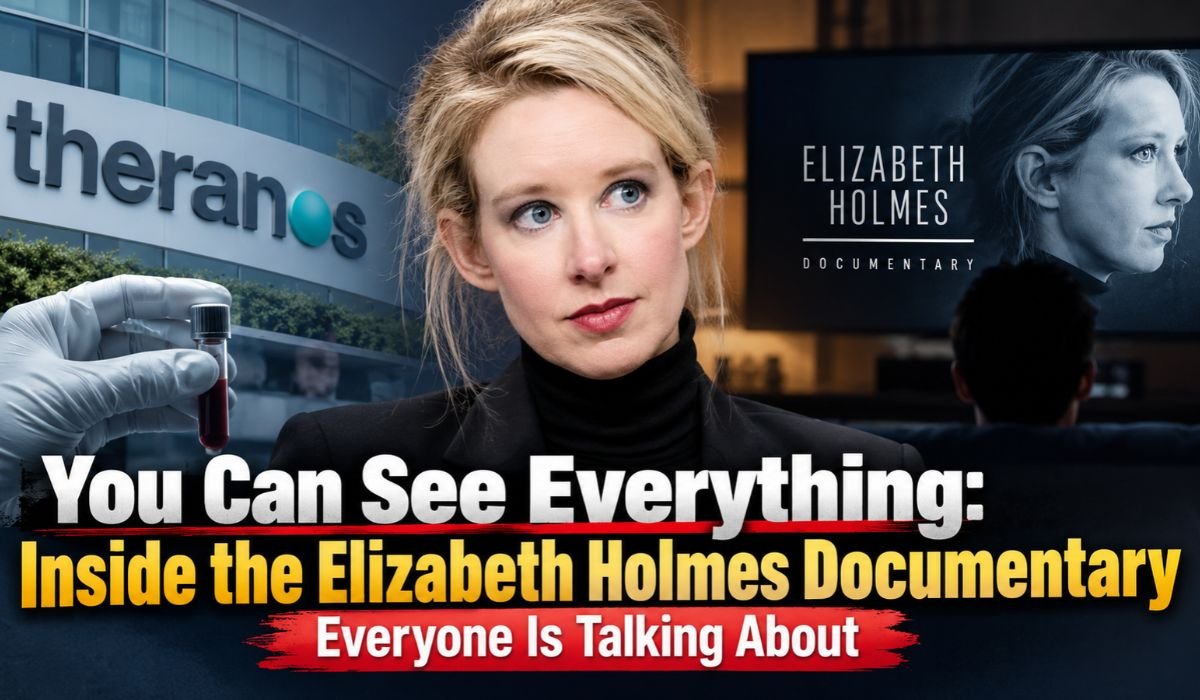
You Can See Everything has emerged as one of the most talked-about documentaries of 2026, but its appeal goes well beyond another retelling of the Theranos scandal. Directed by Nathan Fielder and Lance Oppenheim, the film follows convicted Theranos founder Elizabeth Holmes during an extraordinary period shortly before she entered federal prison.
The access alone makes the project unusual. Rather than building the story mainly from archival footage, old interviews, news reports, and commentary from people around Holmes, the filmmakers bring viewers directly into her world. Holmes is there, speaking for herself, interacting with the crew and responding to questions about a past that has already been examined in courtrooms, books, podcasts, documentaries, and television dramas.
Yet greater access doesn’t necessarily bring greater certainty. In fact, that tension becomes one of the film’s most compelling ideas. How much can a camera really reveal about someone? And when viewers are allowed to see more, does that actually move them closer to the truth?
Those questions have found a surprisingly large audience. You Can See Everything opened in North America in October 2026 and earned about $15.6 million from 855 theaters during its opening weekend, an exceptional start for a documentary. The box office numbers attracted headlines, but they’re only part of what makes the film interesting. At its core, this is a story about Holmes, Theranos, credibility, documentary ethics, and the uneasy gap between what people see and what they can actually know.
What Is You Can See Everything About?
You Can See Everything focuses on Elizabeth Holmes during the final stretch before she reported to federal prison. The filmmakers received close access to Holmes, her partner Billy Evans, and their home life, beginning roughly 34 days before her incarceration.
What starts as an intimate documentary gradually develops into something harder to define. Produced over approximately three years and running close to three hours, the film isn’t structured as a simple biography or chronological recap of the Theranos scandal.
Instead, much of its energy comes from the evolving relationship between Holmes and the people filming her. Nathan Fielder approaches his subject with obvious skepticism. As conversations continue, questions about trust and credibility begin to shape the documentary itself.
That’s an important distinction for viewers. Anyone looking only for a straightforward timeline of Theranos may find You Can See Everything surprisingly unconventional. The filmmakers are interested in what Holmes says, but they’re equally interested in the process of listening to her. The film asks viewers to consider how people construct stories about themselves and whether a documentary can ever completely separate observation from interpretation.
Quick Bio Information
| Information | Details |
|---|---|
| Film | You Can See Everything |
| Release Year | 2026 |
| Main Subject | Elizabeth Holmes |
| Directors | Nathan Fielder And Lance Oppenheim |
| Distributor | A24 |
| Genre | Documentary |
| Primary Language | English |
| Runtime | About 175 Minutes |
| North American Release | October 16, 2026 |
| UK Cinema Release | November 20, 2026 |
| Opening Theater Count | 855 |
| Opening Weekend | About $15.6 Million |
| Opening Weekend Position | Second |
| Festival Premiere | Telluride Film Festival |
| Featured Partner | Billy Evans |
| Notable Appearance | Amanda Seyfried |
| Rating | R |
| Main Themes | Truth, Deception, Trust And Perception |
| Central Background | Theranos Scandal |
| Production Period | Approximately Three Years |
These details reflect publicly reported production, release, and theatrical information available in October 2026. Because You Can See Everything remains in its theatrical cycle, cumulative box office figures can continue to change.
Elizabeth Holmes Before Prison
Timing is crucial to the film’s atmosphere. Holmes isn’t sitting down for a retrospective interview years after her criminal case has faded from public attention. The cameras enter her private life as imprisonment approaches, giving the filmmakers access to a period that had largely remained outside public view.
Viewers see Holmes alongside Billy Evans and their family while Fielder tries to understand the person behind one of Silicon Valley’s most notorious corporate scandals. That proximity could easily have turned the film into a sympathetic personal portrait. Instead, the documentary keeps returning to the question of what proximity actually proves.
Holmes can speak directly. She can explain herself and offer her own interpretation of events. But the filmmakers don’t treat access as evidence of honesty, and neither should viewers.
That creates much of the documentary’s tension. The audience is hearing Holmes’ perspective while also bringing established facts from the Theranos case into the room. The distance between those two things—personal explanation and documented history—is where the film becomes especially interesting.
The Theranos Story Behind The Documentary
To understand why every conversation about credibility carries so much weight, it’s important to understand the history of Theranos.
Holmes founded the health technology company with an ambitious promise: to transform medical testing. Theranos promoted technology that it said could perform numerous laboratory tests using very small quantities of blood. The company attracted major investors, powerful supporters, extensive media attention, and an enormous valuation.
Then serious questions emerged about its technology and claims. Theranos eventually collapsed, and Holmes faced federal criminal charges.
The outcome of her criminal case deserves precise wording. In January 2022, a federal jury convicted Holmes of one conspiracy count and three wire fraud counts involving investors. She wasn’t convicted on every charge. Jurors acquitted her on several patient-related counts and failed to reach verdicts on some additional investor-related charges.
In November 2022, Holmes was sentenced to 135 months in federal prison, equivalent to 11 years and three months.
Those legal facts provide an essential foundation for You Can See Everything. Holmes is free to describe events from her perspective inside the documentary, but her personal account isn’t interchangeable with findings established through the legal process. Keeping that distinction clear allows viewers to engage with the film without losing sight of the historical record.
Nathan Fielder And Lance Oppenheim
The choice of directors goes a long way toward explaining why You Can See Everything doesn’t resemble a conventional true-crime documentary.
Nathan Fielder is best known for projects including Nathan for You and The Rehearsal. His work regularly places real people in unusual circumstances and then explores what happens when reality, performance, planning, discomfort, and spontaneity begin to overlap. Watching his projects can sometimes leave audiences wondering exactly where ordinary behavior ends and performance begins.
Lance Oppenheim comes from a documentary filmmaking background and has built his work around distinctive people, environments, and communities. Rather than forcing complicated subjects into tidy conclusions, his approach often leaves contradictions visible.
Put those sensibilities together and the result is a particularly unusual fit for the Holmes story. Fielder and Oppenheim aren’t simply trying to assemble another investigation of Theranos. They’re examining what happens when filmmakers gain extraordinary access to someone whose credibility is already central to the public understanding of her story.
That shifts the documentary’s focus. Holmes remains the subject, but the process of documenting Holmes becomes part of the subject too.
When Nathan Fielder Becomes Part Of The Story
Fielder doesn’t pretend to be an invisible observer standing safely behind the camera. His conversations with Holmes increasingly become part of the narrative, and his doubts aren’t hidden from the audience.
As he listens to Holmes and questions elements of her account, his own uncertainty begins to matter.
That changes the relationship between filmmaker and subject. Traditional documentaries sometimes encourage audiences to forget that cameras, producers, editors, and interviewers inevitably affect what happens in front of them. You Can See Everything does almost the opposite. It acknowledges that presence and allows the interaction between Holmes and the filmmakers to shape the movie.
Fielder’s skepticism is therefore more than a stylistic device. It reminds viewers that access shouldn’t be mistaken for verification.
The documentary doesn’t simply ask, “What is Holmes telling us?” It also asks, “Why is she telling us this, how is it being presented, and what can we reasonably conclude from it?”
Those are harder questions, but they’re also more interesting ones.
Why You Can See Everything Feels So Different
True-crime documentaries often follow recognizable patterns. There may be archival footage, court documents, expert interviews, narration, timelines, and testimony from people connected to the case.
You Can See Everything has a different center of gravity.
Its defining feature is the closeness between filmmakers and subject. At first, that level of access might seem like the ideal documentary situation. If filmmakers can observe enough conversations and private moments, surely they’ll eventually arrive at a clearer understanding.
The film complicates that assumption.
More access can produce more information, but information isn’t necessarily the same as certainty. A camera can record what someone says, how they react, where they live, and how they behave in a particular moment. It can’t directly record intention.
That limitation turns You Can See Everything into something broader than another Theranos documentary. The movie isn’t only examining Holmes. It’s also examining the tools documentary filmmakers use to claim that they’re showing audiences something real.
Amanda Seyfried And The Reconstructed Material
Amanda Seyfried’s presence adds another intriguing layer to an already unconventional project.
Seyfried previously portrayed Elizabeth Holmes in The Dropout, the scripted television drama that introduced many viewers to a dramatized version of the Theranos story. Her appearance in You Can See Everything therefore carries unusual meaning.
The documentary uses reconstructed material for moments that couldn’t be captured through ordinary observational filming. Bringing Seyfried into that process creates a deliberate overlap between the real Holmes, the actress associated with portraying Holmes, and the filmmakers’ attempt to represent events that weren’t directly recorded.
That doesn’t automatically make the documentary less trustworthy. Reconstruction has long been used in nonfiction storytelling. What matters is whether viewers understand when they’re seeing observed reality and when they’re seeing a creative representation of something that happened outside the camera’s view.
In You Can See Everything, that distinction isn’t merely a technical concern. It fits directly into the film’s wider interest in performance, representation, and the difficulty of deciding what an image actually proves.
The Viral Trailer And Growing Curiosity
Part of the excitement surrounding You Can See Everything came from how unexpectedly it appeared.
The project was developed largely away from the constant publicity cycle that surrounds many major films. Its surprise festival debut immediately generated curiosity, and the trailer then offered audiences their first substantial glimpse of the strange dynamic between Holmes and Fielder.
One exchange stood out. Holmes asks Fielder why she would deceive him.
On its own, the question sounds simple. In the context of Theranos and Holmes’ criminal conviction, it carries considerably more weight. Viewers already arrive with knowledge that shapes how they interpret the moment.
The exchange spread online and helped fuel conversation around the movie. Still, it would be misleading to credit social media alone for the documentary’s success. Several factors came together: Holmes remains a widely recognized figure, Fielder has a dedicated audience, reviews generated additional attention, the secretive production created curiosity, and a relatively limited initial release gave the movie a sense of scarcity.
The result was something documentaries rarely achieve—a genuine theatrical event.
You Can See Everything Box Office Success
The opening weekend quickly became a major part of the story.
You Can See Everything earned approximately $15.6 million from 855 theaters across North America and finished second at the domestic box office. That translates to an average of more than $18,000 per theater, an impressive figure for a documentary that runs close to three hours.
Reports also indicated that more than 2,000 screenings sold out during the opening period.
The performance placed the film among the most notable documentary openings in North American box office history. Its debut drew comparisons with Michael Moore’s Fahrenheit 9/11, while its performance from fewer than 1,000 theaters was also compared with the limited opening of Borat in 2006.
Those comparisons need context. Ticket prices change, release strategies evolve, and films from different periods aren’t operating under identical theatrical conditions. Inflation alone makes direct dollar-for-dollar historical comparisons imperfect.
Even after accounting for those differences, however, the central point remains clear: audience demand for You Can See Everything was unusually strong for a documentary.
Why The Box Office Performance Matters
Documentaries don’t often find themselves competing commercially with major studio entertainment. A film approaching three hours faces an additional disadvantage because cinemas simply can’t schedule as many daily screenings as they can for a shorter movie.
That makes the opening performance particularly noteworthy.
Another interesting part of the story is the audience itself. Younger moviegoers reportedly represented a significant portion of the opening crowd. That’s notable at a time when the film industry continues to debate how to persuade younger audiences to choose theaters over the enormous amount of entertainment available at home.
It would be premature to interpret one successful release as evidence of a broad documentary boom. Exceptional films don’t automatically establish industry trends.
What You Can See Everything does show is that nonfiction can still generate theatrical urgency. A recognizable subject, an unusual creative approach, strong reviews, limited availability, and genuine curiosity can make audiences feel that a documentary is something they want to experience immediately rather than eventually stream at home.
What Critics Are Saying
Critical discussion has largely moved beyond the basic question of whether Holmes is an interesting documentary subject. Reviewers have focused instead on the movie’s treatment of deception, performance, reality, knowledge, and the filmmaker’s responsibility when dealing with a controversial figure.
That’s understandable because You Can See Everything works on several levels at once.
It’s a film about Elizabeth Holmes and, inevitably, about the shadow Theranos casts over her public identity. But it’s also a film about what happens when a filmmaker starts questioning the reliability of the person being documented. At another level, it’s about documentary filmmaking itself and the confidence audiences place in images labeled as nonfiction.
That combination has helped generate awards-season discussion.
Still, the language around awards should remain precise. Being described by critics or industry observers as an Oscar contender isn’t the same as receiving a nomination. Until official nominations are announced, awards talk remains prediction rather than confirmed recognition.
Truth, Trust And What A Camera Cannot Show
The title You Can See Everything becomes more interesting the longer you think about it.
Modern cameras can capture astonishing amounts of detail. They can record expressions, conversations, homes, relationships, arguments, silences, gestures, and private routines. None of that guarantees access to another person’s intentions.
That’s especially important in a documentary about Holmes, but the idea reaches far beyond her story.
People now consume enormous quantities of supposedly intimate content. Public figures appear on podcasts for hours. Celebrities share their homes and families on social media. Documentaries promise unprecedented access. Livestreams make audiences feel as though they’re present in someone’s everyday life.
All that visibility can create an illusion of familiarity.
Yet seeing someone frequently isn’t the same as knowing them, just as observing behavior doesn’t automatically explain the motivation behind it.
By allowing uncertainty to remain visible, You Can See Everything asks audiences to question not only Holmes but their own confidence in what images can tell them. It’s a particularly relevant idea in a media environment where “authenticity” has itself become something that can be carefully produced.
Why Elizabeth Holmes Still Fascinates Audiences
The continuing fascination with Elizabeth Holmes can’t be explained by Theranos alone.
Her story touches several powerful themes at once: Silicon Valley ambition, healthcare technology, charismatic entrepreneurship, investor confidence, media influence, corporate governance, wealth, status, and society’s tendency to celebrate disruptive founders before their claims have been fully tested.
At one point, Holmes was publicly presented as an entrepreneur capable of transforming healthcare. The collapse of Theranos and her subsequent criminal conviction created a dramatically different public narrative.
Since then, audiences have encountered the story through investigative journalism, books, podcasts, documentaries, and scripted television. The Dropout turned it into drama. Other projects have concentrated on the company’s technology, employees, investors, or legal consequences.
That leaves You Can See Everything with a difficult task. Most interested viewers already know how the broad Theranos story ends.
Rather than pretending otherwise, the documentary uses that familiarity to its advantage. Its central question isn’t simply what happened at Theranos. It’s what happens when Holmes herself is given space to speak—and what viewers should do with what she says.
You Can See Everything And The Dropout
Comparisons with The Dropout are inevitable, especially because Amanda Seyfried appears in both worlds.
The two productions, however, approach Holmes from fundamentally different directions.
The Dropout is scripted drama. Actors portray real people, writers shape scenes, and events are reconstructed through performance. Even when a dramatization is carefully researched, its primary form remains dramatic storytelling.
You Can See Everything is primarily nonfiction and gives audiences direct access to Holmes herself. But documentary doesn’t mean untouched reality. Filmmakers still decide where to place cameras, what questions to ask, what material to include, how scenes are edited, and how the final narrative is structured.
That’s why neither format should be treated as a replacement for court documents, primary reporting, or other original records when establishing historical facts.
For viewers interested in understanding the Theranos story, the difference is useful rather than problematic. A drama can explore events through performance, while a documentary can examine real interactions. Each reveals something different, and neither automatically provides the entire picture.
Release Date And Where To Watch
You Can See Everything opened theatrically in North America on October 16, 2026.
The film is scheduled to reach UK cinemas on November 20, 2026.
As of October 2026, a confirmed streaming release date hasn’t been publicly announced. That means readers should be careful with websites claiming the film will arrive on a particular streaming service or on a specific date unless the information has been confirmed by the distributor or another official source.
The situation may also change as the theatrical run develops. A movie performing better than expected can remain in cinemas longer, expand to additional locations, or follow a different release strategy from the one initially anticipated.
For now, the confirmed way to experience You Can See Everything is through its theatrical rollout.
Is You Can See Everything Worth Watching?
That depends on what you’re hoping to get from it.
Anyone interested in Elizabeth Holmes, Theranos, Silicon Valley culture, media ethics, unconventional documentary filmmaking, or Nathan Fielder’s work will find plenty to think about. The movie doesn’t simply revisit familiar headlines; it uses Holmes as the center of a broader examination of how people present themselves and how audiences decide whether to believe them.
Someone looking only for a quick Theranos explainer may have a different experience. At roughly 175 minutes, this isn’t designed as a concise summary of the scandal.
Its length allows the filmmakers to stay with uncomfortable moments and unresolved questions rather than racing toward a neat conclusion. That’s central to what the documentary is trying to accomplish.
The most interesting question isn’t simply whether Holmes is telling the truth at any particular moment. It’s how viewers make that judgment when facts, memories, performances, editing, personal narratives, and direct observation all occupy the same screen.
Final Thoughts
You Can See Everything stands apart from many treatments of the Theranos scandal because it isn’t satisfied with simply telling audiences what happened. Nathan Fielder and Lance Oppenheim use their extraordinary access to Elizabeth Holmes to examine a more uncomfortable question: does getting closer to someone actually make that person easier to understand?
The established legal record remains essential context. Holmes was convicted on federal fraud charges involving investors and sentenced to 135 months in prison. Those facts don’t change because a documentary gives its subject an opportunity to explain herself, nor should personal recollection be treated as a substitute for documented evidence.
But documentary filmmaking can explore territory that legal records aren’t designed to address. It can show interactions, contradictions, discomfort, relationships, and the ways people try to shape their own stories.
That’s where You Can See Everything finds its strongest purpose.
Its roughly $15.6 million opening weekend shows that audiences were willing to spend nearly three hours engaging with those questions in a theater. The film’s wider relevance, however, extends well beyond Holmes or Theranos.
People today see more of one another than previous generations could have imagined. Cameras are everywhere. Public figures speak directly to audiences. Private lives become content, and carefully produced intimacy is often presented as authenticity.
Still, visibility has limits.
A camera can show what happened in front of it. It can preserve a conversation or capture a reaction. What it can’t do automatically is tell viewers why someone behaved a certain way, whether every statement is reliable, or what remains outside the frame.
That’s the contradiction at the heart of You Can See Everything. We can watch more than ever before and still be left with uncertainty.
Sometimes, seeing everything isn’t the same as knowing the truth.
FAQs About You Can See Everything
What Is You Can See Everything About?
You Can See Everything is a 2026 documentary centered on Elizabeth Holmes during the period shortly before she entered federal prison. Nathan Fielder and Lance Oppenheim received unusually close access to Holmes and her family life. What begins as a portrait of a controversial public figure develops into a wider exploration of credibility, documentary filmmaking, performance, truth, and the relationship between a filmmaker and subject.
Who Directed You Can See Everything?
Nathan Fielder and Lance Oppenheim co-directed the film. Fielder is known for projects that blur the boundaries between reality, performance, comedy, and social experimentation. Oppenheim comes from documentary filmmaking. Their different approaches help give You Can See Everything its unconventional style.
Is You Can See Everything A True Story?
Yes. The documentary deals with real people and events connected with Elizabeth Holmes and Theranos. However, the film also includes reconstructed material and uses creative documentary techniques. That distinction matters because recreated scenes shouldn’t be confused with footage captured while events were actually happening.
How Long Is You Can See Everything?
You Can See Everything runs for approximately 175 minutes, putting its length just under three hours. That’s unusually long for a theatrical documentary, but the extended runtime gives the filmmakers room to examine both Holmes and the complicated process of documenting her.
How Much Did You Can See Everything Make At The Box Office?
The film earned approximately $15.6 million from 855 North American theaters during its opening weekend. That was an exceptionally strong start for a documentary and placed the movie second at the domestic box office. Its cumulative total will continue changing while the theatrical run remains active.
Is Amanda Seyfried In You Can See Everything?
Yes. Amanda Seyfried appears in connection with the documentary’s reconstructed material. Her participation is especially notable because she previously portrayed Elizabeth Holmes in The Dropout, creating an unusual connection between the dramatized version of Holmes’ story and this documentary treatment.
Where Can I Watch You Can See Everything?
As of October 2026, You Can See Everything is in its theatrical release period. It opened in North America on October 16 and is scheduled for UK cinemas on November 20. No confirmed streaming release date has been announced, so any specific streaming claims should be checked against official distribution information.
Is You Can See Everything An Oscar Contender?
The documentary has attracted awards-season discussion following its critical attention and strong theatrical opening. That makes it reasonable to describe the film as part of the broader awards conversation. However, speculation about a possible nomination shouldn’t be presented as an official Academy Award nomination unless and until the Academy announces one.
Learn more and explore exciting content on: Mexico World Cup 2026: Everything Fans Need to Know












Leave a Reply