
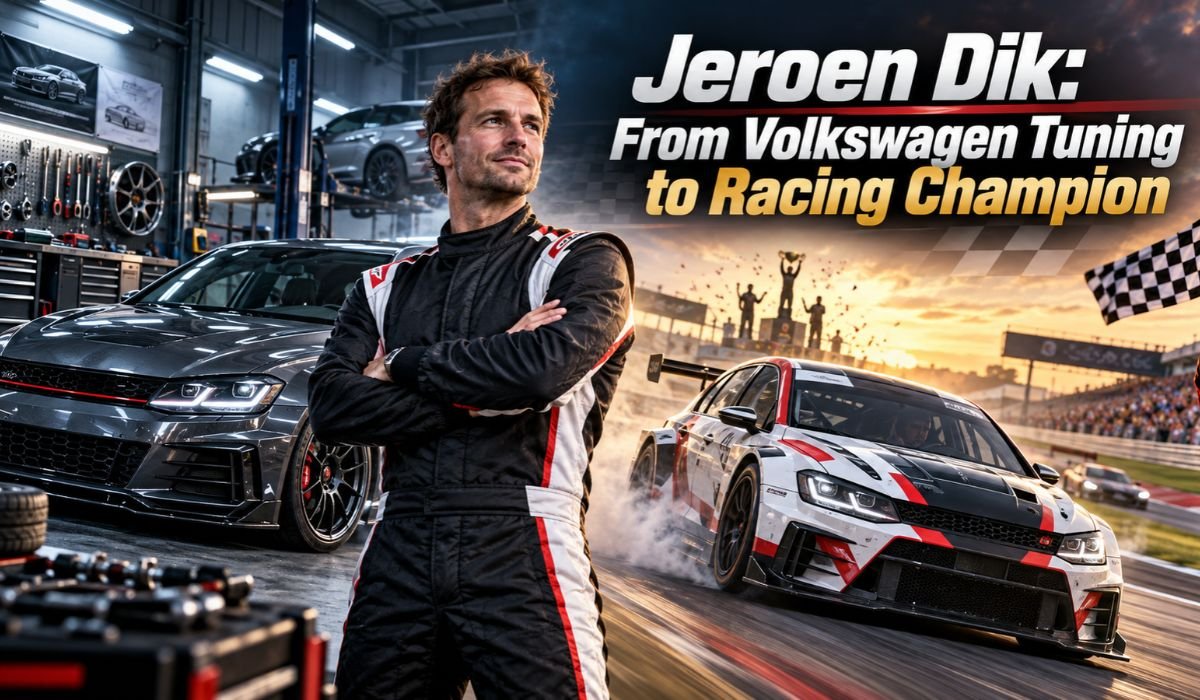
Jeroen Dik has spent much of his professional life where two sides of the automotive world meet: Performance Tuning and Motorsport. The Dutch tuning specialist is best known as the Founder and Owner of JDEngineering, a company closely associated with Volkswagen Group Performance Cars. His career, however, has never been confined to workshop development or Engine Software.
Dik’s roots in Volkswagen Tuning stretch back to the 1990s. He became particularly associated with Volkswagen G60 models at a time when extracting more performance from a car involved an intensive mix of mechanical knowledge, experimentation, and testing. What began with modified Volkswagens eventually developed into a specialist business working primarily with Volkswagen, Audi, SEAT, Skoda, and Porsche vehicles.
Then there’s the racing side of his story. Dik competed in Dutch Motorsport and proved that his interest in performance extended well beyond the Dyno. After coming painfully close to a championship in 2010, he returned the following year and became the 2011 Toerwagen Diesel Cup Champion.
That combination gives Jeroen Dik an unusual automotive résumé. He has approached performance from the workshop, the business side, and the driver’s seat. For anyone researching Jeroen Dik, JDEngineering, Volkswagen Tuning, or his Racing Career, those overlapping experiences provide the clearest way to understand why his name remains familiar within the VAG Performance community.
Quick Bio Information
| Information | Details |
|---|---|
| Full Name | Jeroen Dik |
| Nationality | Dutch |
| Profession | Automotive Tuning Specialist, Entrepreneur, Racing Driver |
| Best Known For | JDEngineering And Volkswagen Performance Tuning |
| Company | JDEngineering |
| Professional Role | Founder And Owner |
| Tuning Career | Began During The 1990s |
| Main Specialty | Volkswagen Group Performance Vehicles |
| Associated Brands | Volkswagen, Audi, SEAT, Skoda, Porsche |
| Early Tuning Specialty | Volkswagen G60 Models |
| Notable Early Project | Volkswagen Golf Mk1 16vG60 |
| Motorsport Discipline | Touring Car Racing |
| Major Racing Series | Toerwagen Diesel Cup |
| 2010 Racing Car | Volkswagen Golf 6 |
| 2011 Racing Car | Volkswagen Golf 5 |
| Major Racing Achievement | 2011 Toerwagen Diesel Cup Champion |
| Reported 2011 Total | 211 Points |
| Championship Decider | Formido Finaleraces |
| Championship Circuit | Circuit Park Zandvoort |
| Business Location | Lochem, Netherlands |
Most reliable public information about Jeroen Dik concerns his Automotive Career, JDEngineering, and Motorsport. Far less is publicly documented about his private life. Details such as his date of birth, education, family background, and other personal information shouldn’t be guessed simply to make a biography appear more complete. Where dependable information isn’t available, it’s better to leave the gap than fill it with speculation.
Who Is Jeroen Dik?
Jeroen Dik is a Dutch Automotive Tuning Specialist, Entrepreneur, and Racing Driver whose career is closely tied to JDEngineering. Through the company, he became known for Performance Tuning involving vehicles from the Volkswagen Group.
That focus is important. Rather than positioning JDEngineering as a tuning operation for virtually every manufacturer, Dik concentrated on a comparatively narrow family of vehicles. Over time, that allowed the business to develop detailed experience with the Engines, Electronics, Engine Management Systems, Transmissions, and diagnostic requirements found across VAG models.
His Motorsport background makes the story more distinctive. Dik wasn’t simply developing Performance Cars for other people to drive. He competed himself and ultimately won a recognized Dutch touring-car championship.
That racing record gives a practical dimension to his reputation. The pressures of competitive driving are very different from those of normal road use, and Dik has experienced vehicle performance in both environments.
How Jeroen Dik Entered Volkswagen Tuning
To understand Dik’s career, it helps to return to the automotive world of the 1990s.
Performance Tuning was already evolving electronically, but it wasn’t yet dominated by software in the way the modern industry often is. Mechanical changes remained highly visible. Tuners worked extensively with Superchargers, Fuel Systems, Ignition, Exhausts, Engine Components, and other hardware to find additional performance.
Dik became particularly interested in Volkswagen G60 models. These cars used Volkswagen’s distinctive G-Lader Supercharger and developed an enthusiastic following among European Performance Car owners.
Working with G60 engines provided more than an opportunity to make cars faster. Increasing output quickly exposes the relationship between different parts of a vehicle. Extra power can produce more heat. More torque can create additional strain on clutches and transmissions. Improved acceleration can expose limitations in tires, traction, and braking.
Those lessons remain relevant today. Effective Performance Tuning has never been only about making one number larger. It’s about getting the engine and its supporting systems to work together.
The Golf Mk1 16vG60 And His Early Reputation
Among the vehicles associated with Dik’s early career, the Volkswagen Golf Mk1 16vG60 stands out.
JDEngineering’s own account of its history describes the modified Golf as an important early project and connects it with sprint competition. Because much of the surviving information about this stage of Dik’s career comes from the company itself, those details are best understood as part of JDEngineering’s documented company history rather than as independently verified professional Motorsport records.
Even so, the Golf helps explain the direction Dik’s career was taking.
A lightweight Volkswagen Golf Mk1 combined with significantly greater engine performance presented exactly the sort of engineering challenge that appeals to serious tuners. Getting the engine to produce power was only one part of the task. That power still had to reach the road effectively while temperatures, traction, and mechanical stress remained manageable.
Projects such as the Golf helped Dik establish a reputation among Volkswagen enthusiasts. As interest in his work increased, what had begun as a passion for modifying cars developed into a professional tuning business.
How JDEngineering Developed
JDEngineering became the commercial foundation of Jeroen Dik’s work and established its base in Lochem, Netherlands.
From the beginning, specialization became one of the company’s defining characteristics. JDEngineering concentrated primarily on Volkswagen Group vehicles, including Volkswagen, Audi, SEAT, Skoda, and Porsche.
There’s a practical reason such a strategy can work well.
Brands within a large automotive group frequently share technologies. Engine families, Transmissions, Electronics, and vehicle platforms can appear across several models and brands. Knowledge gained from one application can therefore provide useful technical context for another.
But shared components don’t make two cars identical.
An engine may use a different Turbocharger in another model. Software revisions can change how Torque Management works. Cooling capacity, Gearboxes, Emissions Systems, and factory performance targets can also vary considerably.
For a specialist tuner, knowing those differences is every bit as important as recognizing what the cars share. That depth of knowledge became central to JDEngineering’s identity.
What Does JDEngineering Do?
JDEngineering is particularly associated with Engine Management Software and Performance Tuning for VAG vehicles.
In a modern car, the Engine Control Unit manages a remarkable number of functions. Fuel Delivery, Ignition Timing, Boost Pressure, Throttle Behavior, Torque Requests, and protective strategies can all be influenced electronically.
Changing those calibrations can unlock additional performance, but professional tuning isn’t simply a matter of increasing values until the car produces more power.
The vehicle’s mechanical condition matters. So do its Engine Hardware, Fuel Quality, Turbocharger, Cooling System, Transmission, and intended use. A calibration suitable for one setup may not necessarily be appropriate for another.
Testing is therefore a major part of serious tuning.
JDEngineering uses Dynamometer equipment, allowing vehicles to operate under controlled load while their performance is measured. A Dyno can show maximum Power And Torque, but those headline figures are only part of the information available. The shape of the Power Curve, consistency of delivery, and the way an engine responds across its operating range can be equally revealing.
Jeroen Dik’s Approach To Performance Tuning
Horsepower attracts attention. It’s easy to understand, simple to compare, and useful in marketing. But it doesn’t tell you whether a modified car is actually good to drive.
That distinction is important when looking at the tuning philosophy associated with Jeroen Dik and JDEngineering.
A car can produce an impressive peak figure yet deliver its torque too aggressively, struggle for traction, generate excessive heat, or place unnecessary stress on supporting components. In everyday use, a slightly less powerful but better-balanced setup may be far more satisfying.
Modern Turbocharged Engines make that balance especially important. Software can substantially influence Boost Pressure and Torque Delivery, meaning considerable changes in vehicle behavior may be achieved electronically.
The ability to request additional performance doesn’t mean every available margin should be used. Experienced tuning involves knowing where meaningful gains can be made and where mechanical limits deserve respect.
For road cars, smooth delivery, predictable response, appropriate temperatures, and dependable operation can matter just as much as the final Dyno figure.
Why Volkswagen Group Vehicles Became His Specialty
Volkswagen Performance Cars have remained at the center of Jeroen Dik’s professional life since his early G60 projects.
As Volkswagen Group technology developed, JDEngineering’s field naturally expanded across related vehicles from Audi, SEAT, Skoda, and Porsche. That created opportunities to build knowledge around recurring Engine Families and shared technologies while adapting to the differences between individual models.
Those differences have become increasingly complicated.
A modern VAG vehicle may combine Direct Fuel Injection, sophisticated Turbocharging, Particulate Filters, advanced Engine Management, a Dual-Clutch Transmission, and numerous interconnected electronic systems. Hybrid technology adds yet another layer.
As a result, the knowledge required to tune a Volkswagen Group vehicle in 2026 looks very different from the expertise needed to modify a G60 Volkswagen in the 1990s.
That evolution makes specialization valuable. A tuner can’t rely forever on knowledge gained from one generation of engines. New Hardware, Software, Emissions Systems, and drivetrain technologies require continuous learning and testing.
From The Workshop To Motorsport
The next chapter in Dik’s career moved beyond the workshop and onto the racetrack.
For someone involved professionally in Performance Tuning, Motorsport offers a very different perspective on how cars behave. A Dynamometer provides controlled data, while racing introduces an environment where nearly every major system is repeatedly stressed.
Engines remain under heavy load. Brakes are used aggressively lap after lap. Tire grip changes as temperatures and wear increase. Cooling becomes critical. Drivers must also deal with traffic, changing track conditions, and the pressure of competition.
Problems that might take months to appear in ordinary road driving can become obvious very quickly on a circuit.
There’s also the human element. A technically knowledgeable driver can feel changes that data alone may not fully communicate. Throttle Response, Traction, Balance, Braking Stability, and Torque Delivery are experienced directly through the controls.
Road Cars and Race Cars still have very different requirements, of course. Motorsport experience shouldn’t be used to imply that every racing solution belongs on a street vehicle. What it can provide is another way of understanding how a car behaves near its limits.
The 2010 Toerwagen Diesel Cup Title Fight
By 2010, Jeroen Dik was competing seriously in the Toerwagen Diesel Cup.
Contemporary Motorsport coverage places him among the leading drivers that season in a Volkswagen Golf 6. His campaign included race victories and developed into a genuine championship challenge.
The ending was painfully close.
According to JDEngineering’s retrospective account of his Racing Career, Dik missed the 2010 championship by just one point. In Motorsport terms, that’s about as narrow as a defeat can get.
It also illustrates why championships can’t be reduced to outright speed. Winning individual races matters, but a title is built across an entire season. Reliability, consistent finishes, strategy, qualifying performance, and avoiding costly mistakes all influence the final standings.
For Dik, 2010 ended without the championship. It did, however, set up the defining season of his Racing Career.
Jeroen Dik’s 2011 Championship Season
Dik returned to the Toerwagen Diesel Cup in 2011, this time racing a Volkswagen Golf 5.
The season wasn’t built around a single spectacular weekend. Consistency became one of its defining features. JDEngineering’s account of the campaign states that Dik reached the podium at least once during every race weekend, allowing him to accumulate points steadily while remaining a regular contender for victories.
Some performances were particularly memorable.
During the Profile Tyrecenter Pinksterraces at Zandvoort, Dik started the opening race from tenth position. Contemporary race reporting records him moving through the field and taking victory, an impressive recovery in a touring-car environment where passing multiple competitors is rarely straightforward.
Another important win followed during the RTL GP Masters of Formula 3 weekend. Dik again won the first Toerwagen Diesel Cup race, this time while defending against pressure from a BMW 123d Coupé.
By the time the championship reached its final event, those results had put him in a commanding position.
How Jeroen Dik Became Racing Champion
The decisive weekend came at Circuit Park Zandvoort during the Formido Finaleraces in October 2011.
Dik arrived with a 39-point championship lead. There were still 44 points available, so the title wasn’t mathematically settled, but his advantage meant his rivals needed a major swing in results.
He didn’t need to chase an unnecessary victory.
Driving the Volkswagen Golf 5, Dik finished second in the first race. The Golf shared by Ronald Morien and Dennis de Groot took the victory, but second place gave Dik everything he needed.
The championship was secured with another race still remaining.
The event also produced unusual circumstances. Contemporary coverage records that fading daylight contributed to the race being neutralized and finishing behind the Safety Car.
Once the 14-race season was complete, the published championship standings showed Jeroen Dik at the top with 211 points. Ferdinand Kool and Henry Zumbrink finished second with 168.
For Dik, the title carried extra significance after the disappointment of the previous year. He had gone from missing the championship by a single point in 2010 to securing it before the final race was even run in 2011.
What Racing Can Teach A Performance Tuner
It’s tempting to draw a straight line between Jeroen Dik’s racing experience and every aspect of his professional tuning work, but that would go beyond the available evidence.
A more useful conclusion is also a more credible one.
Racing gave Dik direct experience of how vehicles behave under sustained pressure. A Dyno can measure Power And Torque under controlled conditions, but competition introduces Heat, Tire Degradation, Braking Loads, Grip Changes, and repeated acceleration over an extended period.
A driver with technical knowledge can also provide unusually detailed feedback. Instead of simply saying that a car feels faster or slower, an experienced driver may recognize changes in Torque Delivery, Throttle Response, Traction, or balance.
That doesn’t make a Race Car setup appropriate for a Road Car. The two environments demand different compromises. But experiencing both can encourage a broader understanding of what usable performance actually means.
How Performance Tuning Changed During His Career
One of the most interesting ways to view Jeroen Dik’s career is as a timeline of change within the tuning industry itself.
The G60 era was strongly associated with visible mechanical modifications. Engine Hardware, Superchargers, Fuel Systems, Exhaust Components, and hands-on mechanical development played obvious roles in the pursuit of performance.
Mechanical knowledge is still essential, but electronics now influence almost every aspect of a modern Performance Car.
Engine Control Units communicate with Automatic Transmissions, Stability Systems, Emissions Equipment, Turbochargers, Fuel Systems, and a growing network of sensors. Torque can be electronically requested, limited, and managed according to operating conditions.
Dual-Clutch Gearboxes have their own control strategies. Direct Injection has changed Fuel Management. Particulate Filters and increasingly strict Emissions Systems add further complexity. Hybrid Performance Vehicles introduce electric motors, batteries, and additional control systems into the equation.
By 2026, professional tuning is therefore as much about Software, Diagnostics, Data, and systems integration as traditional mechanical modification.
Dik’s career spans much of that transformation, from modified G60 Volkswagens to the highly interconnected VAG Performance Cars of today.
Performance, Reliability And Responsible Tuning
For readers who discover Jeroen Dik while researching modifications for their own Volkswagen, Audi, SEAT, Skoda, or Porsche, there’s another side of Performance Tuning worth considering.
More power places greater demands on a vehicle.
Turbochargers may operate harder. Cooling requirements can increase. Clutches and Transmissions have to handle additional Torque. Tires and Brakes also become more important as acceleration improves.
Vehicle condition matters just as much. Modifying a well-maintained car with healthy components isn’t the same proposition as increasing the output of a vehicle already suffering from mechanical problems.
Owners also need to consider matters beyond engineering. Depending on the country, Performance Modifications can affect manufacturer warranties, insurance policies, Emissions Compliance, inspections, and road legality.
Local requirements should therefore be checked before significant modifications are carried out.
The sensible question isn’t simply, “How much power can this engine make?” A better question is, “What level of performance suits this particular car and the way it will actually be used?”
That distinction separates meaningful tuning from chasing numbers for their own sake.
Why Jeroen Dik Matters In Volkswagen Tuning Culture
No single car or racing result fully explains Jeroen Dik’s standing among Volkswagen Performance enthusiasts.
His reputation comes from the way several parts of his career overlap.
There were the early G60 projects and the Golf Mk1 16vG60. Then came the growth of JDEngineering and its specialization in Volkswagen Group vehicles. Alongside the tuning business, Dik built a genuine Motorsport record, culminating in the 2011 Toerwagen Diesel Cup Championship.
That championship is particularly important because it provides a clearly measurable achievement outside the tuning workshop.
At the same time, the longevity of his connection with Volkswagen Performance Cars is noteworthy. Automotive technology has changed dramatically since Dik began tuning in the 1990s, yet his professional focus has remained centered on the same broad family of manufacturers.
The tools and technologies have evolved. The underlying interest in understanding how a car can perform better has remained remarkably consistent.
Final Thoughts
Jeroen Dik’s journey from Volkswagen Tuning to Racing Champion isn’t simply a story about making cars faster. It’s a career built around specialization, experimentation, technical development, and competition.
His early work with Volkswagen G60 models established the foundation. Projects such as the Golf Mk1 16vG60 helped build his reputation among enthusiasts, while JDEngineering turned that experience into a specialist Performance Tuning business focused on Volkswagen Group vehicles.
Motorsport then added another chapter.
After missing the Toerwagen Diesel Cup title by just one point in 2010, Dik returned the following season in a Volkswagen Golf 5. A combination of victories and consistent podium performances gave him control of the championship, and his second-place finish during the Formido Finaleraces at Zandvoort secured the 2011 title. He eventually completed the 14-race season with 211 points.
His career also mirrors the changing nature of Automotive Tuning itself. Dik began in an era when mechanical modifications were at the center of many Performance Projects. Today, Software, Electronics, Diagnostics, and Data are inseparable from modern vehicle development.
Yet the basic challenge hasn’t changed as much as the technology has.
A genuinely well-developed Performance Car needs more than an impressive horsepower figure. Power has to be usable. The supporting components need to cope with it. Reliability matters, and the vehicle must work as a complete system.
That broader understanding of performance—shaped by decades around Volkswagen vehicles, specialist tuning work, and real competition—is what makes Jeroen Dik’s career particularly interesting within European Volkswagen Tuning and Dutch Motorsport.
FAQs About Jeroen Dik
Who Is Jeroen Dik?
Jeroen Dik is a Dutch Automotive Tuning Specialist, Entrepreneur, and Racing Driver. He is best known as the Founder and Owner of JDEngineering, a company specializing in Performance Tuning for Volkswagen Group vehicles. His career also includes a successful period in Dutch touring-car racing.
What Is JDEngineering?
JDEngineering is an Automotive Performance Tuning company based in Lochem, Netherlands. Its specialist areas include Engine Management Software, Chiptuning, Diagnostics, Performance Development, and Dynamometer Testing, with a particular focus on Volkswagen Group vehicles.
What Cars Does JDEngineering Specialize In?
JDEngineering focuses primarily on vehicles from Volkswagen Group brands, including Volkswagen, Audi, SEAT, Skoda, and Porsche. The exact tuning possibilities depend on the individual model, Engine, Hardware, Software, Transmission, and intended use.
When Did Jeroen Dik Start Tuning Cars?
JDEngineering’s published company history places the beginning of Jeroen Dik’s Performance Tuning activities in the 1990s. He became especially associated with Volkswagen G60 models during the early years of his career.
What Championship Did Jeroen Dik Win?
Jeroen Dik won the 2011 Toerwagen Diesel Cup Championship. He secured the title during the Formido Finaleraces at Circuit Park Zandvoort after finishing second in the opening race of the weekend.
What Car Did Jeroen Dik Race In 2011?
Dik raced a Volkswagen Golf 5 during his championship-winning 2011 Toerwagen Diesel Cup campaign. His 2010 season was associated with a Volkswagen Golf 6, an important distinction when comparing accounts of the two championship campaigns.
How Many Points Did Jeroen Dik Score In 2011?
Published final standings list Jeroen Dik with 211 points after 14 races in the 2011 Toerwagen Diesel Cup. Ferdinand Kool and Henry Zumbrink finished second with 168 points.
Is Jeroen Dik Still Associated With JDEngineering?
JDEngineering continues to publicly connect Jeroen Dik with the company and its history. Because business roles and services can change over time, current commercial information is best distinguished from older Motorsport reports and historical enthusiast coverage.
Learn more and explore exciting content on: Felix O. Adlon: His Life, Career, Family, and Personal Story














Leave a Reply