
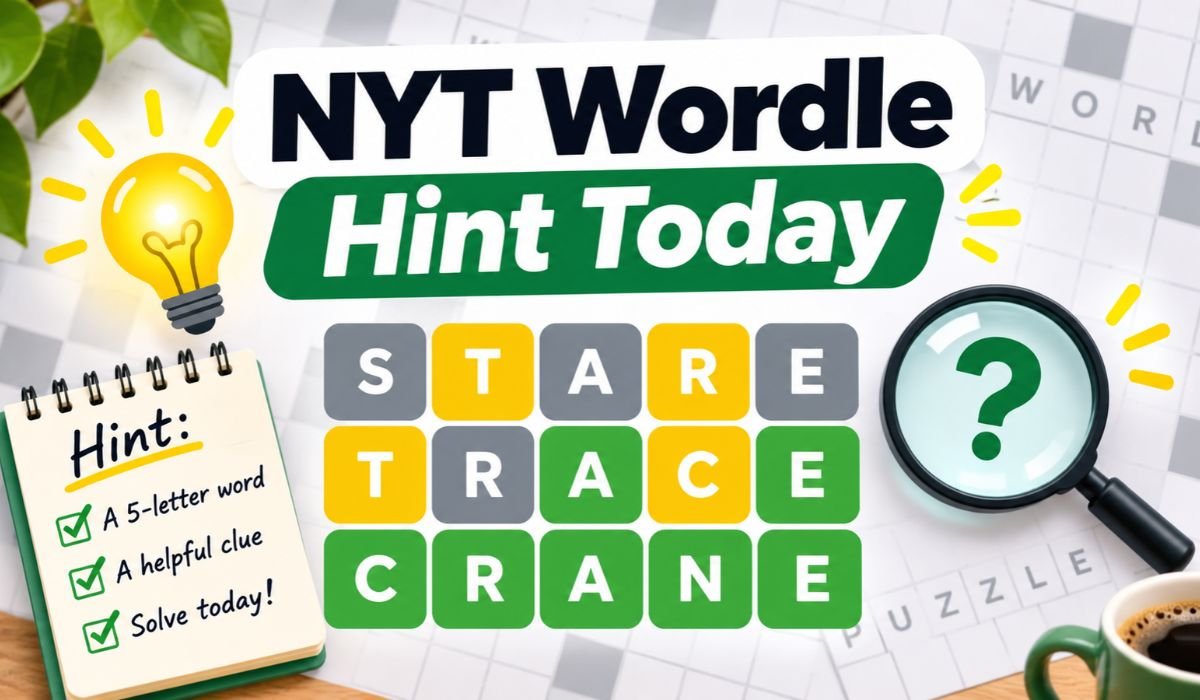
There’s something satisfying about starting the day with Wordle. It takes only a few minutes to play, yet finding the correct five-letter word can sometimes feel like solving a much bigger mystery. When your guesses aren’t getting you anywhere, a well-timed NYT Wordle Hint can help you get back on track.
Today’s Wordle puzzle for Wednesday, November 25, 2026, features a familiar English word with a vowel pattern that might catch some players by surprise. Although the answer is commonly used in everyday conversations, identifying the right combination of letters can take some careful thinking.
Whether you’re determined to protect your winning streak or simply enjoy a daily brain challenge, this guide has everything you need. You’ll find spoiler-free clues, today’s Wordle answer, previous solutions, useful starting words, and practical advice for improving your game.
Before jumping straight to the solution, give the hints a chance. You might be closer to the answer than you realize.
Last Updated: November 25, 2026
Quick Information About NYT Wordle
| Information | Details |
|---|---|
| Game Name | Wordle |
| Official Publisher | The New York Times |
| Game Creator | Josh Wardle |
| Public Release | October 2021 |
| NYT Acquisition | January 2022 |
| Game Category | Word Puzzle |
| Today’s Date | November 25, 2026 |
| Day | Wednesday |
| Today’s Puzzle Number | #1985 |
| Word Length | Five Letters |
| Maximum Attempts | Six |
| Puzzle Frequency | Daily |
| Repeated Letters Today | None |
| Traditional Vowels Today | One |
| Additional Vowel Today | One |
| Game Modes | Normal Mode and Hard Mode |
| Supported Platforms | Web, Android, and iOS |
| Daily Puzzle Access | Free |
| Puzzle Reset Time | Midnight Local Time |
| Next Puzzle Date | November 26, 2026 |
Today’s NYT Wordle Hints (Spoiler-Free)
Sometimes, all you need is a small clue to see a puzzle from a different angle. If you’re looking for today’s NYT Wordle Hint without spoiling the fun, these clues should help you narrow down your choices.
To begin with, today’s answer doesn’t contain any repeated letters. Every letter in the hidden word appears just once, so you won’t need to worry about duplicates.
The vowel pattern is slightly more interesting. Today’s word contains only one of the five traditional vowel letters, although another letter also serves as a vowel.
Need something more specific? The answer begins with S and ends with Y.
The final clue involves food. Think about the word you’d use to describe a meal prepared with hot peppers, chili, or strongly flavored spices. It’s a familiar adjective that you’ll often encounter on restaurant menus and in recipes.
Take a moment to work through these clues before moving on. Look at the letters you’ve already eliminated, consider the remaining possibilities, and give yourself another chance to solve the puzzle.
Today’s NYT Wordle Answer for November 25, 2026
Spoiler Warning: Today’s Wordle solution is revealed below.
According to CNET’s daily puzzle coverage, the answer to NYT Wordle puzzle #1985 for Wednesday, November 25, 2026, is SPICY.
At first glance, SPICY doesn’t look particularly difficult. It’s a familiar word made up of five different letters: S, P, I, C, and Y. However, its vowel arrangement can make it harder to identify, particularly if your opening guesses focus heavily on traditional vowels.
The letter I is the only traditional vowel letter, while Y represents the final vowel sound. The answer also matches the food-related clue perfectly.
If you managed to solve today’s puzzle without revealing the answer, that’s another successful day added to your record. If you needed a little assistance, consider what made the word difficult to discover.
Understanding where you struggled can be just as valuable as getting the correct answer. It gives you something useful to remember when a similar puzzle appears.
What Does Today’s Wordle Answer Mean?
SPICY is an adjective most commonly associated with food containing spices, particularly ingredients that produce a strong or hot flavor. It is pronounced SPY-see and contains two syllables.
Think about a bowl of noodles seasoned with chili oil, a curry prepared with hot peppers, or chicken coated in flavorful spices. All of these foods could reasonably be described as spicy.
However, the word has uses beyond the kitchen. In everyday conversation, people sometimes use SPICY to describe something provocative, exciting, controversial, or unexpectedly bold. A lively discussion might be called a spicy debate, while an unexpected piece of gossip could be described as spicy news.
It’s also worth remembering that spicy food doesn’t always have to be extremely hot. Depending on the context, the word can simply describe food with a noticeable spice flavor.
Discovering these different meanings is one of the enjoyable aspects of Wordle. Even when the answer is a word you’ve known for years, taking a closer look at its meaning can deepen your understanding of the language.
Why Today’s Wordle Puzzle Is Tricky
The difficulty of a Wordle puzzle doesn’t always depend on how unusual the answer is. Sometimes, an ordinary word becomes surprisingly challenging because of its spelling or the other words that resemble it.
SPICY is a good example.
Many players begin with words containing several traditional vowels. That’s often a sensible approach, but it may provide limited information today because the answer contains only I among the traditional vowel letters.
The final Y adds another layer of difficulty, especially for players who don’t immediately consider it when searching for vowel sounds.
There are also several similar five-letter words. SPINY and SPIKY, for instance, share four letter positions with today’s answer. Even after discovering most of the correct letters, you could still find yourself choosing between multiple possibilities.
In Normal Mode, a separate word that tests several remaining consonants might help resolve the uncertainty. This approach can be particularly useful when you have enough guesses left to gather more information.
Today’s puzzle is a reminder that knowing four correct letters doesn’t always guarantee an easy finish.
Yesterday’s Wordle Answer
If you missed yesterday’s challenge, the Wordle answer for Tuesday, November 24, 2026, was SNEER. It appeared in puzzle #1984.
The word SNEER can function as both a noun and a verb. It refers to an expression, remark, or manner of speaking that communicates contempt, disrespect, or mockery.
Someone might sneer at an idea they consider ridiculous, for example, or respond to another person’s suggestion with a disrespectful expression.
Interestingly, yesterday’s solution follows a different spelling pattern from today’s answer. SNEER contains two occurrences of E, whereas SPICY doesn’t contain any repeated letters.
That contrast highlights why flexibility matters when playing Wordle. A strategy that worked perfectly yesterday might not be particularly helpful today.
Rather than expecting every answer to follow a familiar pattern, allow the feedback from each guess to guide your decisions. Every puzzle presents a different set of possibilities, and adapting to those differences is an important part of becoming a stronger player.
Recent NYT Wordle Answers
Looking through previous Wordle answers can be an interesting way to understand the variety of words that appear in the game. Some puzzles feature everyday vocabulary, while others introduce unusual letter combinations, repeated letters, or less familiar meanings.
Here are the recent Wordle solutions reported as of November 25, 2026.
| Date | Puzzle Number | Wordle Answer |
|---|---|---|
| November 20, 2026 | #1980 | AROSE |
| November 21, 2026 | #1981 | STENT |
| November 22, 2026 | #1982 | UPEND |
| November 23, 2026 | #1983 | FILTH |
| November 24, 2026 | #1984 | SNEER |
| November 25, 2026 | #1985 | SPICY |
These answers demonstrate how different one puzzle can be from the next. AROSE contains three traditional vowels, STENT includes a repeated consonant, and FILTH has a less obvious consonant-heavy ending.
Studying previous answers may help you become more comfortable with these variations. However, don’t assume that a word can never appear again simply because it has been used before. Unless an official rule confirms otherwise, previous solutions shouldn’t be treated as permanently excluded.
Use Wordle answer history as a learning resource rather than a guaranteed prediction tool.
What Is NYT Wordle?
Wordle is a daily online word puzzle created by software engineer Josh Wardle. What began as a personal project eventually became one of the internet’s most recognizable word games.
Wardle made the game publicly available in October 2021. Its popularity grew quickly, partly because of its straightforward rules and the ease with which players could share their results without revealing the answer.
The New York Times acquired Wordle in January 2022, adding it to its collection of digital games.
The concept remains remarkably simple. Players receive six attempts to identify a hidden five-letter word, with color-coded feedback guiding them after every guess.
Unlike games that demand hours of attention, Wordle offers a single daily challenge. You can play over breakfast, during a lunch break, or whenever you have a few spare minutes.
In 2026, that simplicity remains an important part of its appeal. Wordle doesn’t need complicated graphics or lengthy instructions to keep players interested. A clever word and six opportunities to find it are enough.
How Does Wordle Work?
Learning to interpret Wordle’s color-coded feedback is one of the most important steps toward becoming a better player.
Whenever you submit a valid five-letter guess, the game changes the color of each tile according to how that letter relates to the hidden answer.
A green tile means you’ve found the correct letter in the correct position. A yellow tile indicates that the letter belongs in the answer but needs to be placed somewhere else. A gray tile generally means the letter isn’t present in the solution or that you’ve guessed more occurrences of it than the answer contains.
Imagine starting with CRANE and discovering that C turns yellow while the other letters turn gray. You now know that C belongs somewhere in the hidden word, but it can’t occupy the first position.
Repeated letters can make the feedback slightly more complicated. If one occurrence of a letter appears green and another appears gray, it doesn’t mean the letter is entirely absent. Instead, the answer may contain fewer copies of that letter than your guess.
Once you understand these distinctions, Wordle becomes less about random guessing and more about making informed decisions.
How to Use NYT Wordle Hints
There’s a difference between reading a helpful Wordle clue and immediately checking the solution. The first gives you an opportunity to think, while the second removes the mystery altogether.
The most rewarding way to use a NYT Wordle Hint is to begin with broad information. Finding out whether the answer contains repeated letters or how many vowels it has may be enough to point you in the right direction.
If you’re still uncertain, look for clues about the first or last letter. These details can significantly reduce the number of possible answers.
Meaning-based hints are particularly helpful when you’ve already discovered part of the word but can’t quite complete it.
Try making another guess after each new clue rather than reading every hint at once. This gives you more opportunities to solve the challenge independently.
Over time, this approach may also help you recognize familiar spelling patterns and improve your vocabulary. You aren’t simply being told the answer; you’re learning how to find it.
Best Wordle Starting Words
Choosing a good starting word can influence how much useful information you receive from your opening guess.
Words such as CRANE, SLATE, STARE, TRACE, RAISE, and TRAIN are popular examples because they contain combinations of vowels and consonants that frequently appear in English words.
Some players prefer opening with AUDIO or ADIEU. Both words test four traditional vowels, which can be helpful when you’re trying to establish the answer’s vowel pattern.
The disadvantage is that vowel-heavy words leave less room for testing consonants. If the solution contains only one traditional vowel, as today’s answer does, your first guess might reveal less than you expected.
A balanced opening word offers a different approach by testing several consonants alongside one or more vowels.
There’s no single starting word that guarantees a successful result. Instead of searching endlessly for the perfect opener, choose a word that gives you information you can use effectively in your second and third guesses.
Smart Wordle Solving Tips
A useful Wordle strategy involves thinking beyond the immediate answer and considering how much information your next guess could provide.
Imagine you’ve discovered the pattern SPI_Y. You might be considering SPICY, SPINY, and SPIKY, all of which fit the known letter positions.
Guessing each word individually could work, but it might also use several valuable attempts.
If you’re playing Normal Mode and have enough guesses remaining, a word such as CLINK could help test C, N, and K simultaneously. Its feedback might reveal which consonant belongs in the answer.
This is an example of an information-gathering guess. Although the word itself may not be the solution, it can help you eliminate several alternatives at once.
Familiar letter combinations such as ST, SP, CR, and TH are also worth remembering. Don’t overlook repeated letters or the possibility that Y functions as a vowel.
Before submitting a guess, take a few seconds to consider what you’ll learn from it. A carefully chosen word can provide more value than several rushed attempts.
Common Wordle Mistakes to Avoid
Many unsuccessful Wordle games aren’t caused by a lack of vocabulary. Instead, players sometimes lose because they overlook information the game has already provided.
One common mistake is placing a yellow letter in a position that has already been ruled out. Another involves forgetting a confirmed green letter while trying to guess the answer.
Players may also assume that every hidden word contains two or more traditional vowels. Today’s answer demonstrates why that assumption isn’t always reliable.
Getting attached to a particular word can create problems, too. Once an idea comes to mind, it’s easy to focus on it and overlook alternatives that might match the available clues more accurately.
When several words fit the same pattern, compare them carefully before making your next move.
As you approach your final attempt, avoid unnecessary experiments. Instead, focus on a possible answer that matches all the confirmed information.
Developing these habits won’t eliminate every mistake, but it can make challenging puzzles much easier to approach.
How to Maintain Your Wordle Winning Streak
A long Wordle winning streak can be rewarding, particularly when you’ve worked through several difficult puzzles along the way. Maintaining that record, however, requires more than choosing a familiar starting word each morning.
Consistency plays an important role. Establishing a regular playing routine reduces the chances of forgetting a puzzle before the daily reset.
Patience matters just as much. When a word refuses to come to mind, stepping away from the game for a few minutes may help. Returning with a fresh perspective sometimes makes an overlooked possibility easier to recognize.
Reading books, newspapers, and other written material can introduce you to new vocabulary and spelling patterns. That knowledge may prove useful when you encounter a particularly challenging answer.
Spoiler-free Wordle hints can also provide assistance when you’re stuck without immediately revealing the solution.
Of course, even experienced players occasionally lose. No strategy can promise a perfect winning streak, and missing a puzzle shouldn’t take away from the enjoyment of the game.
What Is Wordle Hard Mode?
For players who enjoy an additional challenge, Wordle offers an optional setting known as Hard Mode.
The difference becomes apparent once the game reveals useful information. In Hard Mode, correct letters discovered in previous guesses must be included in subsequent attempts, while green letters must remain in their established positions.
Normal Mode provides more freedom. Players can choose a word that tests several new letters without necessarily using every previously discovered clue.
This flexibility can be useful when multiple possible answers share the same letter pattern. Hard Mode limits that approach, requiring players to think more carefully about the words they choose.
Beginners may find Normal Mode more comfortable while learning how the game works. Experienced players who want an additional challenge can enable Hard Mode through the game’s settings.
Neither option guarantees a better score. The choice ultimately depends on how you enjoy approaching puzzles and whether you prefer flexibility or additional restrictions.
When Does the Next Wordle Puzzle Come Out?
A fresh NYT Wordle puzzle generally becomes available at midnight according to your local time zone.
Following today’s puzzle #1985, the next scheduled challenge is Wordle #1986 on Thursday, November 26, 2026.
Because the game follows local time, players in different countries may gain access to a new puzzle at different moments. Someone in Australia, for example, may already be working on the next day’s word while players elsewhere are still completing the previous challenge.
This also explains why new Wordle hints and answers sometimes appear online before the corresponding puzzle becomes available in your location.
If you enjoy solving puzzles independently, be careful when browsing social media or visiting daily puzzle websites near the reset time. You might accidentally encounter tomorrow’s solution before having an opportunity to play.
Where Can You Play NYT Wordle?
The official Wordle game is available through The New York Times Games website and the NYT Games mobile application.
Players can enjoy the standard daily puzzle for free on supported smartphones, tablets, laptops, and desktop computers.
Some additional features, including access to the Wordle archive, may require a qualifying subscription. However, a paid subscription isn’t generally necessary to complete the standard daily challenge.
Signing into a New York Times account can also help preserve your progress and synchronize game statistics across supported devices.
Although numerous unofficial Wordle alternatives are available online, they may follow different rules, use separate word lists, or display different daily answers.
If you’re following a NYT Wordle Hint guide or comparing results with friends, playing through the official platform is the best way to ensure you’re working on the correct daily puzzle.
Final Thoughts
Today’s NYT Wordle Hint demonstrates how even a familiar English word can present an unexpectedly interesting challenge. The answer for November 25, 2026, is SPICY, a common adjective whose vowel pattern may have made it more difficult for some players to identify.
The most useful lesson from today’s puzzle is the importance of staying flexible. Familiar starting words can help, but understanding letter patterns, recognizing alternative vowels, and interpreting tile feedback are equally valuable.
If you find yourself struggling with a future puzzle, work through the available clues gradually. Give yourself enough time to consider different possibilities before revealing the complete answer.
Wordle’s appeal lies in its simplicity. Every day brings another opportunity to exercise your thinking skills, explore the English language, and experience the satisfaction of solving a small but rewarding mystery.
FAQs About NYT Wordle Hint
What Is Today’s NYT Wordle Answer?
Today’s reported Wordle answer for Wednesday, November 25, 2026, is SPICY. It is the solution to puzzle #1985. The word commonly describes food with a strong or hot spice flavor, although it can also describe exciting or provocative subjects.
Does Today’s Wordle Have Repeated Letters?
No. Today’s Wordle answer contains five different letters. None of them appear more than once, which means players don’t need to consider duplicate letters when solving this particular puzzle.
How Many Vowels Are in Today’s Wordle?
Today’s solution contains one traditional vowel letter, I. However, the letter Y also functions as a vowel at the end of SPICY, representing the final vowel sound.
What Was Yesterday’s Wordle Answer?
Yesterday’s Wordle answer for Tuesday, November 24, 2026, was SNEER. It appeared in puzzle #1984 and contains two occurrences of the letter E. The word describes an expression or remark showing contempt or mockery.
What Is the Best Wordle Starting Word?
CRANE, SLATE, and STARE are useful starting words because they test familiar combinations of vowels and consonants. AUDIO and ADIEU are alternatives for players who prefer testing several vowels first. No single starting word guarantees success.
Is Using Wordle Hints Cheating?
Wordle is primarily a personal challenge, so using hints depends on how you prefer to play. Spoiler-free clues can help you learn without immediately discovering the answer. If you’re competing with friends, it’s worth agreeing beforehand about whether outside assistance is allowed.
Is NYT Wordle Free to Play?
Yes, the standard daily NYT Wordle puzzle is available for free through The New York Times Games platform. Certain additional features, including archive access, may require a qualifying paid subscription.
What Time Does NYT Wordle Reset?
Wordle generally resets at midnight in your local time zone. Once the new puzzle becomes available, players receive another six attempts to identify a hidden five-letter word.













Leave a Reply