
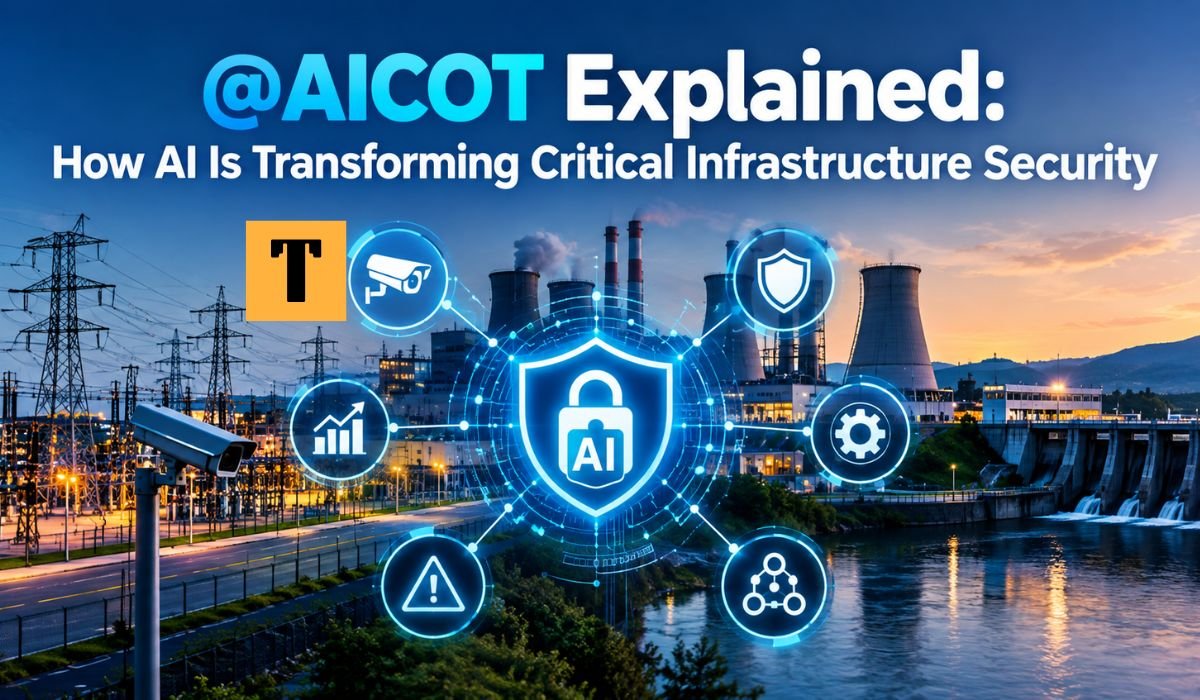
Critical Infrastructure is so deeply woven into everyday life that most people rarely stop to think about it. Electricity networks keep homes and businesses running, water facilities support entire communities, transportation systems move people and goods, and factories produce many of the products modern society relies on. Behind much of this infrastructure are digital systems known as Operational Technology (OT).
As these systems become more connected, however, their Cybersecurity challenges are becoming more complicated. Many industrial environments still depend on older equipment, specialized communication protocols, and technologies that were designed long before today’s Cyber Threats emerged. At the same time, organizations are connecting OT environments with IT networks, remote services, and other digital platforms to improve efficiency and visibility.
This is the problem AICOT is designed to address. AICOT is an AI-focused Cybersecurity initiative centered on OT environments within Critical Infrastructure. Its approach brings together Artificial Intelligence, Machine Learning, Anomaly Detection, security monitoring, OT analysis, and Cyber Threat Intelligence.
It’s important to understand AICOT in the right context. The project represents research and technology development rather than a universally proven commercial security product. Its proposed approach reflects a wider direction in European Cybersecurity research: using AI to help security teams identify unusual behavior while keeping human expertise at the center of important operational decisions.
AICOT Information at a Glance
Project Focus: AI-Powered Cybersecurity for Operational Technology.
Primary Security Area: OT Cybersecurity and Critical Infrastructure Protection.
Core Technologies: Artificial Intelligence, Machine Learning, Security Analytics, and OT Monitoring.
Key Detection Concept: Anomaly Detection and Behavioral Analysis.
Security Data: SIEM and other Cybersecurity information can provide broader visibility.
Industrial Context: OT devices, networks, commands, and communication protocols.
Relevant Protocols: Modbus, DNP3, PROFINET, and IEC 61850 are examples of industrial protocols relevant to OT security.
Threat Intelligence: Cyber Threat Intelligence forms part of the wider security approach.
Information Sharing: The project concept includes privacy-conscious CTI sharing.
Blockchain: Discussed as a possible mechanism for trusted and traceable information exchange.
Target Environments: Critical Infrastructure and Industrial OT.
Potential Sectors: Energy, Water, Transport, Manufacturing, and similar environments.
European Context: Connected with broader European Cybersecurity and technological capability goals.
Testing: Realistic OT environments and Pilot Validation are important to the project’s stated direction.
Readiness: A Technology Readiness Level target around 7–8 has been associated with the project description.
Human Role: Security professionals and OT operators remain important for interpreting alerts and making operational decisions.
Main Challenge: Detecting threats accurately without disrupting legitimate industrial activity.
What Is AICOT?
AICOT is an AI-oriented Cybersecurity initiative focused on Operational Technology and Critical Infrastructure. At its core, the project explores how Artificial Intelligence and security analytics can be applied to environments where digital systems interact directly with physical equipment.
That distinction is significant. A conventional business network may primarily contain computers, servers, cloud services, and software applications. An OT environment, by contrast, can contain industrial controllers, sensors, pumps, turbines, production machinery, and specialized control systems. A Cybersecurity incident in such an environment can potentially affect much more than information stored on a computer.
AICOT’s proposed approach combines AI-based analysis with OT-specific monitoring and broader Cybersecurity capabilities. The aim is to help operators recognize suspicious behavior, gain a clearer picture of activity across industrial networks, and respond more effectively without unnecessarily interfering with physical processes.
For anyone researching AICOT, there’s an important distinction to keep in mind. The project’s stated objectives and planned capabilities shouldn’t automatically be treated as results that have already been independently demonstrated at large commercial scale.
Is AICOT a Product or Research Project?
AICOT is best understood as a Cybersecurity research and development initiative, rather than simply as an off-the-shelf security product.
That distinction matters because research projects can develop technologies, create prototypes, conduct pilot programs, and evaluate performance before a solution is ready for wider deployment. Even a successful pilot doesn’t necessarily mean a technology is suitable for every power facility, water plant, factory, or transportation network.
This is especially relevant in OT Cybersecurity. Industrial environments can differ dramatically from one another. Equipment, network configurations, operating procedures, and safety requirements may all change from one site to another. A system that performs well in one environment may need further development or adaptation before it can be safely introduced elsewhere.
Other European OT Cybersecurity research projects illustrate why this validation stage matters. For example, the EU-funded IDUNN project developed and tested Cybersecurity tools across industrial pilot environments, including technologies for OT fingerprinting, threat detection, forecasting, and resilience.
What Is Operational Technology?
Operational Technology, commonly shortened to OT, refers to hardware and software used to monitor, control, or manage physical processes.
In a factory, OT may include Programmable Logic Controllers, sensors, industrial machines, control systems, and specialized networks. In the energy sector, it can be involved in monitoring and controlling equipment used for generation or distribution. Water facilities can also depend on digital control systems to manage treatment and distribution processes.
OT differs from ordinary Information Technology because its systems can directly influence physical operations. A problem involving an office computer might prevent an employee from accessing files or applications. A problem involving an industrial controller could potentially interrupt production or affect a physical process.
As a result, OT Cybersecurity has to look beyond traditional data protection. Availability, reliability, safety, and operational continuity can be just as important as confidentiality.
Why Critical Infrastructure Needs Better Security
Many OT environments can’t simply be shut down whenever a security update becomes available or an investigation needs to take place. Industrial equipment may be expensive, highly specialized, and designed to operate continuously. Some systems can also remain in service for many years.
Connectivity has introduced another layer of complexity. Industrial environments increasingly communicate with enterprise IT networks, remote monitoring platforms, cloud services, and other connected technologies. These links can provide major operational benefits, but they can also expand the potential attack surface.
European Cybersecurity research has highlighted the growing relationship between IT and OT as an important security issue. OT systems were historically more isolated, but modern operations increasingly connect them with other services for remote monitoring, management, and control.
That makes context particularly important. A security platform shouldn’t only know that two devices communicated. It should ideally help determine whether that communication makes sense for the particular industrial environment in which it occurred.
How AICOT Uses Artificial Intelligence
Artificial Intelligence can process enormous amounts of information and identify patterns that would be difficult for people to examine manually. In Cybersecurity, that ability can help teams analyze network traffic, logs, alerts, device activity, and other sources of information.
AICOT’s approach centers on using AI and Machine Learning to help identify activity that could indicate a Cyber Threat. Rather than depending entirely on known attack signatures, AI-based behavioral analysis can look for changes or patterns that don’t match expected activity.
This approach is particularly interesting in OT because many industrial environments have relatively predictable operating patterns. Devices may normally communicate with specific systems, use particular protocols, and perform certain activities according to established routines.
Still, AI shouldn’t be treated as a guarantee of accurate detection. Model design, training data, data quality, the operating environment, and human interpretation can all affect how well an AI system performs.
That balanced view is important in the wider Cybersecurity landscape, too. European AI Cybersecurity research recognizes that Artificial Intelligence can strengthen defensive capabilities while also giving attackers new ways to identify weaknesses and improve their own operations.
AICOT and Anomaly Detection
Anomaly Detection is one of the central ideas behind AI-supported OT Cybersecurity. Put simply, it involves identifying activity that differs from an established pattern of normal behavior.
Consider an industrial controller that normally communicates with a small number of systems during specific operating periods. If that controller suddenly begins communicating with an unfamiliar device or sends an unusual command, the change could become an important security signal.
But an anomaly doesn’t automatically mean an attack has occurred. Scheduled maintenance, configuration changes, equipment replacement, and unusual operating conditions can all produce behavior that looks different from the normal baseline.
That’s why context matters so much. An AI system can identify something unusual, while security analysts and OT operators can investigate the event and determine whether there’s a legitimate explanation or whether further action is needed.
In an industrial environment, this combination of automated analysis and human judgment can be particularly valuable because an incorrect response could potentially affect physical operations.
The Role of SIEM and Security Data
Security Information and Event Management (SIEM) systems collect and analyze security information from multiple sources. They help security teams bring together logs, alerts, and other events so potentially related activity can be investigated more efficiently.
For OT environments, adding industrial context can make this information far more useful. A conventional alert might indicate that unusual network traffic has occurred, for example, but OT-aware analysis can provide additional information about the device involved and the type of industrial communication that took place.
AICOT’s proposed approach fits into this broader model of combining Security Data with OT-specific information. Rather than treating industrial networks as completely separate from an organization’s wider Cybersecurity operation, the goal is to create a more complete picture of what’s happening.
This could also benefit organizations that already use SIEM platforms or Security Operations Center processes. The idea isn’t necessarily to replace every existing security tool, but to improve the information available to teams investigating potential threats.
Understanding OT Protocols
Industrial environments rely on specialized communication protocols that aren’t commonly found on ordinary business networks. Examples include Modbus, DNP3, PROFINET, and IEC 61850.
These protocols allow industrial devices and control systems to exchange information. Understanding them is important because simply recording that two network addresses communicated doesn’t necessarily explain what happened from an operational perspective.
The security significance of an industrial command can depend on several factors, including which device sent it, which device received it, what the command was intended to do, and whether the activity matches normal operating conditions.
This is where OT Protocol Analysis becomes useful. It can provide another layer of visibility, helping security teams move beyond simply seeing network traffic and toward understanding industrial communication within its operational context.
How AICOT Could Support Critical Infrastructure
AICOT’s focus is relevant to industries that depend heavily on OT. Energy infrastructure uses digital control systems and industrial equipment. Water facilities rely on automated processes for treatment and distribution. Transportation systems increasingly use connected operational technologies, while manufacturing facilities depend on industrial automation throughout the production process.
The potential consequences of a Cybersecurity incident in these environments can go far beyond stolen information. Depending on the system involved, a serious incident could disrupt operations, interrupt services, damage equipment, or create safety concerns.
That makes early detection particularly valuable. When an organization can identify and understand suspicious activity sooner, it may have more time to investigate, contain, and respond before a problem becomes a larger operational disruption.
AICOT’s proposed combination of AI and OT-specific monitoring fits this broader defensive goal. At the same time, its effectiveness ultimately needs to be evaluated through technical testing and realistic validation rather than assumed simply because Artificial Intelligence is involved.
AICOT and Cyber Threat Intelligence Sharing
Cyber Threat Intelligence (CTI) refers to information that helps organizations understand Cyber Threats, including attacker techniques, indicators, behaviors, and other observations that can support defensive decisions.
Sharing CTI can help organizations learn from incidents that have already occurred elsewhere. If one organization discovers a new attack technique or suspicious indicator, information about that activity can potentially help another organization recognize a similar threat sooner.
For Critical Infrastructure operators, though, sharing information isn’t always straightforward. Details about network architecture, vulnerabilities, security incidents, and internal systems can be highly sensitive.
AICOT’s project concept includes secure and privacy-conscious CTI sharing, with Blockchain-based approaches discussed as part of that direction.
It’s important not to overstate the role of Blockchain. It isn’t a replacement for Cybersecurity. Its potential purpose in this context is related to trusted, traceable, and controlled information exchange. Whether that approach delivers practical benefits depends on implementation, governance, interoperability, and real-world testing.
Why European Digital Sovereignty Matters
AICOT also fits within a broader European interest in strengthening domestic technological capabilities. Digital Sovereignty generally refers to having enough technological capacity, control, and strategic choice over important digital infrastructure and services.
Cybersecurity is an important part of that conversation because Critical Infrastructure operators rely on trusted technologies to protect essential services.
European research projects are increasingly examining how AI, Cybersecurity, interoperability, and resilience can work together. Other EU-funded initiatives have placed particular emphasis on trustworthy AI-based Cybersecurity, including areas such as robustness, explainability, and resilience.
AICOT’s European focus should therefore be viewed as part of a much wider technology and Cybersecurity landscape. Developing European capabilities can increase technological choice, but it doesn’t automatically eliminate supply-chain concerns or guarantee that a particular security solution will work in every environment.
Real-World Testing and Technology Readiness
A Cybersecurity platform can perform well in a controlled laboratory and still encounter unexpected difficulties inside a working industrial facility. Real OT environments contain different equipment, legacy systems, network configurations, operating procedures, and safety requirements.
That’s why Pilot Validation is such an important part of technology development. Testing can reveal whether a system generates useful alerts, handles different environments, scales effectively, and remains practical for both security teams and operational staff.
AICOT has been described with a target around Technology Readiness Levels 7–8, which relates to demonstrating technology in realistic or operationally relevant conditions. This should be understood as a development and validation target, not as evidence that the technology has already achieved universal commercial deployment.
The distinction is important. A research objective describes what a project is working toward. A measured result shows what the technology has actually demonstrated. Keeping those two ideas separate makes discussions about AICOT more reliable and transparent.
Potential Benefits of AI-Powered OT Cybersecurity
The potential value of AICOT comes from bringing several Cybersecurity capabilities together around the specific requirements of industrial environments.
AI-based analysis could help security teams process large amounts of information and draw attention to behavior that deserves closer investigation. OT-aware monitoring could then add important context, while SIEM integration could help connect industrial events with broader Cybersecurity activity.
Improved visibility is another potential benefit. Complex industrial networks can contain large numbers of specialized devices, making it difficult for security teams to manually understand every connection and event.
Still, these benefits should be described as possibilities rather than guaranteed outcomes. Real-world value depends on detection quality, data availability, integration with existing systems, operational safety, and the ability of security teams to make effective use of the information.
Challenges AICOT Must Address
Artificial Intelligence doesn’t eliminate the fundamental challenges of OT Cybersecurity.
One of the biggest concerns is the false-positive problem. If a system incorrectly labels normal industrial activity as suspicious, analysts may be flooded with alerts. Over time, excessive alerts can make it harder to identify the events that genuinely matter.
False negatives create the opposite concern. If a real attack isn’t detected, the consequences can be considerably more serious in a safety-sensitive environment.
Data presents another challenge. Machine Learning systems require useful information for training and evaluation, yet high-quality, labeled OT attack data can be difficult to obtain. Industrial organizations may also be understandably reluctant to share sensitive operational information.
Then there’s the fact that no two industrial environments are exactly alike. A manufacturing plant, water facility, power system, and transportation network may rely on entirely different equipment and operating procedures. A useful platform therefore needs to adapt to different environments without introducing unnecessary operational risk.
The Human Role in AI-Powered OT Security
AI should support Cybersecurity professionals rather than remove human responsibility from important decisions.
An AI model might identify an unusual command, for instance, while an OT operator knows that the activity is part of scheduled maintenance. The opposite can also happen: an apparently minor network change may turn out to be significant because it involves an important industrial controller.
That’s why Human Oversight, Explainability, and Operational Context are so important. Security teams need to understand why an alert was generated and have enough information to decide what response makes sense.
This principle is also reflected in broader European work on trustworthy AI, where explainability, robustness, transparency, and human involvement are treated as important elements of responsible AI deployment.
In safety-sensitive environments, the goal isn’t simply to make cybersecurity faster. It’s to make it more informed without creating new operational risks.
What Could AICOT Mean for the Future of OT Cybersecurity?
AICOT reflects a broader change in Industrial Cybersecurity, where organizations are moving beyond basic perimeter protection toward continuous monitoring, behavioral analysis, threat intelligence, and a deeper understanding of OT environments.
That shift is becoming even more relevant as Artificial Intelligence changes both defensive and offensive Cybersecurity. AI can help identify vulnerabilities, process large amounts of information, and support security analysis. At the same time, attackers can use similar technologies to improve their ability to find weaknesses and develop attacks.
For OT environments, that makes context-aware defense increasingly important. Future security platforms may need to understand more than whether network traffic looks unusual. They may also need to determine what that activity means for machines, industrial processes, safety, and operational continuity.
AICOT’s significance, therefore, isn’t simply that it uses the word “AI.” Its more interesting proposition is the combination of AI-based analysis with industrial context and human expertise.
Final Thoughts
AICOT brings together several important areas of modern Cybersecurity, including Artificial Intelligence, Machine Learning, Anomaly Detection, OT Protocol Analysis, SIEM, and Cyber Threat Intelligence.
Its central challenge is straightforward but significant: protecting digital systems that don’t simply store information but help operate the physical infrastructure people depend on every day.
Ultimately, the most important measure of AICOT will be how well its technology performs under realistic conditions. Detection accuracy, false-positive rates, explainability, interoperability, scalability, data quality, and operational safety will matter just as much as the underlying AI.
For that reason, AICOT is best understood as part of the evolving field of AI-Powered OT Cybersecurity, rather than as a finished solution whose benefits can simply be assumed. Its development reflects a broader move toward more context-aware, continuously monitored, and human-supported protection for Critical Infrastructure.
As industrial systems become increasingly connected and Cyber Threats continue to evolve, the ability to combine automated analysis with a deep understanding of physical operations will become increasingly important. That’s ultimately where the promise of projects such as AICOT lies: not in replacing experienced security and operations teams, but in giving them better information with which to protect the systems modern society depends on.
FAQs About AICOT
What Does AICOT Focus On?
AICOT focuses on AI-driven Cybersecurity for Operational Technology environments associated with Critical Infrastructure. Its approach brings together Artificial Intelligence, Machine Learning, security monitoring, Anomaly Detection, OT analysis, and Cyber Threat Intelligence.
Is AICOT a Commercial Cybersecurity Product?
AICOT is best described as a Cybersecurity research and development initiative. Its technology objectives and validation activities shouldn’t automatically be interpreted as evidence of widespread commercial deployment.
Which Industries Could Benefit From AICOT?
The approach is relevant to OT-dependent sectors such as Energy, Water, Transport, and Manufacturing. The suitability of any Cybersecurity technology ultimately depends on the specific environment, equipment, network architecture, and operational requirements.
How Can AI Help With OT Cybersecurity?
AI can analyze large volumes of network and security information, identify unusual patterns, and help security teams prioritize events for investigation. Its effectiveness depends on factors such as data quality, model performance, appropriate operational context, and human oversight.
What Is Anomaly Detection in OT?
Anomaly Detection identifies behavior that differs from an established pattern of normal activity. In an OT environment, this could involve an unusual command, unexpected device communication, or an abnormal change in network behavior.
Does AICOT Replace Existing Cybersecurity Tools?
AICOT’s proposed approach is better understood as working alongside broader Cybersecurity capabilities, including security monitoring and SIEM, rather than automatically replacing every security tool an organization already uses.
Why Is OT Cybersecurity Different From IT Cybersecurity?
OT systems can directly interact with physical processes and equipment. Because of that, Cybersecurity decisions must consider safety, reliability, availability, and operational continuity alongside traditional concerns such as confidentiality and data protection.
Why Is AICOT Important?
AICOT addresses an important Cybersecurity challenge: protecting increasingly connected industrial environments. Its proposed use of AI and OT-specific analysis represents one approach to identifying unusual behavior and providing security teams with more context when they investigate potential threats.
Learn more and explore exciting content on: Boaz Dov Wong: The Story of BD Wong’s Son and His Twin Brother











Leave a Reply