
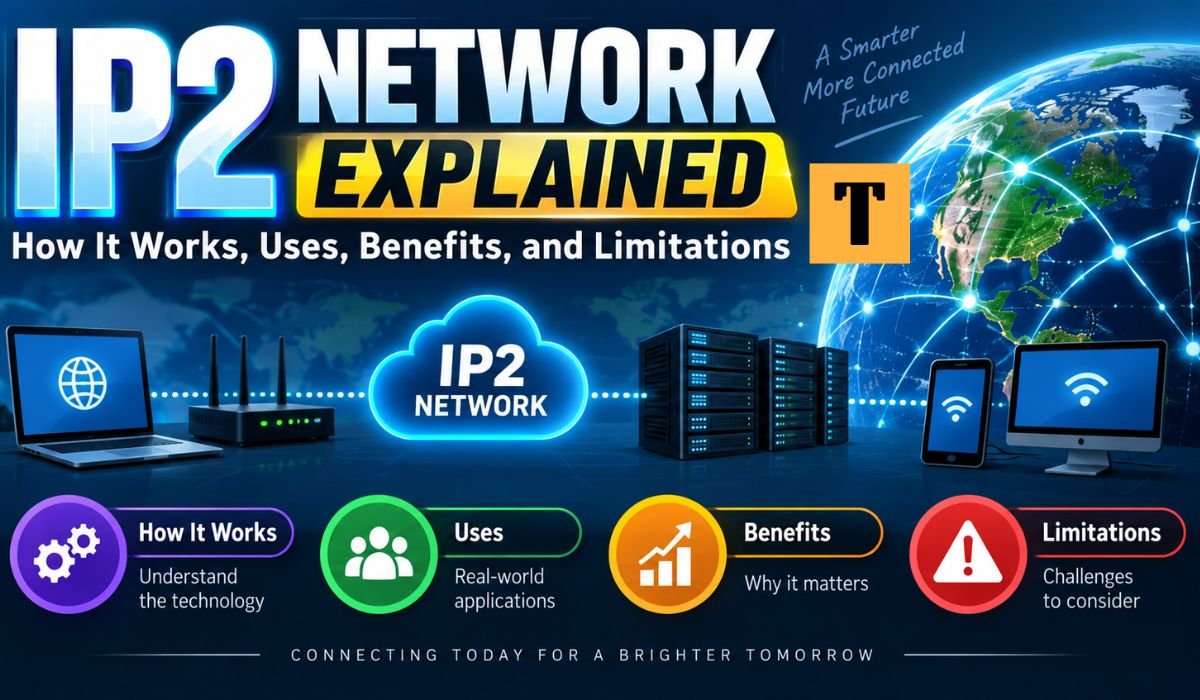
If you’ve searched for IP2 Network, you may have noticed something confusing: the term doesn’t have one universally accepted technical meaning. Unlike familiar networking standards such as IPv4, IPv6, or TCP/IP, IP2 Network isn’t the recognized name of a separate internet protocol.
In privacy and networking discussions, however, “IP2 Network” is sometimes used informally or incorrectly when the subject is actually I2P, or the Invisible Internet Project. I2P is a decentralized, encrypted, peer-to-peer network layer built to support privacy-focused communication and applications.
Rather than relying on a single company or central server, I2P uses participating routers, cryptographic Destinations, distributed network information, and temporary unidirectional tunnels to move data. Its ecosystem can support websites, email, chat, file sharing, web browsing through compatible applications, and other services.
That distinction is important. IP2 Network and I2P shouldn’t automatically be treated as two official names for the same technology. If you came across IP2 Network while researching private or decentralized networking, this guide explains what the term may mean, what I2P actually does, how it works, where it’s used, and where its limitations become important.
Quick Bio Information About The IP2/I2P Network
| Fact | Information |
|---|---|
| Common Search Term | IP2 Network |
| Established Technology | I2P |
| Full Name | Invisible Internet Project |
| Network Type | Decentralized Peer-To-Peer Network |
| Main Purpose | Privacy-Focused Communication |
| Routing Model | Temporary Unidirectional Tunnels |
| Tunnel Types | Inbound And Outbound |
| Core Infrastructure | I2P Routers |
| Application Identity | Cryptographic Destination |
| Network Database | netDb |
| Main netDb Records | RouterInfo And LeaseSets |
| Distributed Database Role | Router And Destination Discovery |
| Network Services | Websites, Email, Chat, File Sharing |
| Current Router Transports | NTCP2 And SSU2 |
| Network Structure | Distributed |
| Public Web Access | Possible Through Supported Applications |
| VPN Equivalent | No |
| Tor Equivalent | No |
| Complete Anonymity | Not Guaranteed |
What Is An IP2 Network?
The first thing to clear up is the terminology. IP2 Network isn’t the established name of a separate internet protocol. Modern internet communication relies on technologies such as IPv4 and IPv6, while I2P is the established name of the Invisible Internet Project.
The phrase “IP2 Network” can therefore be misleading. In some privacy-related content, it appears to be a mistaken reference to I2P. I2P itself is an encrypted, decentralized, peer-to-peer network layer that operates over the existing internet.
One of the interesting features of I2P is the separation between the I2P router and an application’s Destination. The router participates in the network, while an application can have its own cryptographic identity for communication. This arrangement allows multiple applications to use the same I2P router while maintaining separate identities.
I2P can support a variety of privacy-focused activities, including websites, web hosting, email, chat, file sharing, and web browsing through supported applications. The network is therefore better understood as an infrastructure layer for privacy-conscious applications rather than simply a tool for changing or hiding an IP address.
So, if you encounter IP2 Network in a privacy context, it’s worth checking whether the source is actually discussing I2P.
Is IP2 The Same As I2P?
Not technically. I2P stands for Invisible Internet Project, and that’s the established name of the privacy network. IP2 Network, on the other hand, is an ambiguous phrase that can mean different things depending on the context in which it appears.
This distinction matters when researching privacy software. A service, website, or community that uses the phrase “IP2” shouldn’t automatically be assumed to be part of the I2P ecosystem.
When a discussion mentions I2P routers, tunnels, Destinations, LeaseSets, the network database, or .i2p services, it’s referring to I2P. The project describes I2P as an anonymous network layer designed to provide a foundation for privacy- and security-conscious applications.
For people searching online, IP2 Network may be the phrase that leads them to this subject, but I2P is the technical term they need to understand.
What Is I2P And Why Was It Created?
I2P was developed as a network layer that applications can use when private and anonymous communication is important. Instead of requiring every application to create its own privacy network, I2P provides the underlying infrastructure.
That approach gives applications access to privacy-focused networking while allowing developers to make decisions about issues such as anonymity, latency, and throughput. The I2P architecture is designed to be self-organizing and resilient, giving applications a way to communicate without relying on a single centralized routing provider.
The network can support websites, web hosting, email, chat, file sharing, blogging, and other services. It isn’t simply a browser, nor is it a conventional VPN service. Instead, I2P provides a network environment that applications can use.
That distinction gives I2P a broader role than a simple IP-hiding tool. Its purpose is to provide the infrastructure needed for decentralized, privacy-focused communication and services.
How Does The IP2/I2P Network Work?
To understand How The IP2 Network Works, assuming the term refers to I2P, it’s helpful to start with its routing system.
I2P doesn’t simply send information directly from one computer to another. Instead, it creates temporary unidirectional tunnels through participating I2P routers. An outbound tunnel carries messages away from its creator, while an inbound tunnel carries messages toward its creator. A complete exchange can therefore involve separate paths for the two directions.
When one I2P user communicates with another, the sender can use an outbound tunnel while the recipient maintains inbound tunnels. The sender’s tunnel can connect to the gateway of one of the recipient’s inbound tunnels, allowing information to move through the network without establishing a simple direct connection between the two endpoints.
Encryption is built into the communication process. Each router has a particular role within a tunnel and doesn’t simply receive a complete picture of the source-to-destination path.
I2P also uses encrypted router-to-router transports. Its current architecture includes NTCP2, which operates over TCP, and SSU2, which operates over UDP. These transports help protect communication between participating routers.
The result is a network in which routing, encryption, and decentralized participation work together rather than depending on one central provider.
What Are I2P Tunnels?
I2P Tunnels are at the heart of the network’s architecture. They are temporary, one-way communication paths made up of participating routers.
There are two basic types. An outbound tunnel carries messages away from the router that created it, while an inbound tunnel carries messages toward its creator. Since the tunnels are unidirectional, sending information and receiving a response generally involve separate paths.
I2P uses layered encryption within this process. Routers perform specific jobs based on their positions in the tunnel, so an individual participant doesn’t simply see the entire communication route.
Tunnel length is also important. Adding more hops can provide additional privacy properties, but it can also increase latency and reduce throughput or reliability. Shorter tunnels may perform better but can introduce different privacy trade-offs.
That’s an important detail to keep in mind: more hops don’t automatically mean unlimited privacy. Like other privacy technologies, I2P has to balance anonymity, performance, reliability, and network efficiency.
What Is The I2P NetDb?
Another major component of I2P is the I2P Network Database, commonly known as the netDb.
The netDb is a distributed database containing important network information. Two of its primary types of records are RouterInfo and LeaseSets. RouterInfo contains information needed to contact an I2P router, while LeaseSets contain information that helps other routers reach a particular Destination.
The database isn’t maintained by one central server. Instead, I2P uses a distributed system involving routers known as floodfills, which help store and distribute network information.
This arrangement fits naturally with I2P’s decentralized architecture. Routers can discover peers and destinations without depending on a single organization to maintain a master directory for the entire network.
Network information is also signed and includes information related to freshness. That helps routers determine whether the information they’re using is valid and current.
For newcomers, the netDb may sound complicated, but its basic purpose is straightforward: it helps I2P routers discover the information they need to communicate across a decentralized network.
What Is The IP2/I2P Network Used For?
When IP2 Network is being used to refer to I2P, the technology has several practical applications.
One major use is private communication. Applications can use I2P to exchange information through its privacy-focused routing system rather than relying on a straightforward direct connection. Chat and email applications can operate within the I2P environment as well.
I2P also supports websites and web hosting. Services can be hosted within the network, allowing users to create and access sites designed specifically for the I2P ecosystem.
Another important use is file sharing. I2P supports peer-to-peer applications, including I2PSnark and other file-sharing tools.
Web browsing is another possible use when applications and browsers are configured to communicate through I2P. The network can therefore support a mixture of internal services and privacy-focused access methods.
The common thread is that I2P isn’t simply about hiding an IP address. It provides the underlying network infrastructure for decentralized and privacy-focused applications.
Can You Access Regular Websites With I2P?
This is one of the most common points of confusion surrounding I2P.
I2P is strongly associated with services operating within its own ecosystem, including websites and other internal services. However, I2P can also be used for web browsing through a browser configured to use an I2P proxy.
That doesn’t mean I2P is simply another VPN. Its architecture and goals are different.
A VPN generally provides a convenient way to route internet traffic through infrastructure operated by a VPN provider. Tor is widely associated with anonymity-oriented web access. I2P, meanwhile, is designed as a decentralized network layer that supports applications and services through its own architecture.
So it would be inaccurate to say that I2P can never interact with the regular web. The better explanation is that I2P is designed primarily as a privacy-focused network layer, with particular emphasis on decentralized services and communication, rather than as a straightforward replacement for ordinary internet access.
What Are The Main Benefits Of The IP2/I2P Network?
One of I2P’s biggest strengths is decentralization. Unlike a conventional VPN service, it doesn’t depend on one company to operate the entire routing infrastructure. Participating routers collectively contribute to the network.
Privacy is another central benefit. I2P combines encrypted communication with layered tunnel routing, making it more difficult for an observer to obtain a complete picture of a communication path.
The network also separates routers from application Destinations. That gives applications their own cryptographic identities while allowing the underlying router to participate in network communication.
I2P can also contribute to censorship resistance because services aren’t necessarily dependent on a single centralized server or provider. Its distributed architecture makes the network less dependent on one point of control.
Perhaps most importantly, I2P gives developers and users a foundation for building and using decentralized services. It isn’t only something to connect through; it can serve as an environment in which privacy-focused applications operate.
What Are The Limitations Of The IP2/I2P Network?
I2P has genuine advantages, but it also comes with trade-offs.
The first is the learning curve. Terms such as routers, Destinations, tunnels, LeaseSets, and netDb can be unfamiliar to people who have only used conventional browsers and internet services.
Performance is another consideration. I2P is a dynamic network, and routers differ in bandwidth, latency, capacity, and connectivity. As the available peers and network conditions change, tunnel performance can change as well.
The ecosystem is also smaller than the conventional web. I2P supports a range of applications and services, but users shouldn’t expect every mainstream website or online platform to have an I2P equivalent.
There are also privacy limitations. I2P can provide meaningful anonymity and privacy protections, but it isn’t a guarantee of perfect anonymity against every possible threat. Tunnel configuration, application behavior, user actions, network conditions, and the capabilities of a potential adversary can all affect the outcome.
In other words, I2P is powerful, but it’s not magic.
Is The IP2/I2P Network Safe?
Whether an IP2 Network is safe depends partly on what the term actually refers to. If you’re talking about I2P, the technology includes encryption, decentralized routing, and privacy-focused design. Those protections are valuable, but they don’t automatically make everything done through the network secure.
It’s helpful to distinguish security, privacy, and anonymity.
Security is concerned with protecting systems and information from attacks. Privacy is about limiting unwanted exposure of information or activity. Anonymity is about making it difficult to connect activity with a specific person or identity.
I2P can strengthen privacy and provide anonymity-related protections, but users can still weaken those protections themselves. Revealing personal information, using identifying accounts, running vulnerable software, downloading malicious files, or configuring applications incorrectly can all introduce risks.
There are also inherent trade-offs in anonymity networks. For example, I2P documentation explains that tunnel length can affect anonymity as well as latency, throughput, and reliability.
The most accurate way to describe I2P is therefore as a privacy-enhancing network, not as a guarantee of complete anonymity or security.
IP2/I2P Vs. VPN And Tor
I2P, VPNs, and Tor are often mentioned together because they’re all associated with online privacy. However, they’re built differently and aren’t interchangeable.
A VPN normally routes traffic through servers controlled by a VPN provider. This can make everyday private internet access relatively straightforward, but it also means the provider becomes an important part of the trust model.
Tor takes a different approach. It routes traffic through multiple relays and uses layered encryption. Its architecture is designed to prevent a single relay from seeing both a user’s identity and the destination of their communication.
I2P has its own architecture based on unidirectional tunnels, participating routers, cryptographic Destinations, and a distributed network database.
These differences mean there isn’t a universal winner. A VPN may be the most convenient option for someone seeking simple private internet access. Tor can be well suited to anonymity-focused web browsing and onion services. I2P is particularly relevant to people interested in decentralized private services, peer-to-peer communication, and applications built around its network.
The better choice ultimately depends on the problem you’re trying to solve.
Who Should Consider Using The IP2/I2P Network?
I2P is particularly interesting for people who want to explore decentralized privacy technology rather than simply install a one-click privacy service.
Developers can use I2P as a network layer for privacy-focused applications. Researchers can examine its routing architecture, peer selection, tunnel design, and distributed database. Privacy-conscious users may also find its decentralized approach appealing.
People interested in peer-to-peer services and private internal websites may find the ecosystem especially relevant.
On the other hand, someone who simply wants a convenient way to route everyday internet traffic privately may find a traditional VPN easier to understand and operate.
There’s no single privacy tool that works best for everyone. The right choice depends on what you’re trying to protect, which services you need to access, and how much technical complexity you’re comfortable managing.
How To Get Started With An I2P Network
Getting started with I2P generally means installing an I2P implementation, running the router, allowing it to establish connections with other peers, and configuring compatible applications.
During the initial setup, the router needs to discover other routers. I2P uses a process called reseed to obtain RouterInfo information and begin discovering peers. It can then build exploratory tunnels and develop a local view of the network database.
This means the first experience can feel different from opening a conventional browser. I2P needs time to discover peers and establish useful tunnels.
New users should also pay attention to configuration. Privacy isn’t simply a matter of installing software and assuming every application will automatically behave in the same way. Browser settings, application configuration, accounts, and personal behavior can all influence privacy.
Because the technology continues to develop, current documentation should be preferred over old setup guides. Instructions written several years ago may describe settings, transports, or procedures that have since changed.
Common Misconceptions About IP2 And I2P
One common misconception is that IP2 is an official replacement for IPv4 or IPv6. It isn’t. Those are separate networking concepts, while I2P is a privacy-focused network layer.
Another misconception is that I2P makes users completely anonymous. That’s too broad a claim. I2P is designed to provide strong privacy and anonymity properties, but no privacy system should be treated as an absolute guarantee against every threat.
It’s also inaccurate to describe I2P as simply another VPN. A VPN typically depends on a centralized provider, while I2P uses a decentralized network of participating routers and is designed around a different set of applications and services.
Some people also assume that I2P exists only for illegal activity. That’s an overly simplistic view. Privacy networks have legitimate uses, including communication, research, decentralized services, websites, file sharing, and protecting sensitive activity from unnecessary exposure.
Finally, accessing a website or application through I2P doesn’t automatically make that service trustworthy. Network privacy and content safety are separate concerns.
Final Thoughts
The most important thing to understand about the IP2 Network is that the phrase itself can create confusion. IP2 isn’t the established name of a standardized internet protocol. In privacy-related searches, it may instead be an informal or mistaken reference to I2P, the Invisible Internet Project.
I2P is a sophisticated decentralized network layer built around routers, cryptographic Destinations, distributed network information, and temporary unidirectional tunnels. That architecture supports a range of privacy-focused applications, including websites, web hosting, email, chat, file sharing, and compatible web browsing.
Its decentralized design is one of its biggest strengths. Unlike a traditional VPN model, I2P doesn’t place the entire routing process in the hands of one provider. Instead, participating routers collectively contribute to the network.
At the same time, I2P isn’t a magic shield for online privacy. It can provide meaningful privacy and anonymity protections, but configuration, application behavior, personal information, network conditions, and potential traffic analysis all matter.
For anyone searching for IP2 Network, the best first step is to identify what the term means in context. If the discussion includes I2P routers, tunnels, Destinations, LeaseSets, the netDb, and .i2p services, you’re almost certainly looking at I2P.
Understanding that distinction makes the rest of the technology much easier to understand—and helps readers make a more informed decision about whether I2P is the right privacy technology for their needs.
FAQs About The IP2 Network
What Does IP2 Network Mean?
IP2 Network is an ambiguous phrase rather than the established name of a standardized networking technology. In privacy-related discussions, it may be used when the writer actually means I2P, the Invisible Internet Project. I2P is a decentralized, encrypted peer-to-peer network layer designed for privacy-focused communication and services.
Is IP2 The Same As I2P?
Not technically. I2P is the established name of the Invisible Internet Project. “IP2 Network” is an inconsistent term that may be used by some sources when discussing I2P-related technology. The safest approach is to check the context before assuming that IP2 refers to I2P.
What Does I2P Stand For?
I2P stands for Invisible Internet Project. It’s a decentralized network layer designed to support privacy-focused applications and services, including websites, web hosting, email, chat, and file sharing.
How Does An I2P Network Work?
I2P uses participating routers and temporary encrypted tunnels. Outbound tunnels carry messages away from their creator, while inbound tunnels carry messages toward their creator. Separate paths can be used for sending and receiving, helping provide the network’s privacy-oriented routing model.
Is I2P Completely Anonymous?
No. I2P is designed to improve privacy and provide anonymity-related protections, but it doesn’t guarantee complete anonymity against every possible threat. User behavior, application configuration, tunnel choices, network conditions, and traffic-analysis capabilities can all affect privacy.
Is I2P Better Than A VPN?
Neither technology is universally better. A VPN is usually easier for general private internet access and depends on a centralized provider. I2P uses a decentralized architecture and focuses heavily on privacy-focused applications and services. The right choice depends on the user’s specific needs.
Is I2P Different From Tor?
Yes. Both are privacy technologies, but their architectures differ. I2P uses unidirectional tunnels and a decentralized network of participating routers, while Tor uses a distributed relay system. Their typical applications and approaches to anonymous communication also differ.
Is I2P Safe To Use?
I2P includes important privacy and security mechanisms, but it doesn’t make every website, application, or downloaded file safe. Users still need to keep software updated, avoid revealing unnecessary personal information, configure applications carefully, and understand that privacy technology has limitations.
Learn more and explore exciting content on: Who Is Mark Fluent? Inside Justine Bateman’s Husband’s Life, Career, and Family












Leave a Reply