
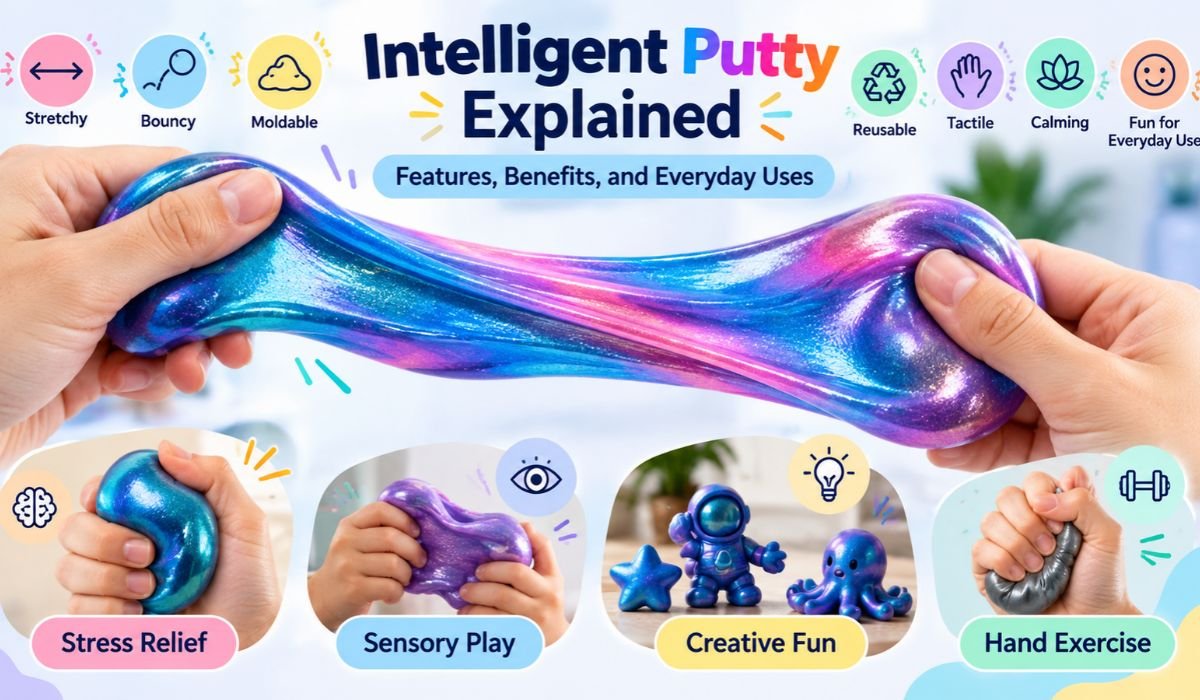
At first glance, Intelligent Putty doesn’t seem particularly complicated. It’s soft, colorful, easy to shape, and small enough to hold in one hand. Spend a few minutes experimenting with it, though, and the material starts doing things that ordinary Modeling Clay simply doesn’t do.
Pull it gently and it may stretch into a surprisingly long strand. Give it a sudden tug and it can tear or snap. Roll certain varieties into a compact ball, drop them onto a hard surface, and they’ll bounce. Leave that same putty sitting untouched for long enough and it may slowly flatten and spread. Magnetic Intelligent Putty adds another curious behavior: with the right magnet nearby, the material can gradually move and change shape.
Despite its name, there’s no Artificial Intelligence hidden inside Intelligent Putty. The word “Intelligent” is used to describe the way the material responds to different physical conditions. Much of that behavior comes from Viscoelasticity, a property that allows a material to show characteristics associated with both elastic solids and materials that flow.
That unusual combination has made Intelligent Putty popular for far more than casual play. It can be used for Sensory Activities, Creative Play, classroom demonstrations, and simple science experiments. For parents, teachers, students, hobbyists, and curious adults, it’s an accessible way to see some surprisingly interesting physics in action.
What Is Intelligent Putty?
Intelligent Putty is a soft, moldable material known for changing its behavior depending on how it’s handled. It can usually be squeezed, folded, rolled, stretched, and reshaped repeatedly. What separates it from conventional Modeling Clay is what happens when the speed or duration of that movement changes.
Slowly stretch a piece between your hands and many formulations will become longer and thinner. Try a much faster pull and the putty may split instead. Some varieties can bounce when formed into a ball, while others gradually spread if they’re left sitting on a suitable surface.
These aren’t random effects. They’re connected to the material’s Viscoelastic Properties and the way its internal structure responds to force over time.
It’s also important to recognize that Intelligent Putty isn’t a single standardized chemical formulation. The name is used for different specialty putties, so ingredients, texture, firmness, color, elasticity, magnetic response, and recommended age can vary from one product to another.
That variation is worth remembering whenever you’re comparing products. A feature advertised for one Intelligent Putty shouldn’t automatically be assumed to apply to every other variety.
Quick Bio Information
| Feature | Details |
|---|---|
| Product Name | Intelligent Putty |
| Material Category | Specialty Moldable Putty |
| Main Property | Viscoelasticity |
| Typical Texture | Soft And Flexible |
| Stretching Ability | Usually Stretches When Pulled Slowly |
| Breaking Behavior | May Snap Under Rapid Force |
| Bouncing Ability | Available In Many Formulations |
| Slow-Flowing Behavior | Common In Viscoelastic Varieties |
| Magnetic Properties | Available In Selected Products |
| Color Options | Vary By Manufacturer |
| Glow-In-The-Dark Options | Available |
| Reusability | Many Products Support Repeated Use |
| Main Purpose | Sensory Play And Material Exploration |
| Educational Value | Demonstrates Basic Physics |
| Creative Applications | Temporary Modeling And Shaping |
| Storage Requirements | Follow Manufacturer Instructions |
| Safety Considerations | Age, Ingredients, And Accessories |
| Artificial Intelligence | Not Present |
| Recommended Users | Depends On Product Age Guidance |
How Does Intelligent Putty Work?
The science behind Intelligent Putty becomes easier to understand once you stop thinking of it as ordinary clay. Its unusual behavior is closely associated with Viscoelasticity.
A purely elastic material tends to recover its shape after being deformed. A viscous material, by comparison, flows when force is applied. Viscoelastic materials show elements of both behaviors, and the response can depend heavily on how quickly the force is applied.
Imagine slowly pulling Intelligent Putty apart. Because the movement happens gradually, its internal polymer structure has more time to rearrange while the material changes shape. The result can be a long, thin stretch.
A sudden pull creates very different conditions. There isn’t as much time for that internal rearrangement, so the material may resist rapid deformation more strongly. Depending on the formulation, it can behave more like an elastic solid and may eventually tear or fracture.
Research involving Silly Putty and related magnetic formulations has documented this kind of rate-dependent mechanical behavior. Temperature and composition can influence the response as well, which helps explain why two products that look almost identical may feel noticeably different when handled.
In other words, Intelligent Putty isn’t changing into a different substance every time you touch it. You’re simply seeing different sides of the same material under different physical conditions.
Main Features Of Intelligent Putty
The appeal of Intelligent Putty comes from the number of different behaviors packed into one deceptively simple material. Instead of being designed only for shaping, it invites users to experiment with movement, force, and time.
Stretchable And Flexible Texture
Pull Intelligent Putty gently and many varieties will extend into thin strands. How far they stretch depends on the formulation, temperature, and speed of the movement. This flexibility makes the material particularly suitable for repeated manipulation and simple experiments involving deformation.
Bouncing Properties
Many Intelligent Putty products can bounce when they’re rolled tightly into a ball and dropped onto a hard surface. During the quick impact, the material can behave more elastically than it does during a slow stretch, allowing some of the impact energy to be returned as the ball rebounds.
Breaking Under Sudden Force
Stretching isn’t guaranteed. Pull the same putty sharply and it may snap instead. The contrast between slow stretching and rapid breaking is one of the clearest demonstrations of its rate-dependent behavior.
Slow-Flowing Behavior
Time changes the picture again. Leave some viscoelastic putties sitting undisturbed and they gradually lose their original shape. Gravity slowly pulls the material outward, causing it to flatten or spread.
Reusable Material
Many commercial varieties are made for repeated use and don’t harden in the same way as Air-Drying Clay. Still, “reusable” doesn’t mean indestructible. Dirt, fibers, heat, poor storage, and repeated handling can eventually affect the texture and performance.
Taken together, these Intelligent Putty Features explain why the material works equally well as an entertaining object and a simple introduction to Materials Science.
Different Types Of Intelligent Putty
There’s no single version of Intelligent Putty that represents the entire category. Manufacturers have developed different varieties, each emphasizing a particular appearance, texture, or physical effect.
Traditional Intelligent Putty
Standard Intelligent Putty focuses on the familiar combination of squeezing, stretching, folding, bouncing, and reshaping. It’s usually intended for repeated tactile interaction rather than creating permanent sculptures.
Magnetic Intelligent Putty
Magnetic Intelligent Putty contains material that responds to an external magnetic field. With a suitable magnet nearby, the putty may gradually move, stretch, rise, or deform in the magnet’s direction.
Color-Changing Intelligent Putty
Some specialty varieties use pigments that respond to changes in temperature. The warmth of a person’s hands, for instance, may temporarily alter the color of certain products. The exact effect varies by formulation.
Glow-In-The-Dark Intelligent Putty
Glow varieties contain pigments capable of absorbing energy from light and releasing some of that energy afterward as visible light. How brightly they glow, and for how long, depends on the product and the lighting conditions.
Sensory Intelligent Putty
Sensory-focused products can vary considerably in firmness, resistance, and texture. Some are easier to manipulate, while firmer varieties require more effort to stretch or squeeze.
These differences make product selection important. Someone interested in magnetic experiments won’t necessarily want the same putty as someone looking for simple Creative Play.
How Does Magnetic Intelligent Putty Work?
Magnetic Intelligent Putty takes the unusual behavior of ordinary putty and adds another force to the equation.
These products contain magnetic or ferromagnetic particles distributed through the soft putty matrix. When an appropriate magnet comes close enough, magnetic forces act on those particles. Because they’re embedded throughout a flexible substance, their movement can cause the surrounding putty to deform as well.
The effect is usually gradual rather than instantaneous. Depending on the strength of the magnet, the amount of putty, the distance between them, and the formulation itself, the material may form a raised peak, stretch toward the magnet, creep across a surface, or slowly surround part of it.
Watching that happen can make the putty appear almost alive. In reality, there’s no intelligence or independent movement involved. It’s a visible interaction between magnetic forces and a deformable material.
The underlying concept has attracted scientific interest beyond toys. Researchers have investigated specialized magnetic putties and related soft materials for areas such as reconfigurable systems and Soft Robotics.
That connection needs some context, however. A consumer Magnetic Intelligent Putty toy isn’t automatically an engineering material simply because both respond to magnetic fields. Their formulations, performance requirements, and intended applications can be very different.
Safety deserves equal attention. Small or powerful magnets can be extremely dangerous when swallowed, so magnetic products and their accessories should always be handled according to their specific safety instructions.
Why Does Intelligent Putty Stretch, Bounce, And Break?
One of the most interesting things about Intelligent Putty is that stretching, breaking, bouncing, and flowing aren’t unrelated tricks. They’re different expressions of the same material responding to different conditions.
Start with a slow stretch. As you gradually separate your hands, the putty’s internal structure has time to rearrange. Many formulations will keep extending, becoming progressively thinner.
Now increase the speed dramatically. During a sudden pull, the material has much less time to accommodate the movement. Its resistance increases, and it may tear rather than forming a long strand.
Bouncing occurs over an even shorter period. When a compact ball of suitable putty strikes a hard surface, the impact happens quickly. Under those conditions, its elastic response can allow some mechanical energy to be stored and then released during the rebound.
Leave that ball alone for an extended period and a completely different behavior becomes visible. Gravity can slowly deform it until the original round shape begins to flatten.
The material hasn’t mysteriously changed from a solid to a liquid and back again. The timescale and type of force have changed, revealing different aspects of its Viscoelastic Behavior.
Intelligent Putty Vs Traditional Modeling Clay
Put Intelligent Putty beside traditional Modeling Clay and the two materials may initially seem very similar. Both can be pressed, rolled, flattened, and shaped by hand. Their purposes, however, aren’t quite the same.
Modeling Clay is generally designed with shape-making in mind. If you’re sculpting a figure or creating a detailed model, you usually want the material to retain the form you’ve given it while you continue working.
Intelligent Putty is much more dynamic. The experience centers on stretching, folding, bouncing, squeezing, tearing, and reforming it. Because many varieties slowly flow, a carefully shaped object may gradually lose its form if it’s left sitting for long enough.
That makes traditional clay the more practical option for many sculpting projects. Intelligent Putty is often better suited to Sensory Activities, experimentation, temporary modeling, and demonstrations of physical properties.
Of course, neither category is completely uniform. Different clays and putties have different formulations, so product-specific characteristics should always take priority over general assumptions.
Key Benefits Of Intelligent Putty
The most realistic Intelligent Putty Benefits are sensory, creative, recreational, and educational.
Handling the material naturally involves finger and hand movements. Users can pinch, squeeze, twist, roll, stretch, flatten, and reform it, creating a varied tactile experience. Those actions can also form part of recreational Fine-Motor Activities.
Its educational value is equally important. Intelligent Putty invites questions. What happens if it’s stretched more slowly? Will a colder piece behave differently from a warmer one? How long does it take to spread? Does changing the shape affect the bounce?
Questions like these turn casual play into observation and experimentation.
Adults may enjoy the material for simpler reasons. Keeping a piece of putty at a desk provides a tactile activity during an appropriate break, and some people find repetitive squeezing or reshaping personally relaxing.
Claims about health benefits require more caution. Enjoying a sensory or fidget activity isn’t the same as receiving medical treatment. Ordinary Intelligent Putty shouldn’t be presented as a proven treatment for Anxiety, ADHD, stress disorders, or other medical conditions unless a specific claim is supported by appropriate clinical evidence.
Everyday Uses Of Intelligent Putty
Part of Intelligent Putty’s appeal is that it doesn’t require elaborate instructions or specialist equipment. A single piece can support several kinds of activity.
At home, it can be used for stretching challenges, temporary shapes, tactile exploration, and simple experiments. Children can observe what happens when they change the speed of a pull or compare how the material behaves after being handled for a while.
In classrooms, suitable Intelligent Putty can make otherwise abstract ideas more concrete. Concepts such as Elasticity, Viscosity, Deformation, Gravity, and Rate-Dependent Behavior become easier to discuss when students can observe them directly.
Magnetic varieties introduce another dimension by showing how a deformable material can respond to a magnetic field.
Adults may use putty as a desk object or occasional Fidget Activity, while creative users can experiment with shapes, impressions, patterns, and textures.
The common thread is interaction. Intelligent Putty is rarely at its most interesting when it’s simply sitting in a container. Its character becomes apparent when it’s handled, tested, and observed.
Easy Intelligent Putty Experiments To Try
You don’t need a laboratory to investigate Intelligent Putty. A few controlled comparisons can reveal much of what makes the material unusual.
Slow Stretch And Quick Pull Experiment
Begin with a small piece and stretch it gradually between both hands. Pay attention to how long and thin it becomes before breaking.
Then take a similar amount and pull it sharply.
Many formulations produce noticeably different results. The slow pull may create a long strand, while the faster movement can produce a sudden tear. It’s a straightforward demonstration of how deformation rate affects behavior.
Bouncing Ball Experiment
Roll an appropriate amount of putty into a compact ball. Drop it from a consistent height onto a clean, hard, protected surface.
Observe the rebound. Repeating the experiment from the same height makes comparisons more meaningful.
Not every formulation will bounce equally well, so differences between products can become part of the experiment.
Slow Flow Experiment
Place a small piece on a clean, nonporous surface that’s suitable for contact with the product. Observe its outline when you begin, then check it again later.
If the putty gradually becomes wider and flatter, you’re seeing its long-term deformation under gravity.
Magnetic Movement Experiment
With Magnetic Intelligent Putty, use only an appropriate magnet and follow the product’s instructions.
Bring the magnet gradually closer and observe what changes. The putty may develop a raised area or slowly move toward the magnetic source.
Rather than treating these activities as tricks, encourage observation. Changing only one condition at a time makes it easier to understand what’s actually influencing the result.
Is Intelligent Putty Safe For Children?
There’s no universal yes-or-no answer because Intelligent Putty products vary.
A product’s ingredients, size, accessories, intended use, and age recommendation all matter. Parents and caregivers should therefore read the manufacturer’s instructions instead of assuming that every soft or colorful putty is automatically suitable for children.
Putty isn’t food and shouldn’t be placed in the mouth. Children who are likely to chew or swallow non-food objects require particular supervision.
Magnetic varieties demand even greater care. Small or powerful magnets can cause severe internal injuries when swallowed, particularly if multiple magnets attract one another through body tissue or interact with another metal object.
Suspected magnet ingestion requires immediate medical attention rather than waiting to see whether symptoms develop.
It’s also sensible to keep Intelligent Putty away from pets and food-preparation areas and to follow any product-specific warnings about skin contact or ingredients.
Labels such as “Non-Toxic” shouldn’t be misunderstood either. They don’t mean that a product is edible, appropriate for every age, or harmless under every possible use.
Does Intelligent Putty Dry Out?
One frequently advertised advantage of Intelligent Putty is its ability to remain workable for a long time. Many formulations don’t dry and harden in the same way as conventional Air-Drying Clay.
That doesn’t mean they’re unaffected by age or storage conditions.
Dust, hair, fabric fibers, food particles, oils, and other contaminants can become incorporated into the material. Excessive heat or unsuitable storage may also change how it feels and behaves.
Temperature can produce temporary differences as well. Some putties feel firmer when cool and softer after warming in the hands.
Good storage therefore matters even for products designed for repeated use. Returning the putty to its original container after use, keeping the container properly closed, and handling the material with clean hands can help preserve its original condition.
There’s no universal lifespan that applies to every Intelligent Putty. Manufacturer guidance remains the most reliable source for the care and expected durability of a particular product.
How To Clean And Store Intelligent Putty
Preventing a mess is generally easier than cleaning one.
Intelligent Putty should be used on an appropriate clean surface and returned to its container when the activity is finished. Leaving it unattended on carpets, upholstery, bedding, clothing, paper, or unfinished wood can create problems.
Because some putties slowly flow, they may work their way into fabric fibers over time. Pigments or other ingredients may also leave marks on certain materials.
If putty becomes stuck to clothing or upholstery, don’t immediately reach for a strong solvent or apply heat. A cleaning method that works for one formulation could damage another product or the surface underneath it.
Check the manufacturer’s care instructions first.
The same cautious approach applies when putty becomes dirty. Minor surface contamination may sometimes be manageable according to product instructions, but heavily contaminated material can be difficult to restore. If it contains food, excessive dirt, or other unwanted substances, replacement may be the more sensible option.
Clean hands, a suitable work area, and proper storage prevent many of these problems before they begin.
How To Choose The Best Intelligent Putty
The Best Intelligent Putty isn’t necessarily the product with the longest feature list. It’s the one that suits the activity you actually have in mind.
For everyday Sensory Play, texture and firmness are important. Some people prefer very soft material that stretches easily, while others enjoy a firmer putty that offers more resistance.
For classroom demonstrations or home science activities, look at the physical behavior the manufacturer actually describes. A product intended for bounce and stretching experiments may be more useful than one designed primarily for visual effects.
Anyone purchasing Intelligent Putty for a child should place age recommendations and safety information ahead of novelty features. Magnetic varieties deserve particularly careful attention because of the risks associated with accessible magnets.
It’s also worth checking storage instructions, product quantity, potential staining warnings, and whether any special accessories are required.
Most importantly, don’t assume that marketing terms apply across the entire category. Magnetic, Non-Toxic, Glow-In-The-Dark, Color-Changing, and Long-Lasting are product-specific claims that should be verified for the individual item.
Common Mistakes To Avoid
Many disappointing experiences with Intelligent Putty come from expecting every variety to behave exactly the same way.
A standard product won’t suddenly become magnetic simply because another type of Intelligent Putty responds to magnets. Likewise, one formulation may produce an impressive bounce while another emphasizes stretching or visual effects instead.
Surface choice is another common issue. Leaving putty on furniture, fabric, carpet, or other unsuitable materials can allow it to spread, stick, or leave residue.
Poor storage creates problems too. Putty that’s repeatedly exposed to dust, crumbs, fibers, or dirty hands can gradually become unpleasant to handle.
It’s also unwise to mix in oils, cleaners, solvents, or other household substances in an attempt to change the texture unless the manufacturer specifically recommends doing so.
Finally, Intelligent Putty shouldn’t automatically be treated as a substitute for therapeutic equipment, professional craft compounds, industrial materials, or engineering-grade smart materials. Similar appearances don’t mean products have the same composition or intended purpose.
What Makes Intelligent Putty Scientifically Interesting?
Perhaps the most valuable thing about Intelligent Putty is that it puts surprisingly complex Materials Science into your hands.
Researchers studying materials are interested in how substances respond to stress, strain, temperature, time, and other conditions. Intelligent Putty offers an accessible example because several of these effects can be observed without specialized laboratory equipment.
It also challenges the everyday idea that a material must behave simply like a solid or a liquid. Over a short timescale, putty can respond elastically. Give it much more time and the same material may slowly deform.
Research involving Silly Putty and magnetic formulations has examined these rate-dependent mechanical properties in more controlled settings. Scientists have also investigated specialized magnetic putties and other soft, reconfigurable materials for potential applications in areas such as Soft Robotics.
Consumer putty and experimental research materials shouldn’t be treated as interchangeable. Still, the connection is useful because it shows how a playful everyday material can introduce physical principles relevant to much more advanced scientific work.
That may ultimately be the most interesting feature of Intelligent Putty: something that looks like a simple toy can open the door to questions about polymers, forces, deformation, energy, magnetism, and the way materials respond to the world around them.
Final Thoughts
Intelligent Putty manages to make some surprisingly sophisticated science feel simple. You don’t need laboratory equipment to notice that a slow pull produces a different result from a sharp tug, or that a material capable of bouncing can also spread gradually when it’s left alone.
Those contradictions are precisely what make it interesting.
For children, an age-appropriate product can provide opportunities for Creative Play and supervised experimentation. Teachers can use suitable putty to make ideas such as Elasticity, Viscosity, Deformation, and Gravity easier to visualize. Adults may appreciate the same material as a tactile desk object or simply as an entertaining example of everyday physics.
Specialty products expand those possibilities further. Magnetic Intelligent Putty introduces magnetic forces, while color-changing and Glow-In-The-Dark varieties add different visual effects.
Still, it’s worth keeping the claims in perspective. Intelligent Putty isn’t actually intelligent. Not every version is magnetic, not every formulation behaves identically, and a recreational sensory material shouldn’t be presented as a medical treatment.
Its appeal doesn’t need exaggeration. The real behavior is interesting enough.
Choose a product that fits the intended activity, pay attention to age and safety information, store it properly, and experiment with it carefully. A simple stretch, bounce, or slow-flow test can reveal why Intelligent Putty remains such an engaging example of how unusual everyday materials can be.
FAQs About Intelligent Putty
What Is Intelligent Putty Made Of?
The exact composition varies by manufacturer and product. Many familiar viscoelastic toy putties use silicone-based polymer systems, while specialty versions may include pigments, magnetic particles, or other additives. Anyone who needs ingredient-specific information should check the product packaging or manufacturer’s documentation rather than assuming all putties use the same formula.
Why Is Intelligent Putty Called Intelligent?
The name refers to the way the material responds differently under changing physical conditions. It may stretch during a slow pull, break during a rapid one, bounce after a quick impact, and slowly spread when left alone. Intelligent Putty doesn’t contain Artificial Intelligence, sensors, electronics, or an ability to make decisions.
Is Intelligent Putty The Same As Silly Putty?
Not necessarily. The two can display similar Viscoelastic Behavior, but Silly Putty is a specific branded product. Intelligent Putty is a broader description used for various specialty putties. Ingredients, textures, colors, magnetic properties, and other features can therefore differ.
Can Intelligent Putty Really Bounce?
Many varieties can. When suitable putty is shaped into a compact ball and dropped onto a hard surface, its elastic response during the rapid impact can return some energy and produce a rebound. The amount of bounce varies with formulation, temperature, shape, and testing conditions.
Is All Intelligent Putty Magnetic?
No. Magnetic behavior is a specialty feature. Only Intelligent Putty containing suitable magnetic material should be expected to respond noticeably to a magnet. Always check the individual product description rather than assuming the feature is standard.
Can Intelligent Putty Help With Stress?
Some people find squeezing, stretching, or reshaping putty relaxing and enjoy it as a tactile or Fidget Activity. That personal experience shouldn’t be confused with evidence that ordinary Intelligent Putty treats stress, Anxiety, ADHD, or another medical condition. Medical claims require appropriate evidence.
Does Intelligent Putty Last Forever?
No material should automatically be expected to last forever. Many Intelligent Putty formulations are designed for repeated use and resist drying, but dirt, heat, contamination, storage conditions, and regular handling can eventually affect their texture. Proper care can help extend their useful life.
Is Intelligent Putty Suitable For Adults?
Absolutely. There’s nothing about Intelligent Putty that limits it to children’s activities. Adults may use suitable products for tactile exploration, desk breaks, creative experiments, science demonstrations, or simply because the unusual material behavior is enjoyable to investigate.
Learn more and explore exciting content on: SparkPressFusion com: A Complete Guide to Features, Services, and Benefits
















Leave a Reply