
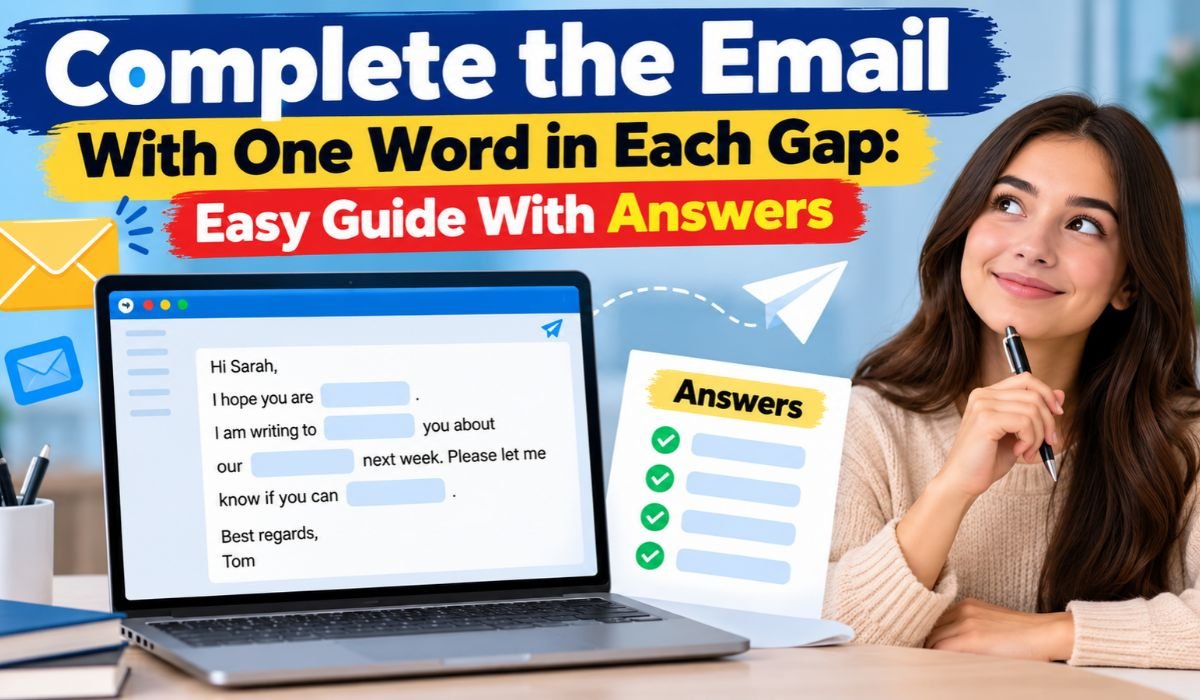
You’ve probably come across an English exercise that asks you to Complete the Email With One Word in Each Gap. At first glance, it seems straightforward. There’s an email with a few missing words, and your job is to fill in the blanks. But once you start, you might realize that choosing the right word isn’t always as easy as it looks.
The challenge isn’t usually about knowing difficult vocabulary. It’s about understanding how English works. A simple preposition, article, or helping verb can change the meaning of an entire sentence. That’s why these exercises are widely used in English classrooms, grammar worksheets, and language-learning materials.
The good news is that you don’t need advanced English skills to improve. Once you understand common grammar patterns and learn to recognize clues within sentences, finding the missing words becomes much easier.
This guide explains everything you need to know about email gap-fill exercises, from basic grammar rules to practical examples with answers. You’ll also learn how to avoid common mistakes, improve your accuracy, and apply these skills to everyday email writing.
Quick Information About Email Gap-Fill Exercises
| Information | Details |
|---|---|
| Exercise Name | Email Gap-Fill |
| Common Instruction | One Word in Each Gap |
| Exercise Format | Open Cloze |
| Main Purpose | Improve Grammar Accuracy |
| Additional Skill | Reading Comprehension |
| Common Word Types | Prepositions and Articles |
| Other Word Types | Pronouns and Auxiliary Verbs |
| Typical Prepositions | For, To, In, With |
| Common Articles | A, An, The |
| Common Pronouns | It, We, They |
| Auxiliary Verbs | Is, Are, Have, Has |
| Modal Verbs | Can, Could, Would |
| Linking Words | If, But, Because |
| Email Formats | Formal and Informal |
| Learning Levels | Beginner to Advanced |
| Main Requirement | Exactly One Word Per Gap |
| Common Difficulty | Choosing Correct Prepositions |
| Exam Connection | Cambridge Open Cloze |
| IELTS Connection | Supporting Grammar Practice |
| Best Learning Method | Practice With Explanations |
What Does Complete the Email With One Word in Each Gap Mean?
The instruction “Complete the Email With One Word in Each Gap” means you must read an email containing blank spaces and fill each blank with exactly one suitable word.
The missing word should make the sentence grammatically correct while preserving its intended meaning.
For example, consider this sentence:
Thank you _____ your message.
The correct answer is for.
That’s because “thank you for” is a common English expression used to show appreciation.
These activities are often called open cloze exercises. Unlike multiple-choice questions, where several answers are provided, open cloze exercises require you to find the correct word independently.
The important thing to remember is that the answer depends on context. A word might seem correct when you look at one part of a sentence, but it may not work when you read the entire message.
Why Are Email Gap-Fill Exercises Important?
There’s more to email gap-fill exercises than simply filling empty spaces. They encourage students to think carefully about grammar, sentence structure, and meaning.
When you choose a missing word, you’re actually using several language skills at once. You need to understand what the writer is saying, recognize the grammatical pattern, and decide which word fits naturally.
Take this example:
I am looking forward _____ hearing from you.
The correct answer is to.
Once you recognize “look forward to” as a fixed expression, you can complete similar sentences without having to guess.
These exercises also strengthen reading comprehension. Instead of focusing on individual words, you begin paying attention to how sentences connect and how meaning develops throughout a message.
That skill is useful well beyond the classroom. Whether you’re emailing a teacher, contacting an employer, or writing to a colleague, accurate grammar helps your message sound clearer and more professional.
Common Types of Words Used in Email Gap-Fill Exercises
Most grammar-focused email completion exercises involve short, familiar words. Although these words may look simple, they’re essential for building correct sentences.
Prepositions are among the most common. Words such as in, on, at, for, to, and with appear in everyday expressions.
For instance, we say “interested in learning,” “responsible for the project,” and “discuss the problem with someone.”
Articles are another important category. In the sentence “I received _____ invitation,” the missing word is an because “invitation” begins with a vowel sound.
Pronouns also appear frequently. Words such as it, we, they, and who help connect ideas without repeating the same nouns.
Auxiliary verbs are equally important because they help establish tense and sentence structure. For example, “She _____ completed her assignment” requires has when expressing the present perfect tense.
Conjunctions such as if, because, although, and but connect different ideas.
Some gap-fill activities also test vocabulary rather than grammar alone. That’s why it’s important to read the instructions and understand what the exercise is designed to assess.
Essential Grammar Rules for Completing Missing Words
A good understanding of basic grammar makes email completion exercises much less intimidating.
One important rule involves subject-verb agreement. In English, the verb must agree with its subject.
For example, “She _____ working today” requires is, while “They _____ working today” requires are.
Verb tenses provide another useful clue. Consider the sentence “I have _____ the documents.” Depending on the meaning, words such as “received” or “reviewed” could complete it correctly.
Articles require careful attention, too. Many learners assume that “a” and “an” depend entirely on the first letter of a word. In reality, pronunciation matters more.
We write “an invitation” because the word begins with a vowel sound. However, we write “a university” because its first sound is a consonant sound.
Conditional sentences also appear in email exercises. For example, “Please contact me _____ you need assistance” naturally takes if.
Once these grammar patterns become familiar, identifying missing words feels more like recognizing a structure than solving a puzzle.
How to Complete the Email With One Word in Each Gap
The most effective way to approach an email gap-fill exercise is to understand the message before trying to complete it.
Start by reading the entire email. Pay attention to who is writing, who will receive the message, and why the email was sent. This gives you a clearer picture of the intended meaning.
Next, examine the words surrounding each blank. Often, the grammar immediately before or after a gap provides the strongest clue.
Consider this sentence:
I look forward _____ hearing from you.
The correct answer is to, because “look forward to” is a fixed expression. The word “to” functions as a preposition here, which explains why the next verb takes the -ing form.
It’s also helpful to complete the easiest gaps first. When you answer familiar questions, the rest of the email often becomes easier to understand.
Once you’ve finished, read the completed message from beginning to end. Check that every sentence sounds natural, the grammar makes sense, and each blank contains exactly one word.
Complete the Email With One Word in Each Gap: Easy Practice
Now that you understand the basic approach, it’s time to try a simple example.
Imagine a student writing to a teacher about an upcoming lesson.
Dear Teacher,
Thank you _____ your message. I am writing _____ ask about tomorrow’s lesson. I would _____ grateful if you could send the homework details. Please let me know _____ there are any changes.
Kind regards,
Emma
The correct answers, in order, are for, to, be, and if.
The first gap requires “for” because the expression is “thank you for.”
The second answer is “to,” which introduces the purpose of writing.
The third gap takes “be,” completing the polite expression “would be grateful.”
Finally, “if” introduces a condition relating to possible changes.
Notice that none of these answers involves difficult vocabulary. The challenge is recognizing familiar grammatical structures and using them correctly.
Formal Email Gap-Fill Exercise With Answers
Formal emails often follow predictable language patterns. They typically include polite requests, professional greetings, and expressions that communicate respect.
Here’s an example involving a business meeting.
Dear Mr. Wilson,
I am writing _____ confirm our meeting scheduled _____ Monday. We would _____ pleased to discuss the project with your team. Please contact us _____ you require additional information.
Kind regards,
Sarah
The intended answers are to, for, be, and if.
“To” introduces the purpose of the email, while “for” connects the scheduled meeting with Monday.
“Be” completes the polite expression “would be pleased,” and “if” introduces a condition.
There’s also an important distinction worth understanding. “Scheduled for Monday” usually means the meeting will take place on Monday. “Scheduled on Monday” can mean the scheduling itself happened that day.
Learning these small differences helps you write more precise professional emails.
Informal Email Gap-Fill Exercise With Answers
Informal emails sound more relaxed because they’re usually written to friends, family members, or people we know well.
They often include contractions, friendly greetings, and everyday expressions.
Consider this example.
Hi Alex,
How _____ you? I hope everything is going well. I’m planning _____ visit my cousins next weekend. Would you like _____ come with me? Let me know _____ you’re free.
See you soon,
Jack
The intended answers are are, to, to, and if.
“Are” completes the familiar greeting “How are you?”
The next two gaps require “to” because the sentences use infinitive verb structures.
The final answer, “if,” introduces a question about Alex’s availability.
However, “when” could also fit the final sentence in a different situation. This highlights why context matters and why some exercises may accept more than one grammatically correct answer.
Intermediate and Advanced Email Gap-Fill Practice
As your English improves, gap-fill exercises begin testing more complicated grammar patterns.
Intermediate activities may involve perfect tenses, relative pronouns, and conditional sentences.
For example:
I have been working here _____ January.
The correct answer is since.
We use “since” to identify the starting point of an action or situation that continues into the present.
Advanced exercises may require a deeper understanding of sentence structure.
Consider:
The report, _____ was submitted yesterday, contains updated information.
The missing word is which, introducing a non-defining relative clause.
Another example is:
Had I _____ about the delay, I would have contacted you earlier.
The correct answer is known.
This sentence uses an inverted third conditional structure. It describes an imagined alternative to something that happened in the past.
At higher levels, success depends less on memorizing individual expressions and more on understanding how grammatical structures work together.
Common Email Phrases and Expressions to Remember
One of the easiest ways to improve your performance is to become familiar with expressions commonly used in emails.
For example, “thank you for” is used to express gratitude, while “I am writing to” introduces the purpose of a message.
In professional communication, expressions such as “I would appreciate it if” and “please let me know” are especially useful.
Other common combinations include “interested in,” “responsible for,” “apologize for,” and “look forward to.”
Consider this sentence:
I apologize _____ the inconvenience.
The correct answer is for.
Rather than memorizing “for” as an isolated word, learn the complete expression “apologize for.”
This approach helps you recognize familiar combinations more quickly and understand when to use them in your own writing.
Common Mistakes Students Should Avoid
Even students with a good understanding of English grammar sometimes make mistakes in gap-fill exercises.
One common problem is choosing the wrong preposition. For example, “interested on” is incorrect when expressing interest in something. The correct phrase is “interested in.”
Articles can also cause confusion. Some learners write “an university” because the word begins with the letter “u.” However, the correct expression is “a university” because the word begins with a consonant sound.
Subject-verb agreement is another frequent challenge.
The sentence “She have completed the task” is incorrect. The correct form is “She has completed the task.”
Students also sometimes write two words when the instructions clearly require one.
Perhaps the most avoidable mistake is failing to review the completed email. Reading the entire message again can reveal errors that weren’t obvious when answering individual gaps.
How to Find the Correct Missing Word Using Context Clues
Context clues are especially helpful when a missing word isn’t immediately obvious.
Instead of focusing only on the blank, consider what the complete sentence is trying to communicate.
For example:
I couldn’t attend the meeting _____ I was sick.
The natural answer is because, since the second part explains the reason for missing the meeting.
Now consider:
Please call me _____ you arrive.
The word “when” fits naturally because it connects the requested action with a particular time.
However, “before” or “after” could also work if the intended meaning were different.
This shows why grammar alone doesn’t always determine the answer. You also need to understand the writer’s intention and the relationship between ideas.
A carefully designed exercise should provide enough context to make the expected answer clear.
Best Tips to Improve Speed and Accuracy
Getting faster at email gap-fill exercises takes practice, but speed shouldn’t come at the expense of accuracy.
Start with shorter exercises that focus on familiar grammar patterns. Once you feel comfortable, move on to longer emails containing more challenging structures.
After each exercise, review your incorrect answers. Don’t simply memorize the correct word. Try to understand why your original choice didn’t work.
Reading well-written English emails can also help. Pay attention to how writers introduce requests, explain situations, and close their messages.
When practicing under time limits, avoid getting stuck on one difficult blank. Complete the gaps you’re confident about, then return to the remaining questions.
Keeping a small record of expressions you frequently get wrong can be useful, too. Over time, you’ll begin recognizing those patterns more naturally.
Which English Exams Include Open Cloze Exercises?
Open cloze exercises are used in several Cambridge English qualifications, although the texts aren’t always presented as emails.
In Cambridge B1 Preliminary, Reading Part 6 includes an open cloze activity with six gaps. Candidates complete each gap using one word, demonstrating their understanding of grammar and common expressions.
Cambridge B2 First includes an open cloze task in Reading and Use of English Part 2. This section contains eight gaps and tests grammatical knowledge, vocabulary relationships, and sentence structure.
Cambridge C1 Advanced also includes open cloze questions, with greater emphasis on complex grammatical patterns and precise language use.
IELTS General Training follows a different approach. Writing Task 1 requires candidates to write a letter of at least 150 words in response to a given situation. It doesn’t use email-based open cloze as a standard writing task.
Still, practicing missing-word exercises can help IELTS learners improve grammatical accuracy and sentence construction.
Because examination formats can change, students should always consult the current official requirements for their chosen test.
How Email Gap-Fill Exercises Improve Everyday Writing
The benefits of gap-fill practice don’t end when you finish an English examination.
These exercises teach you how words work together in real communication. That knowledge becomes useful whenever you write an email, whether it’s a quick personal message or an important professional request.
For example, understanding “I would appreciate it if” helps you make polite requests without sounding demanding.
Similarly, knowing how to use “I look forward to hearing from you” gives you a natural way to close professional correspondence.
Accurate articles, prepositions, and helping verbs also make sentences easier to understand.
As you become more familiar with these patterns, you’ll spend less time questioning every word and more time concentrating on what you want to say.
Final Thoughts
Learning to Complete the Email With One Word in Each Gap is about more than choosing the correct word. It’s an opportunity to understand English grammar more deeply and become a clearer, more confident writer.
The most useful habits are simple: read carefully, pay attention to context, recognize common expressions, and review your answers before finishing.
You don’t need to master every grammar rule overnight. Regular practice with realistic examples will gradually make familiar sentence patterns easier to recognize.
Whether you’re studying for an examination, completing a classroom assignment, or improving your everyday English, these skills can help you communicate more accurately and naturally.
FAQs About Completing the Email With One Word in Each Gap
What Does Complete the Email With One Word in Each Gap Mean?
It means reading an incomplete email and filling every blank with exactly one suitable word. Each answer must follow English grammar rules and fit the meaning of the sentence. These exercises commonly test prepositions, articles, pronouns, helping verbs, and linking words.
How Can I Identify the Correct Missing Word?
Start by reading the complete sentence and examining the words around the gap. Look for familiar expressions, grammatical patterns, and clues about the writer’s intended meaning. If the answer isn’t obvious, read the surrounding sentences before making your choice.
What Words Commonly Appear in Email Gap-Fill Exercises?
Prepositions such as “for,” “to,” and “with” are common, along with articles, pronouns, conjunctions, and auxiliary verbs. Some exercises also test vocabulary. The missing words depend on the difficulty level and the grammatical skills being assessed.
Can More Than One Answer Be Correct?
Yes. Some sentences allow more than one grammatically acceptable word, especially when the surrounding context is limited. Well-designed exercises aim to make the intended answer clear, while formal examinations may accept alternatives specified in their marking schemes.
Can I Write Two Words in One Gap?
No. If the instructions say to use one word, you must follow that limit. Writing two separate words may make an otherwise correct answer unacceptable. Rules concerning contractions can vary, so check the instructions for your particular examination or worksheet.
Are Email Gap-Fill Exercises Useful for Cambridge Exams?
Yes. They provide useful practice for grammatical structures tested in Cambridge open cloze tasks. However, Cambridge examinations may use articles, reports, or other passages rather than emails. Practicing different text types will give you broader preparation.
How Often Should I Practice Email Completion Exercises?
Regular practice is generally more effective than studying only occasionally. Short sessions can help you develop familiarity with grammar patterns without becoming overwhelmed. Reviewing mistakes and understanding the correct answers is more valuable than simply completing large numbers of questions.
What Is the Best Way to Improve English Email Writing?
Combine grammar exercises with practical writing experience. Read examples of well-written emails, learn common expressions, and practice writing messages for everyday situations. Pay attention to grammar, clarity, and tone, then review your work to identify areas for improvement.
Learn more and explore exciting content on: Peitner Explained: Features, Benefits, and Future of AI Gaming














Leave a Reply