
A brand name seems like one of the simplest pieces of information a business can store. But once thousands—or millions—of records begin moving between product catalogs, supplier feeds, marketplaces, customer forms, spreadsheets, analytics platforms, and internal databases, even a small naming difference can create a surprisingly large data problem.
The same brand might appear with different capitalization, punctuation, spacing, abbreviations, spelling errors, or legal company suffixes. One database may recognize those variations as belonging to the same brand, while another may treat each one as a separate entity. The result can be duplicate records, fragmented reports, inconsistent product listings, and unnecessary manual cleanup.
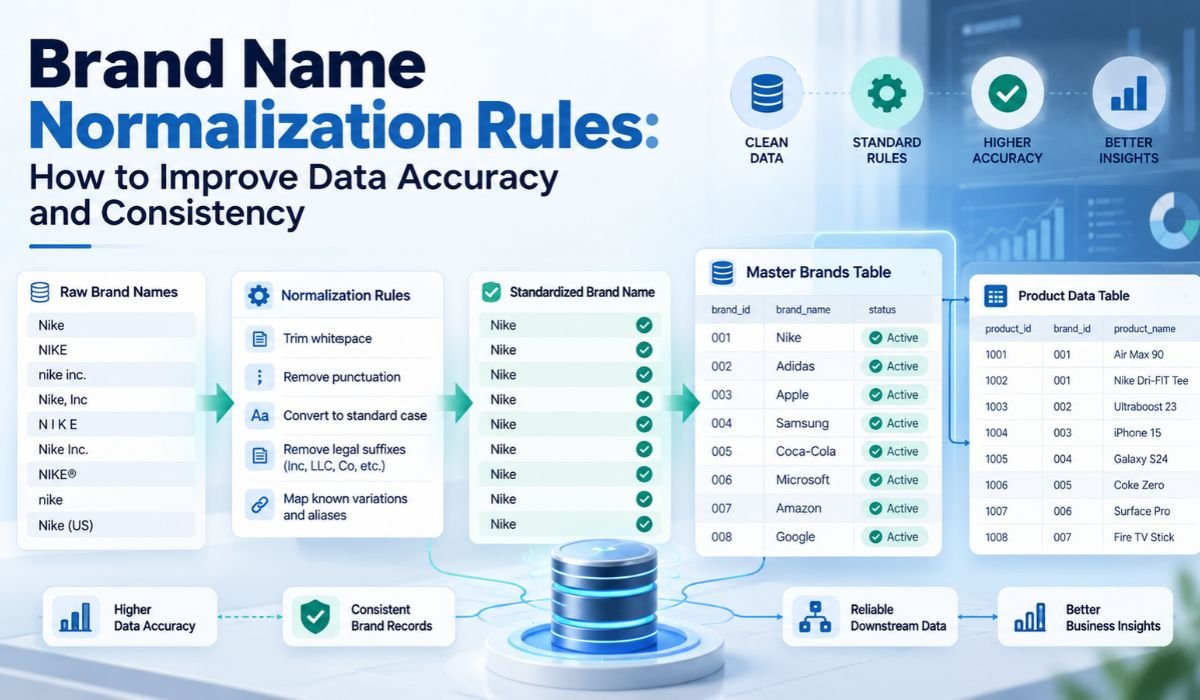
This is where Brand Name Normalization Rules become useful. They provide a controlled way to clean, compare, match, and organize brand-name data. The goal isn’t to force every name into an identical-looking format. Instead, good normalization determines when different values refer to the same real-world brand while preserving meaningful differences between genuinely separate entities.
That distinction has become especially important in 2026. Businesses increasingly depend on automated data pipelines, AI-assisted search, machine learning, large digital catalogs, and real-time analytics. Those systems can process information quickly, but their results are only as dependable as the data they receive. Consistent brand information provides a stronger foundation.
What Are Brand Name Normalization Rules?
Brand Name Normalization Rules are predefined instructions that help organizations manage variations in brand-name data. They make names easier to compare and, when appropriate, connect different versions of a name to the same verified brand identity.
Imagine a dataset containing “Example Brand,” “EXAMPLE BRAND,” “ExampleBrand,” and “Example Brand Inc.” Some or all of these entries may describe the same organization, depending on where the information came from and what the database is designed to represent. Normalization prepares these values for comparison and can associate verified variations with an approved brand record.
A well-designed system doesn’t necessarily erase or overwrite the original value. In fact, preserving the raw input is often the safer approach. The database can retain what a supplier, customer, or employee originally entered while storing a normalized name and stable brand identifier in separate fields.
That separation offers the best of both worlds. Teams get consistent data for analysis and search while retaining the original information for auditing, troubleshooting, and future review.
Quick Bio Information
| Information | Details |
|---|---|
| Main Topic | Brand Name Normalization Rules |
| Primary Goal | Improve Brand Data Accuracy |
| Core Process | Cleaning, Matching, And Mapping |
| Main Problem | Inconsistent Brand Names |
| Canonical Record | Approved Brand Identity |
| Raw Value | Original Source Name |
| Exact Matching | Identifies Equivalent Prepared Values |
| Alias Mapping | Connects Verified Name Variations |
| Fuzzy Matching | Finds Potential Similar Names |
| Case Handling | Manages Capitalization Differences |
| Whitespace Cleaning | Removes Unwanted Spacing |
| Character Normalization | Handles Equivalent Text Representations |
| Stable Brand ID | Identifies A Brand Beyond Display Text |
| Human Review | Resolves Uncertain Matches |
| Master Brand List | Stores Controlled Brand Records |
| Key Benefit | More Consistent Data |
| Major Risk | Incorrect Brand Merging |
| Important Safeguard | Preserve Original Data |
| Long-Term Need | Monitoring And Rule Maintenance |
Why Brand Name Consistency Matters
Inconsistent brand names don’t just make a database look untidy. They can influence how information is grouped, searched, analyzed, and ultimately understood.
Consider a retailer that records sales for the same brand under several slightly different names. If its reporting software doesn’t recognize those variations as one entity, revenue may be split across multiple records. A manager reviewing the dashboard could then receive an incomplete picture of the brand’s actual performance.
The problem can spread beyond sales reports. Product filters may show duplicate brands. Inventory analysis can become fragmented. Supplier reports may contain unnecessary duplicates, while advertising dashboards and internal search systems may struggle to connect related information.
Improving Brand Name Consistency gives these systems cleaner information to work with. Still, normalization shouldn’t be treated as a cure for every data-quality issue. Incorrect prices, missing identifiers, outdated product details, and inaccurate source records need their own controls. Brand normalization is most effective when it forms part of a broader data-quality strategy.
What Causes Inconsistent Brand Names?
Brand-name variations can enter a database from almost anywhere.
An employee may type a name manually. A customer might make a spelling mistake. A supplier may follow its own naming convention, while a marketplace could format the same company differently. Legacy databases often contain older names, and imported spreadsheets can introduce unwanted spaces, punctuation changes, or character differences.
There is also a more complicated issue: a brand isn’t necessarily the same thing as the company that owns it.
A parent organization may control several consumer brands, each with its own identity. Combining all of them into the parent company’s record might make sense for one type of corporate analysis but would be incorrect for a consumer product catalog.
Legal company names create similar challenges. A registered business name and the name customers see on products may be closely related, yet they aren’t always interchangeable.
International data adds another layer. Different languages, writing systems, transliterations, and character representations can produce variations that aren’t obvious at first glance.
Before introducing Brand Name Normalization Rules, businesses need to understand why these variations exist and, just as importantly, what each field in the database is supposed to represent.
How Brand Name Normalization Works
A dependable normalization workflow begins with the original source value rather than immediately replacing it.
The first stage usually involves safe preparation. A system might remove accidental whitespace around a name or ensure that text is represented consistently. The prepared value can then be compared with a controlled directory of known brands.
Straightforward exact matches and previously verified aliases can often be handled with high confidence. Less obvious cases require more care. The system might evaluate additional information, calculate similarity, or compare contextual signals before suggesting a possible match.
If there isn’t enough evidence, the safest response may be to leave the record unresolved and send it for review. Forcing an uncertain value into the closest available brand can create a much harder problem later.
Once the identity has been confirmed, the record can be linked to a stable brand ID. This is useful because names aren’t permanent. Companies change their styling, update branding, merge, or reorganize. A stable identifier allows the underlying identity to remain consistent even when the displayed name changes.
Keeping the original input alongside the normalized record also creates an audit trail. If a mistake is discovered later, teams can see what entered the system and how the final match was produced.
Common Brand Name Normalization Rules
Some normalization rules are relatively straightforward, while others require considerable caution.
Case handling is a good example of a simple rule. A matching system may treat uppercase and lowercase versions of a name as equivalent where appropriate. That doesn’t mean the official brand styling should be changed. The comparison value and the display value can serve different purposes.
Whitespace is another common issue. Accidental spaces at the beginning or end of a name, or repeated spaces between words, can often be cleaned without changing the identity.
Punctuation is more complicated. Hyphens, periods, apostrophes, and ampersands sometimes represent harmless formatting differences, but they can also be meaningful parts of a brand name. A rule that strips every special character may therefore create incorrect matches.
Known spelling errors can be managed through verified mappings. Rather than assuming every similar-looking word is a typo, the organization can record confirmed misspellings as aliases of the correct brand.
Legal suffixes such as Inc., LLC, Ltd., and Corp. also need context. Ignoring them may help in some matching tasks, but deleting them universally can erase distinctions that matter in legal or corporate datasets.
International data introduces Unicode Normalization as well. Text that appears identical on screen can sometimes be represented by different underlying character sequences. Unicode normalization provides standard ways to make equivalent representations more consistent. Compatibility transformations, however, deserve extra caution because they can remove distinctions that may be meaningful in a brand name.
Practical Brand Name Normalization Examples
Real examples show why normalization requires more judgment than simple find-and-replace rules.
Suppose one record stores a brand in uppercase while another uses its normal display capitalization. A case-insensitive comparison may determine that the values are equivalent, while the customer-facing system continues to show the brand’s preferred styling.
Accidental spaces are similarly straightforward. Leading and trailing whitespace can usually be removed before comparison without altering the intended identity.
Misspellings are less predictable. A name that differs from a known brand by a single letter might be a typing error. It could also belong to an entirely separate company. Automatically changing it simply because the strings are similar would be risky.
Abbreviations present the same challenge. A few initials may clearly refer to one company within a specific dataset but represent something completely different in another industry or country.
That’s why reliable Brand Name Matching asks more than whether two strings look alike. The real question is whether there is enough evidence to conclude that both records refer to the same entity.
Normalization And Standardization
Brand name normalization and brand name standardization are closely related, and the terms are sometimes used interchangeably. Still, there can be a useful distinction between them.
Normalization generally focuses on preparing different representations so equivalent values can be compared more reliably. Standardization often goes a step further by determining which approved representation should be used across a particular dataset or system.
For instance, normalization may allow uppercase and lowercase versions of a name to match. Standardization may then determine which official spelling appears in the product catalog.
There isn’t one universal vocabulary used by every database, software vendor, or organization. Businesses should therefore document what these terms mean within their own systems. Clear definitions prevent one team from interpreting “normalization” differently from another.
Creating Effective Normalization Rules
The strongest normalization rules usually come from examining actual data rather than imagining every variation that might occur.
Teams can begin by reviewing existing records and identifying recurring patterns. They may find predictable capitalization differences, common misspellings, historical brand names, abbreviations, legal suffixes, or aliases that appear repeatedly.
From there, each transformation can be classified according to risk. Some changes, such as trimming accidental whitespace, are relatively safe. Others, particularly those that merge separate records, require stronger evidence.
Testing is essential. A rule that works correctly for most records can still cause significant damage if it incorrectly combines unrelated brands. Before a new rule is applied widely, teams should test it against representative data and review unexpected results.
It’s also important to accept uncertainty. A database doesn’t become more accurate simply because every record has been assigned somewhere. In many cases, leaving an uncertain name unmatched until it can be verified is the more trustworthy decision.
Building A Master Brand List
A well-maintained Master Brand List gives the normalization process a reliable reference point.
Instead of containing only a name, each master record can include a canonical display name, stable internal identifier, known aliases, current status, and relevant organizational relationships. Additional fields may help distinguish brands that happen to have similar names.
The stable ID is particularly useful because a displayed name is ultimately just text, and text changes. A brand may update its capitalization, shorten its name, or undergo a broader rebranding. If the underlying ID remains stable, connected systems can preserve continuity without treating every naming change as a new entity.
The master list should also distinguish ownership from brand identity where necessary. A parent company, subsidiary, and consumer brand can be related without being interchangeable.
Most importantly, this directory can’t be treated as a one-time project. Companies merge, brands change ownership, aliases evolve, and new businesses enter the market. A master brand list is living reference data and needs ongoing governance.
Exact Matching, Alias Mapping, And Fuzzy Matching
Different matching methods are useful at different stages of the process.
Exact Matching is usually the safest starting point. Once approved preprocessing has been performed, identical values can often be connected with relatively little ambiguity.
Alias Mapping handles variations that have already been verified. If an alternative spelling, former name, or abbreviation is known to belong to a particular brand, that relationship can be recorded and reused.
Fuzzy Matching tackles less obvious cases by measuring how similar two strings are. It can uncover potential spelling mistakes and previously unknown variations that exact matching would miss.
The trade-off is uncertainty.
A high similarity score isn’t proof that two businesses are the same. Separate brands can have names that differ by only one character. Meanwhile, a widely used abbreviation may look nothing like the company’s full name.
For stronger decisions, similarity can be combined with contextual evidence when available. Product category, manufacturer information, geographic market, data source, or verified identifiers can all provide additional clues.
Manual And Automated Brand Normalization
Manual normalization gives people close control over individual decisions. That makes it practical for smaller datasets and useful for difficult cases where context matters.
Its limitation is scale. Reviewing hundreds of thousands of records manually is slow, expensive, and difficult to perform consistently.
Automation solves part of that problem. Rules can process large amounts of data quickly and apply the same logic repeatedly. But automation magnifies mistakes just as efficiently as it processes correct matches. One overly broad rule can affect thousands of records before anyone notices.
For many organizations, a hybrid approach offers a better balance. High-confidence matches can move through the system automatically, while uncertain cases enter a review queue.
Those human decisions can then improve the system. A newly verified variation may become an approved alias, making future occurrences easier to process.
The aim shouldn’t be to automate everything. It should be to automate routine decisions while preserving appropriate oversight where uncertainty remains.
AI And Machine Learning For Brand Matching
AI and machine learning can make Automated Brand Normalization more capable when traditional rules and basic string comparisons aren’t enough.
Depending on the information available, a system may consider product descriptions, historical matching decisions, manufacturer information, categories, language patterns, and other contextual data when ranking possible brand identities.
This can be especially useful in large catalogs where new variations appear continuously.
Even so, an AI-generated match is still a prediction rather than unquestionable proof. Similar company names, new brands, acquisitions, regional businesses, and changing ownership structures can create ambiguous situations.
Confidence should therefore influence what happens next. A high-confidence match in a low-risk workflow might be processed automatically. An uncertain match—or one with significant consequences—may be better suited to human verification.
Auditability matters as well. When an important decision affects analytics or product data, teams should be able to investigate how that result was reached.
Brand Normalization For E-Commerce
Few environments illustrate the value of normalization better than e-commerce.
A retailer may receive product data from manufacturers, distributors, independent sellers, marketplaces, and old internal systems. Each source may represent the same brand differently.
Without effective Brand Data Management, shoppers can end up seeing duplicate brand filters, inconsistent product pages, confusing catalog groupings, or incomplete search results. Internally, those same inconsistencies can complicate inventory analysis and sales reporting.
Normalization helps products associated with a verified brand connect to the appropriate record. This can support cleaner catalog navigation, more dependable filters, consistent brand pages, and better-organized product information.
There is also an important SEO distinction. Brand normalization shouldn’t be described as a direct shortcut to higher search rankings. Its value is more fundamental: cleaner and more consistent product information makes a website easier to maintain and can support a clearer information architecture. SEO performance still depends on many other factors.
A Safer Normalization Workflow
One of the most practical ways to reduce errors is to divide normalization into stages instead of applying every transformation at once.
The original source value comes first and should be preserved. Safe preprocessing can then prepare the text for comparison. After that, the system can look for exact matches and verified aliases.
Only unresolved records need to move into less certain methods such as fuzzy matching or AI-assisted suggestions.
High-confidence results can be accepted according to established policies. Borderline cases can move to human review. The system should also record which rule, alias, model, or manual decision produced the final match.
This staged approach makes troubleshooting far easier. If a bad match appears later, teams can determine whether it originated in the raw data, preprocessing, alias mapping, similarity logic, or human review.
That visibility turns normalization from a hidden text-cleaning process into a manageable data-quality workflow.
Common Normalization Mistakes
One of the easiest mistakes to make is over-normalization.
Removing every space, punctuation mark, legal suffix, and character distinction may produce neat-looking text, but neat data isn’t necessarily accurate data. Important distinctions can disappear along the way.
Another common error is treating corporate ownership and brand identity as the same thing. A parent company may own several brands, but merging all of them into one brand record can damage product-level analysis.
Permanently replacing original source values is risky too. Without the raw input, investigating an incorrect match becomes more difficult.
Overly permissive fuzzy matching can create false positives, while thresholds that are too strict can leave genuine variations disconnected. Multilingual text can also create problems when character handling is poorly designed.
Finally, alias tables need maintenance. A mapping that was correct several years ago may no longer reflect current branding or corporate relationships.
The objective of Brand Name Consistency isn’t to make every record look perfect. It’s to make the underlying identities dependable.
Measuring Brand Name Normalization Accuracy
A normalization system shouldn’t be judged simply by how many records it processes automatically.
A better evaluation looks at the quality of those decisions.
Teams can monitor unmatched records, duplicate identities, manual-review volume, rejected automatic matches, and confirmed errors. Regularly sampling automatically matched records can uncover issues that broad statistics might otherwise hide.
False positives and false negatives deserve particular attention.
A false positive occurs when two separate brands are incorrectly merged. A false negative happens when two records representing the same brand remain disconnected.
Those errors don’t always carry equal consequences. In many systems, incorrectly combining separate businesses can be more damaging than temporarily leaving an uncertain record unmatched.
That means the right balance depends on the use case. A product catalog, financial database, supplier directory, and marketing analytics system may each require different confidence thresholds.
Best Practices For Consistent Brand Data
Reliable Brand Name Normalization Rules depend on more than a clever matching algorithm.
Organizations need trustworthy reference data, stable brand identifiers, clearly documented transformations, verified alias mappings, sensible confidence thresholds, and a defined process for exceptions.
Raw values should be retained whenever practical. New rules should be tested before broad deployment, particularly when they can merge existing records. Automated decisions should be monitored rather than assumed to remain correct forever.
Unmatched values also deserve attention. They aren’t necessarily failures. An unmatched record may represent a newly launched brand, an unfamiliar alias, changing market information, or a gap in the current rules.
Periodic review helps normalization systems evolve alongside the real world. Brands are renamed, acquired, discontinued, repositioned, and introduced constantly. Data rules have to keep pace.
Seen this way, normalization isn’t a one-off cleanup job. It’s an ongoing part of responsible data governance.
Final Thoughts
At first glance, Brand Name Normalization Rules may seem like little more than instructions for fixing capitalization, spaces, and spelling. In practice, the challenge goes much deeper.
The real task is identity.
Two names that look different may represent the same brand. Two names that look almost identical may belong to completely separate businesses. Reliable normalization has to tell the difference without destroying useful source information along the way.
That’s why the strongest approach combines several layers: preserved raw data, verified canonical records, stable identifiers, carefully tested rules, contextual matching, sensible automation, human review, and ongoing measurement.
AI and machine learning can make this work faster and help organizations deal with increasingly large datasets in 2026. They don’t, however, remove the need for thoughtful data governance. An automated match is only valuable when it can be trusted.
The best normalization system isn’t the one that forces every record into a category or achieves the highest automatic match rate. It’s the one that handles obvious cases efficiently, recognizes uncertainty when it appears, and gives people a clear way to investigate important decisions.
When that foundation is in place, businesses gain more than cleaner brand names. They gain more dependable product catalogs, stronger analytics, clearer reporting, and data that both people and automated systems can use with greater confidence.
FAQs About Brand Name Normalization Rules
What Are Brand Name Normalization Rules?
Brand Name Normalization Rules are controlled procedures for preparing, comparing, and mapping different representations of brand names. They help a system recognize verified variations while maintaining a consistent identity for each brand.
Why Is Brand Name Normalization Important?
It reduces unnecessary fragmentation across product, sales, supplier, customer, and analytics data. When the same brand is represented consistently, information becomes easier to group, search, analyze, report, and maintain.
What Is A Canonical Brand Name?
A canonical brand name is the approved representation associated with a controlled brand record. Known aliases, alternative spellings, and other verified variations can be connected to that record without necessarily deleting the original source values.
Can Brand Name Normalization Be Automated?
Yes. Exact matching, alias mappings, transformation rules, fuzzy matching, and AI-assisted systems can automate much of the process. However, ambiguous or high-risk matches may still require human verification.
What Is Fuzzy Brand Name Matching?
Fuzzy matching compares text according to similarity rather than requiring two values to be identical. It’s useful for finding potential misspellings and unknown variations, but similarity alone doesn’t prove that two names represent the same brand.
Should Original Brand Data Be Preserved?
Preserving original values is generally useful because it supports auditing, troubleshooting, and future improvements to normalization rules. The normalized identity can be stored separately from the raw source data.
Is Unicode Normalization Important For Brand Names?
It can be, particularly when information comes from multilingual or technically diverse systems. Unicode normalization can make canonically equivalent character sequences consistent for comparison. Compatibility transformations require more caution because they can remove distinctions that may be meaningful.
How Often Should Normalization Rules Be Reviewed?
There isn’t a universal schedule. Review frequency should depend on how quickly the dataset changes, how much new information arrives, and how costly matching errors would be. Large, frequently updated catalogs generally require closer monitoring than small, stable datasets.
Learn more and explore exciting content on: Startup Booted Fundraising Strategy Explained: Benefits, Risks, and Tips













Leave a Reply