
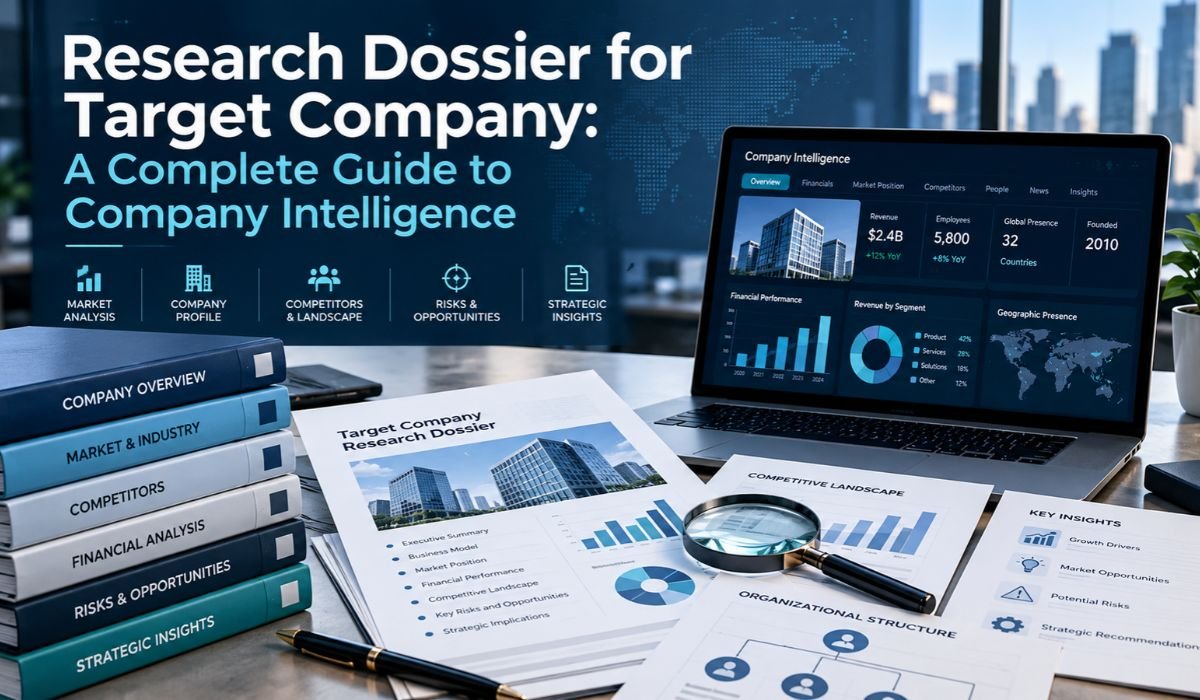
Important business decisions are rarely improved by knowing less about the company involved. Whether the decision concerns an investment, acquisition, strategic partnership, supplier relationship, or competitive move, reliable company intelligence can help decision-makers look beyond polished presentations and promotional claims.
That is where a Research Dossier for Target Company becomes useful. It brings relevant information about a business into one structured, evidence-based report. Instead of merely explaining what a company sells, a well-prepared dossier looks deeper. It considers how the business operates, who owns and controls it, how its finances are developing, where it sits within its industry, who leads it, and which risks or opportunities deserve further attention.
Finding information is only part of the job. Companies now leave substantial digital footprints across corporate registries, regulatory filings, financial disclosures, intellectual-property records, official announcements, and news coverage. The real challenge is working out which information is current, credible, relevant, and independently supported.
A dependable research dossier does more than gather facts in one place. It tests important claims, puts evidence into context, highlights unanswered questions, and clearly separates confirmed information from interpretation. Done properly, it becomes a practical decision-making tool rather than simply a collection of company data.
Quick Research Information
| Research Area | What It Examines |
|---|---|
| Research Type | Company Intelligence And Business Analysis |
| Main Subject | Target Company |
| Primary Goal | Better-Informed Business Decisions |
| Company Identity | Legal And Trading Information |
| Ownership | Shareholders And Corporate Relationships |
| Business Model | How The Company Creates Revenue |
| Financial Position | Revenue, Profitability, Cash Flow And Debt |
| Market Research | Industry Conditions And Customer Demand |
| Competition | Direct, Indirect And Substitute Competitors |
| Leadership | Executives And Board Members |
| Operations | Products, Customers, Suppliers And Processes |
| Legal Review | Litigation And Potential Legal Exposure |
| Compliance | Regulatory Requirements And Licenses |
| Technology | Platforms, Systems And Technical Capabilities |
| Intellectual Property | Patents, Trademarks And Relevant Rights |
| Reputation | Credible Media And Public Information |
| Risk Analysis | Financial, Operational And Strategic Risks |
| Opportunity Analysis | Potential Growth And Strategic Advantages |
| Research Standard | Evidence-Based And Verifiable |
| Final Output | Structured Company Intelligence Report |
What Is A Research Dossier For Target Company?
A Research Dossier for Target Company is an organized body of research and analysis concerning a particular business. In this context, the target company is simply the organization being studied. It might be a possible acquisition, an investment opportunity, a supplier, a strategic partner, a customer, or even a competitor.
The difference between a dossier and a basic company overview lies largely in depth. A simple profile may tell readers when a business was founded, where it operates, and what it sells. A research dossier asks more demanding questions. How does the company make money? Who controls it? Is its financial position stable? What does its competitive environment look like? Are there material legal, regulatory, technological, or operational concerns?
The scope should always reflect the purpose of the research. A preliminary competitor assessment might remain relatively broad. Research supporting a major acquisition could be far more extensive and may eventually require specialist financial, legal, tax, operational, cybersecurity, or technical due diligence.
That distinction matters. Not every research project needs the same level of investigation, and collecting information simply because it is available can make a dossier longer without making it more useful.
Why Target Company Research Matters
Businesses naturally present themselves in the best possible light. Corporate websites, advertisements, presentations, investor materials, and press announcements can all provide useful information, but they represent the company’s own perspective.
Independent target company research adds another layer. It allows important statements to be compared with regulatory records, financial information, market evidence, credible reporting, and other relevant sources.
The questions will differ depending on who is conducting the research. An investor may want to know whether strong revenue growth is accompanied by improving profitability and cash generation. An acquisition team could be more concerned about ownership, liabilities, customer concentration, intellectual property, litigation, or operational dependencies. A potential business partner may place greater emphasis on financial stability, reputation, leadership, and strategic fit.
Good company intelligence isn’t supposed to begin with a verdict and search for evidence to support it. Its purpose is to establish what is known, identify what looks promising, highlight areas of concern, and make unanswered questions visible.
Company Overview And Business Background
Every strong research project starts with something surprisingly basic: making sure the right company is being investigated.
That isn’t always as straightforward as it sounds. Businesses can operate through several legal entities, subsidiaries, brands, and trading names. Similar company names can also create confusion, particularly when researchers are working across different states, countries, or industries.
The dossier should therefore establish the correct legal identity, relevant trading names, headquarters, significant operating locations, industry, core products or services, geographic presence, and business model. Parent companies and important subsidiaries should also be identified when they matter to the research.
Once the identity is clear, the next question is how the business actually earns money. One company might depend mainly on subscriptions, while another relies on product sales, advertising, licensing, transaction fees, professional services, manufacturing, or a mixture of revenue streams.
That information provides the foundation for everything that follows. Financial performance is much easier to interpret once the underlying business model is understood.
Ownership And Corporate Structure
Ownership research helps answer two closely related questions: who controls the company, and how is the wider corporate organization structured?
Depending on the jurisdiction and what information is legally available, researchers may examine shareholders, parent companies, subsidiaries, directors, major investors, affiliated entities, and beneficial ownership information.
Private businesses can require additional care because their ownership structures and financial information may be less visible than those of publicly listed companies. Even where records exist, they may not provide a complete picture.
A complicated corporate structure shouldn’t automatically be treated as suspicious. Large and international businesses routinely establish separate entities for operational, geographic, financing, regulatory, tax, or other legitimate reasons. What matters is understanding those relationships well enough to see where control sits and where significant dependencies may exist.
When ownership can’t be established confidently, the dossier should say so. An acknowledged information gap is far more useful than an assumption presented as fact.
Business Model And Operations
A company can have an impressive product and still have a fragile operating model. That is why target company research needs to move beyond the question of what the business sells.
Operational analysis looks at how the organization functions from day to day. Researchers may examine how products or services reach customers, where revenue comes from, which customer groups matter most, and what resources the company needs to keep operating. Depending on the business, this could involve manufacturing facilities, software platforms, suppliers, distributors, sales channels, geographic operations, logistics networks, and strategic partners.
Dependencies deserve particular attention. A company that relies heavily on one customer may face a significant revenue shock if that relationship ends. Similar concerns can arise when a business depends on a single supplier, marketplace, cloud provider, manufacturer, distributor, or technology platform.
Those dependencies aren’t automatically weaknesses. Some relationships may be long-standing and highly stable. The researcher’s task is to understand their importance and the potential consequences if circumstances change.
A strong Research Dossier for Target Company therefore looks beyond growth and asks whether the operating model appears resilient enough to support the company’s wider strategy.
Financial Performance And Health
Financial information can reveal a great deal about a company, but isolated numbers rarely tell the full story.
Where reliable data is available, researchers can examine revenue growth, gross profit, operating income, net income, cash flow, assets, liabilities, debt, liquidity, financing activity, and capital requirements. Looking at trends over several reporting periods is often more informative than focusing on a single year.
Profit and cash flow also need to be distinguished. A company can report accounting profits without generating the same amount of operating cash. Conversely, a growing business may deliberately invest heavily today in the expectation of producing stronger returns later.
Debt requires similar context. A large debt balance isn’t automatically dangerous, just as a small balance isn’t automatically safe. Researchers should consider the company’s cash generation, earnings, repayment obligations, liquidity, and overall financial position.
For U.S. public companies, regulatory filings can provide particularly useful primary-source evidence. The SEC’s EDGAR system gives public access to corporate filings containing financial statements, business descriptions, risk disclosures, ownership information, and other material details. Comparable reporting systems and corporate records may be available in other jurisdictions.
Private-company research can be harder because detailed financial information may not be publicly disclosed. When dependable figures aren’t available, the dossier should make that limitation explicit rather than presenting unsupported estimates as established facts.
Market And Industry Analysis
Even a detailed examination of a company’s internal performance can be misleading if the wider market is ignored.
Industry research provides that missing context. It can examine market direction, customer demand, important segments, technological developments, economic conditions, regulatory changes, barriers to entry, and shifts in customer behavior.
This helps researchers answer an important question: is the company succeeding because of something distinctive about the business, or is it simply benefiting from a favorable market?
Suppose a company reports rapid growth while its entire industry is expanding at a similar pace. That performance may be healthy, but it doesn’t necessarily indicate that the company is gaining market share. On the other hand, a business maintaining stable revenue in a sharply declining market may be performing better competitively than its headline numbers initially suggest.
Depending on the sector, modern company intelligence may also need to consider artificial intelligence adoption, automation, cybersecurity requirements, data governance, supply-chain resilience, and regulatory change. These factors shouldn’t be added simply because they are fashionable topics; they matter when they materially affect the company or industry being researched.
Competitive Landscape And Market Position
A target company makes more sense when viewed alongside the alternatives available to its customers.
Competitive research should therefore go beyond producing a list of businesses operating in the same industry. Direct competitors may sell similar products, while indirect competitors may solve the same customer problem in a different way. Substitute products and services can also limit demand even when they don’t look like traditional competitors.
Useful comparisons might examine pricing, product capabilities, customer groups, geographic coverage, technology, service quality, distribution, brand positioning, and switching barriers.
Claims about competitive advantage deserve especially careful treatment. Companies often describe their technology, data, intellectual property, brand, network, expertise, or customer relationships as unique strengths. Some of those claims may be well supported; others may be largely promotional.
The more useful question is whether the advantage can be demonstrated and how difficult it would be for a competitor to reproduce. A genuine competitive advantage tends to matter because it affects customer choice, economics, market access, or the company’s ability to defend its position over time.
Management And Leadership Research
Numbers explain part of a company’s story. Leadership helps explain how strategy becomes action.
Research may examine the chief executive, senior managers, board members, professional backgrounds, industry experience, previous positions, leadership changes, and documented strategic statements. The aim isn’t to produce biographies of every executive. It is to understand whether the people responsible for major decisions appear to have experience relevant to the company’s challenges.
Patterns are often more meaningful than individual events. One executive departure may be routine. Several unexpected departures from important leadership roles over a short period could justify additional research, although that pattern alone still wouldn’t prove that something is wrong.
This is also an area where researchers need discipline. Professional histories and potential conflicts of interest should be assessed using credible evidence. Rumor, personal speculation, and irrelevant private information don’t improve company intelligence.
Ultimately, leadership analysis should remain tied to the business question: does management appear equipped to execute the strategy and manage the risks the company faces?
Legal Regulatory And Compliance Research
Legal and regulatory findings can materially change the way a target company is understood, particularly in highly regulated industries.
Depending on the company, jurisdiction, and purpose of the research, a dossier may examine corporate filings, required licenses, regulatory actions, publicly accessible litigation, insolvency proceedings, restructuring records, intellectual-property disputes, and other relevant compliance matters.
Accuracy of language is crucial here.
A lawsuit doesn’t establish that a company is liable. An investigation doesn’t prove misconduct. An allegation isn’t the same as a verified finding, and a regulatory inquiry shouldn’t be described as though an enforcement decision has already been reached.
Those distinctions may appear small, but they are fundamental to trustworthy research. The dossier should describe what has actually happened, explain the current status when known, and avoid drawing conclusions that the evidence doesn’t support.
Where the issue is significant enough to affect an investment, acquisition, or other major decision, specialist legal advice may be required.
Technology And Intellectual Property
Technology increasingly affects companies far beyond the traditional software sector. Retailers, manufacturers, financial businesses, healthcare organizations, logistics companies, and professional services firms can all depend heavily on digital infrastructure.
A research dossier may therefore examine proprietary software, technical platforms, patents, trademarks, research and development, product innovation, technology partnerships, data infrastructure, and cybersecurity considerations.
Intellectual property numbers need context. A large patent portfolio doesn’t automatically mean that a company owns commercially valuable technology. Similarly, holding trademarks doesn’t by itself establish a strong brand.
Researchers should instead ask how technology and intellectual property contribute to the actual business. Do they support revenue? Lower operating costs? Improve customer retention? Create meaningful differentiation? Make competitors’ entry more difficult?
If proprietary technology represents a substantial part of a company’s value, general public-source research may only be the beginning. Specialist technical, cybersecurity, or intellectual-property due diligence may be necessary before a major transaction.
Customers Suppliers And Strategic Partnerships
Companies operate within networks of commercial relationships, and those relationships can be both valuable assets and potential vulnerabilities.
Long-term customers may support predictable revenue. Reliable suppliers can strengthen operations. Distribution partners may provide access to markets the company couldn’t reach efficiently on its own, while technology or strategic partnerships can expand product capabilities.
Concentration changes the risk picture. A business that receives a substantial portion of its revenue from a small number of customers may be more vulnerable if one leaves. The same principle applies when critical materials, software, manufacturing, logistics, or distribution depend on a limited number of providers.
Partnership announcements should also be read carefully. An official announcement may confirm that two organizations have entered a relationship, but it doesn’t necessarily reveal the relationship’s financial value, duration, exclusivity, or strategic importance.
The dossier should distinguish between the existence of a partnership and assumptions about what that partnership means commercially.
Reputation Media And Public Information
Financial reports and corporate records can tell researchers a great deal, but they don’t capture every important development.
Credible media coverage may reveal acquisitions, product recalls, executive departures, operational disruptions, customer problems, regulatory developments, partnerships, industry recognition, and other events that affect how a company is viewed.
The difficulty is separating useful reporting from noise.
Researchers should consider who originally published a claim, when it appeared, what evidence supports it, whether the information has subsequently changed, and whether an authoritative primary source can confirm the underlying facts.
Social-media posts and customer reviews can sometimes identify recurring complaints or emerging issues worth investigating. They shouldn’t automatically be treated as proof of company-wide conditions, however. A handful of highly visible comments may not represent the experience of a broader customer base.
A sensible evidence hierarchy prevents repeated online claims from being mistaken for independently verified facts.
Risk Opportunity And SWOT Analysis
Once the main research is complete, a SWOT analysis can help organize the findings into strengths, weaknesses, opportunities, and threats.
Potential strengths might include healthy cash generation, experienced leadership, valuable technology, strong distribution, or durable customer relationships. Weaknesses could include high leverage, limited geographic reach, weak profitability, operational dependencies, or customer concentration.
Opportunities might emerge from expanding markets, new products, geographic expansion, strategic partnerships, or technological change. Threats could come from regulation, stronger competition, cybersecurity incidents, economic pressure, litigation, shifting customer preferences, or technological disruption.
The framework is useful only when the conclusions come from evidence already gathered. A SWOT table shouldn’t become a place to introduce assumptions that haven’t been researched.
It is also important to separate present conditions from future possibilities. An attractive market opportunity isn’t the same as proven future growth, just as a potential threat isn’t evidence that harm will occur.
Red Flags That Deserve Further Investigation
One of the most practical functions of a company research dossier is identifying issues that deserve a closer look.
Possible warning signals include inconsistent corporate information, deteriorating financial performance, persistent negative cash generation, growing debt pressure, significant customer or supplier concentration, repeated regulatory issues, substantial unresolved litigation, unexpected senior-management turnover, or dependence on a single critical commercial relationship.
None of these should automatically produce a negative conclusion.
Context can completely change the interpretation. A fast-growing young company may deliberately consume cash while investing in products, employees, or market expansion. Persistent negative cash flow at a mature business with falling revenue may tell a very different story.
That is why red flags should lead to questions rather than verdicts. What caused the change? Is it temporary or structural? Has management addressed it? Does independent evidence support the explanation?
A good dossier makes those questions visible.
How To Conduct Target Company Research
A disciplined research process starts by defining the decision the report is intended to support. Researching a company for an acquisition isn’t the same as evaluating it as a supplier, competitor, investment, or strategic partner.
Once the objective is clear, researchers should confirm the exact legal entity and identify the information categories most relevant to that decision. Evidence can then be collected from appropriate sources, including corporate records, regulatory filings, audited financial statements, annual reports, official company disclosures, intellectual-property records, credible industry research, and reputable journalism.
For U.S. public companies, SEC filings can provide extensive primary-source information. Other countries and jurisdictions maintain their own corporate, securities, court, intellectual-property, and regulatory systems, although availability and disclosure requirements differ.
Material findings should be cross-checked where practical. Dates should also be recorded because financial results, leadership, ownership, partnerships, litigation, and market conditions can change quickly.
Most importantly, the final report should distinguish among confirmed facts, statements made by the company, third-party estimates, analytical conclusions, and unanswered questions.
That distinction makes the dossier easier to trust and far more useful to the people making the final decision.
Research Dossier Vs Company Profile And Due Diligence
The terms company profile, research dossier, and due diligence are sometimes used loosely, but they aren’t identical.
A company profile is generally descriptive. It may cover the organization’s history, products, management, locations, and markets. It tells readers what the business is and what it does.
A research dossier adds investigation and analysis. It can examine ownership, finances, operations, competitors, commercial relationships, reputation, risks, opportunities, and inconsistencies in available information.
Formal due diligence usually goes deeper and is commonly linked to a particular transaction or major decision. Depending on the situation, specialists may investigate financial, legal, tax, commercial, operational, environmental, regulatory, cybersecurity, or technical matters.
A public-source research dossier can be extremely useful for screening a company, developing questions, and identifying areas that need further examination. It shouldn’t be presented as a substitute for professional due diligence when specialist investigation is required.
Building A Reliable Research Dossier
A longer dossier isn’t automatically a better one. What matters is the quality of the evidence, the relevance of the analysis, and the transparency of the research process.
Authoritative and primary records generally deserve more weight for material factual claims than anonymous posts or repeated secondary reports. Information should also be checked for recency. Contradictory evidence shouldn’t simply be discarded because it makes the story less convenient.
Researchers should actively look for gaps as well as answers.
An information-gap section can record important questions that couldn’t be resolved through available evidence. Perhaps private-company financial statements aren’t public. Maybe beneficial ownership cannot be fully established from accessible records. The commercial value of an announced partnership might remain undisclosed.
Acknowledging these limitations strengthens a report because readers can see exactly where uncertainty remains.
The executive summary should then bring the most important findings together. It should explain the company’s overall business position, major strengths, significant risks, notable opportunities, and areas requiring additional investigation. That turns research into decision-useful intelligence rather than leaving readers to interpret a pile of disconnected facts.
Research Quality And Evidence Standards
Not every piece of company information deserves the same level of confidence.
Current regulatory filings and official corporate records may provide strong evidence for certain factual questions. Company announcements can reliably establish what the company has publicly stated, but that doesn’t mean every claim within an announcement has been independently verified. Analyst estimates, media reporting, customer comments, and anonymous online allegations require different levels of scrutiny.
A useful research process can therefore classify findings internally according to source quality and verification status. This doesn’t need to make the final report complicated. It simply helps researchers avoid presenting weak evidence with the same confidence as authoritative records.
Recency matters just as much as source quality. Information that was correct several years ago may no longer describe the business. Ownership changes. Executives leave. Financial performance shifts. Lawsuits are resolved. Partnerships end. New regulations take effect.
Before a Research Dossier for Target Company is used for a significant decision, material financial, ownership, leadership, legal, operational, and market findings should be checked for meaningful changes.
The strongest company intelligence allows readers to understand not only what the research concludes, but also how much confidence they should place in that conclusion.
Final Thoughts
A Research Dossier for Target Company turns scattered corporate information into structured, decision-focused intelligence. Financial statements, corporate records, ownership information, leadership histories, market research, legal records, technology analysis, and credible reporting become far more useful when they are examined together rather than in isolation.
The best dossiers don’t pretend that research can remove every uncertainty. Quite the opposite. They make uncertainty visible.
Readers should be able to see what is known, where the information came from, how current and reliable it appears, what conclusions reasonably follow from the evidence, and which questions remain unanswered.
That is ultimately what separates useful company intelligence from a large collection of facts. The goal isn’t to gather everything that can possibly be found about a business. It is to identify what matters, verify it carefully, understand the context, and use the evidence to ask better questions before an important decision is made.
FAQs About Research Dossier For Target Company
What Is A Research Dossier For Target Company?
A Research Dossier for Target Company is a structured business intelligence report focused on a specific organization. Depending on the research objective, it can examine the company’s identity, ownership, business model, operations, finances, market position, competitors, leadership, legal matters, technology, reputation, risks, and opportunities. Its purpose is to turn scattered information into evidence that can support more informed business decisions.
Why Is Target Company Research Important?
Target company research helps reduce information gaps before an investment, acquisition, partnership, supplier relationship, or other significant decision. It gives decision-makers an opportunity to compare company statements with available independent evidence and identify strengths, dependencies, potential risks, and questions that still need answers.
What Should A Company Research Dossier Include?
The exact contents should reflect the purpose of the research. A comprehensive dossier may cover corporate identity, ownership and subsidiaries, business model, products and services, operations, financial performance, market conditions, competitors, management, legal and regulatory matters, technology, intellectual property, customers, suppliers, partnerships, reputation, risks, opportunities, and unresolved information gaps.
How Do You Research A Private Company?
Private-company research may draw on corporate registries, official company disclosures, regulatory records, intellectual-property information, publicly accessible legal records, industry research, reputable media reporting, and other verifiable sources. Because private companies often disclose less financial and ownership information than public companies, researchers should clearly identify what couldn’t be independently verified instead of filling those gaps with unsupported assumptions.
What Sources Are Best For Company Intelligence?
There is no single best source for every question. Corporate registries can help verify legal identity, regulatory filings may contain financial and risk information, intellectual-property records can confirm registered rights, and credible industry research or journalism can provide wider context. For important factual claims, primary and authoritative records should generally be prioritized whenever they are available.
Is A Research Dossier The Same As Due Diligence?
No. A research dossier can provide broad company intelligence and preliminary analysis for several business purposes. Formal due diligence is generally connected to a specific transaction or major decision and may involve specialist financial, legal, tax, commercial, regulatory, operational, cybersecurity, or technical investigation. A dossier can help identify where that deeper work is needed, but it shouldn’t automatically be treated as a replacement for it.
What Are Common Red Flags In Company Research?
Potential warning signs can include deteriorating financial performance, persistent cash-flow problems, increasing debt pressure, heavy dependence on a small number of customers or suppliers, repeated regulatory issues, significant unresolved litigation, inconsistent corporate information, unusual leadership turnover, or reliance on one critical business relationship. These signals aren’t proof that a company is failing or has done something wrong. They are reasons to investigate further and understand the surrounding context.
How Can You Make A Research Dossier More Trustworthy?
Start with reliable and current evidence. Verify material claims through authoritative or independent sources where practical, record when important information was published, distinguish company statements from independently established facts, explain assumptions, and identify missing information openly. Most importantly, avoid presenting estimates, allegations, or interpretations with more certainty than the evidence supports.
Learn more and explore exciting content on: TozyMagazine.com USA Guide: Birthday Wishes, Messages, and More














Leave a Reply