
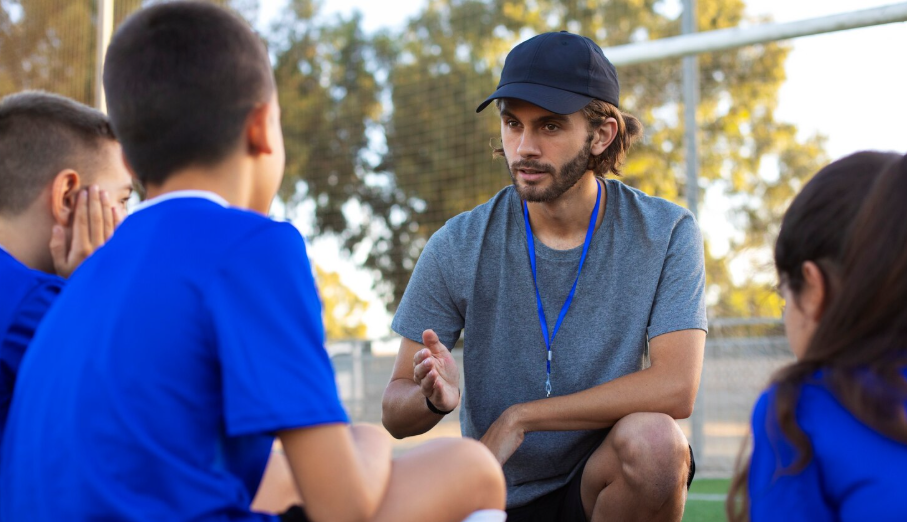
Fast hands win tries. Fast eyes win games. Game awareness involves seeing the field before the ball gets there – and it’s something players can actually learn. Awareness itself is trainable, not something you’re naturally born with. Any player can start today. Good league coaching trains both the body and the brain. The coach guides the player’s eye to the right spot, tells them when to sprint and explains why there’s an opening in the defense. Lots of young athletes learn these things gradually all by themselves. However, with a good coach, it may occur within just one season. Here’s our explanation of what game awareness is all about, its importance, how coaches develop it – and some very effective drills you can try.
What Is Game Awareness?
Game awareness is the ability to read out the game and choose the best action very fast indeed. Sports scientists refer to it as a perceptual-cognitive skill. Studies into team sports – including rugby league – show that more skilled players detect clues even earlier, such as a defender’s feet or an opening in the opposition’s line. They are not always faster runners. They decide faster.
| Awareness skill | What the player sees | What the player does |
|---|---|---|
| Reading defence | Defenders bunching up | Passes wide or kicks |
| Spotting a gap | Space between two defenders | Runs through the hole |
| Judging support | A teammate on the inside | Passes at the right moment |
| Tracking the game | Score, time, tackle count | Picks the safe play or the bold one |
How Do Coaches Build Awareness?
Coaches build awareness with games, not lectures. The idea goes back to 1982, when Bunker and Thorpe introduced Teaching Games for Understanding. Their point was simple. Players learn tactics best when they face real choices in a game-like setting.
Research by Tim Gabbett shows that skill-based games in rugby league build skill and fitness at the same time. So the player works hard and thinks hard in the same minute. Questions help too. A coach who asks “What did you see?” gets more thinking than a coach who only shouts orders. The best coaches wait. They let a mistake happen, then ask one question. Talking is part of awareness too. A player who calls “man on” gives teammates facts they cannot see.
Which Drills Work Best?
Pick drills that force a decision. Here are five that work, and all fit a normal club night:
- Small-sided games: Four versus four or six versus six on a short field means more choices per minute.
- Freeze drills: The coach calls “freeze” mid play. Players name what they see.
- Rule-twist games: A try only counts after three passes. New rule, new decisions.
- Video clips: Watch match footage and pause before the pass. Ask what comes next.
- Position swaps: Play in another spot to learn what teammates need from you.
How Long Until Players Improve?
Skill development is evident within weeks. Developing an awareness of the game really takes around a season. Results will vary greatly depending upon your age – and just how regularly you actually train. Athletes that train all the time tend to get better much faster. Here is the math problem. A match lasts 80 minutes, and a player holds the ball for only a small share of it. Games alone give very few chances to practise decisions. Coaching adds them every week. Parents can assist with one query post-game, ‘what did you see prior to passing?’ Children that answer effectively have indeed read the play itself.






Leave a Reply