
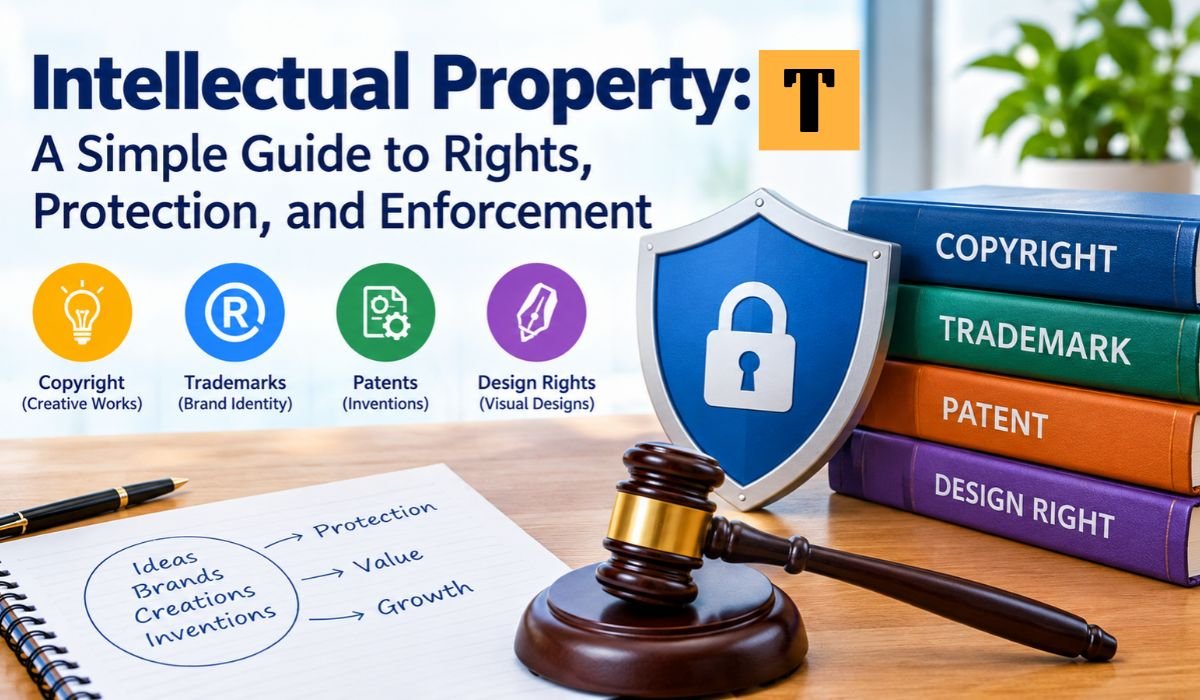
Intellectual Property is woven into everyday life, although most people don’t stop to think about it. A company name, a new medicine, a piece of software, a photograph, a product design, or a song can all involve different forms of intellectual property. These rights give inventors, creators, and businesses legal ways to protect qualifying work and, in many cases, gain commercial value from it.
The World Intellectual Property Organization, commonly known as WIPO, describes Intellectual Property as creations of the mind. These include inventions, literary and artistic works, designs, and commercial symbols, names, and images. Patents, Copyrights, Trademarks, Trade Secrets, Industrial Designs, and Geographical Indications are among the major areas covered by Intellectual Property law.
Understanding Intellectual Property Protection isn’t just a concern for lawyers or multinational corporations. Entrepreneurs, artists, writers, software developers, researchers, manufacturers, and small-business owners may all create or control valuable intellectual assets. Knowing what type of protection may apply, how rights are obtained or maintained, and what Intellectual Property Enforcement involves can help people protect their work and make better business decisions.
This guide takes a closer look at the main types of Intellectual Property, how they differ, how protection generally works, and why enforcement matters. Because IP law differs from one country to another, examples involving U.S. registration and enforcement are identified as U.S.-specific where appropriate.
Quick Bio Information
| Quick Fact | Information |
|---|---|
| Full Term | Intellectual Property |
| Common Abbreviation | IP |
| Related Term | Intellectual Property Rights |
| Abbreviation | IPR |
| Main Purpose | Protect qualifying inventions, creative works, brands, designs, and confidential information |
| Major IP Types | Patents, Trademarks, Copyright, Trade Secrets, Industrial Designs, and Geographical Indications |
| Patent Protection | Generally concerns qualifying inventions |
| Trademark Protection | Identifies and distinguishes goods or services |
| Copyright Protection | Protects qualifying original creative works |
| Trade Secret Protection | Protects qualifying confidential commercial information |
| Industrial Design Protection | Concerns certain ornamental or aesthetic product features |
| Geographical Indication | Connects qualifying goods with a particular geographic origin |
| Global IP Organization | World Intellectual Property Organization |
| U.S. Patent And Trademark Agency | U.S. Patent and Trademark Office |
| U.S. Copyright Agency | U.S. Copyright Office |
| IP Scope | Primarily national or regional, supported by international frameworks |
| Patent Function | Gives qualifying patent owners exclusionary rights |
| Trademark Function | Helps identify and distinguish goods or services |
| Copyright Function | Protects qualifying original creative expression |
| Enforcement | Provides legal mechanisms for addressing unauthorized use or infringement |
What Is Intellectual Property?
Intellectual Property, often abbreviated as IP, is a broad term for creations of the human mind that can receive legal protection under applicable law. Unlike a physical possession such as a building, vehicle, or piece of furniture, intellectual property may involve an invention, creative work, brand identity, product design, or confidential business information.
The purpose of an IP system is to establish legal rights around certain forms of innovation and creativity while balancing those rights with broader public interests. A Patent, for example, can give an inventor an exclusionary right for a limited period while requiring information about the invention to be disclosed. Copyright protects qualifying original creative expression, while a Trademark helps consumers recognize and distinguish the source of particular goods or services.
That means Intellectual Property isn’t a single legal right. It’s a broad field made up of different rights, requirements, limitations, durations, and enforcement mechanisms. Understanding which category applies is often the first step toward protecting an intellectual asset.
Why Does Intellectual Property Matter?
Strong Intellectual Property Rights can encourage investment in research, creativity, product development, and branding. When the law provides protection for qualifying work, creators and businesses may have greater confidence that others can’t simply use that work in ways that violate their rights.
IP can also play a major role in commercialization. An invention can become a product, a creative work can develop into a book, film, game, or software application, and a recognizable Trademark can help consumers distinguish one business from another. Depending on the type of right and applicable law, intellectual property can also be licensed, assigned, sold, or used as part of a broader commercial strategy.
The economic role of IP reaches far beyond technology companies. Manufacturing, pharmaceuticals, entertainment, software, consumer products, publishing, research, and many other industries depend on innovation and creative work. For that reason, Intellectual Property is closely connected with investment, trade, employment, entrepreneurship, and economic development.
What Are Intellectual Property Rights?
Intellectual Property Rights, or IPR, are legal rights that protect particular forms of intellectual creation, commercial identity, or confidential information. The specific right depends on what has been created, how it is used, and which country’s laws apply.
A Patent generally concerns an invention. A Trademark identifies and distinguishes goods or services. Copyright protects qualifying original creative works. Trade Secrets can protect qualifying confidential commercial information, while Industrial Designs can protect certain visual or ornamental features of products. Geographical Indications identify qualifying goods whose qualities, reputation, or characteristics are linked to a particular geographical origin.
One product can involve several IP rights at once. Imagine a new electronic device. Its technical invention might be protected by a Patent, its brand name could function as a Trademark, its software and promotional material might involve Copyright, and certain visual aspects of its appearance could potentially qualify for Industrial Design protection.
This is why businesses shouldn’t think of IP as one broad legal category. Different assets require different forms of protection.
What Are The Main Types Of Intellectual Property?
The best-known forms of Intellectual Property Protection include Patents, Trademarks, Copyright, and Trade Secrets. Other important areas include Industrial Designs and Geographical Indications.
Each category serves a different purpose. A Patent can protect a qualifying invention. A Trademark can protect a distinctive sign used to identify goods or services. Copyright can protect original creative expression, including many forms of digital content. A Trade Secret can protect valuable confidential information when the applicable requirements are met.
Industrial Designs focus on certain aspects of a product’s appearance, while Geographical Indications can protect names or indications associated with qualifying products whose qualities or reputation are connected to a particular place.
These rights aren’t interchangeable. The right approach depends on the nature of the asset, the applicable law, whether the relevant requirements have been satisfied, and where protection is needed.
Patents: Protecting Inventions And Innovations
A Patent is an exclusive right granted for an invention. In the United States, a patent generally gives its owner the right to exclude others from making, using, offering for sale, selling, or importing the patented invention for a limited period.
There’s an important distinction here. A patent is primarily an exclusionary right. Having a patent doesn’t automatically give the owner unrestricted permission to practice the invention. Other laws, regulations, licenses, and third-party rights may still affect what the patent owner can do.
The United States recognizes three main types of patents: Utility Patents, Design Patents, and Plant Patents. Utility Patents can cover qualifying processes, machines, articles of manufacture, compositions of matter, or certain improvements. Design Patents concern qualifying new, original, and ornamental designs for articles of manufacture. Plant Patents cover certain distinct and new plant varieties that are asexually reproduced.
Getting a Patent requires more than having a promising idea. For a U.S. Utility Patent, the invention must satisfy applicable legal requirements, including novelty and non-obviousness, along with other statutory conditions. A suggestion or abstract idea doesn’t become patentable simply because it has been described.
The U.S. patent process can involve searching existing technology and prior art, preparing and filing an application, examination by a patent examiner, responding to examination issues, and maintaining an issued patent. Because patent applications can involve complicated technical and legal questions, inventors may choose to work with qualified patent professionals.
Trademarks: Protecting Brands And Business Identity
A Trademark is a word, phrase, symbol, design, or combination that identifies and distinguishes goods or services in the marketplace. Put simply, a Trademark helps consumers connect particular goods or services with their source.
For businesses, that can make trademark protection extremely valuable. A recognizable brand may become one of a company’s most important commercial assets as customers begin to associate a particular name, symbol, or design with a certain level of quality or service.
Trademark rights, however, don’t amount to ownership of a word or phrase in every possible situation. The scope of a Trademark is connected to its use with particular goods or services and the legal rights that apply in the relevant jurisdiction.
In the United States, trademark rights can arise through use, although unregistered rights can have geographic limitations. Federal registration can provide broader legal protections. Before committing substantial money to a new brand, businesses commonly search existing marks to identify potential conflicts.
It’s also important to distinguish a business name, domain name, and Trademark. They can be related, but they’re not automatically the same legal right. Treating them as interchangeable can lead to confusion when a business is building or expanding a brand.
Copyright: Protecting Creative Works
Copyright protects qualifying original works of authorship. In the United States, Copyright protection generally begins automatically when an original work is created and fixed in a sufficiently permanent form.
That protection can apply to a wide range of creative expression, including books, articles, music, photographs, paintings, films, audiovisual works, sound recordings, software, architectural works, and other eligible creations.
Copyright ownership is also different from ownership of a physical object. Buying a painting, photograph, book, or other physical item doesn’t automatically transfer all Copyright rights in the underlying work.
Registration is another important distinction. In the United States, Copyright generally exists from fixation when the legal requirements are met, while registration with the U.S. Copyright Office can provide important legal benefits. Registration can be particularly significant when an owner needs to enforce Copyright through federal litigation.
For creators, understanding this distinction can prevent a common misunderstanding: owning a copy of a work and owning the legal Copyright in that work aren’t necessarily the same thing.
Industrial Designs, Trade Secrets, And Geographical Indications
Industrial Designs generally concern the ornamental or aesthetic appearance of a product. Depending on the country’s legal system, protection may cover three-dimensional features such as shape or surface, as well as two-dimensional features such as patterns, lines, or colors.
Trade Secrets protect qualifying confidential information that has commercial value because it is secret. This can include certain formulas, manufacturing processes, technical information, business strategies, supplier information, or other confidential commercial knowledge. Protection generally depends on the information remaining secret and the owner taking reasonable steps to preserve that secrecy.
Geographical Indications identify qualifying goods associated with a particular geographical origin. Their qualities, reputation, or other characteristics must be essentially attributable to that place under the relevant legal framework. Agricultural products, foods, beverages, and other regionally associated products can be examples of goods connected with this type of protection.
These forms of IP are sometimes overlooked because Patents, Trademarks, and Copyright receive more public attention. Yet for the right business or creator, they can be just as important.
How Does Intellectual Property Protection Work?
There isn’t one worldwide procedure for protecting Intellectual Property. The process depends on the type of IP and the laws of the country or region where protection is being sought.
Patents and many Trademarks involve formal applications and examination or registration procedures. In the United States, the patent process can include determining whether patent protection is appropriate, researching prior art, preparing an application, undergoing examination by the USPTO, and maintaining an issued patent.
Trademark applications also undergo examination. The relevant authority considers whether the application satisfies legal requirements and whether potential conflicts exist with earlier marks.
Copyright works differently. In the United States, qualifying Copyright generally begins automatically when an original work is fixed. Registration isn’t what creates the copyright, although registration can provide important legal and procedural benefits.
The practical starting point is therefore to identify the asset. Is it an invention, a brand, a creative work, a product design, or confidential information? Once that question is answered, the appropriate protection and applicable legal requirements become easier to determine.
Intellectual Property Infringement: What Does It Mean?
Intellectual Property Infringement generally refers to conduct that violates an applicable IP right without authorization. The exact legal test varies according to the type of IP and the jurisdiction.
For example, a dispute could involve the alleged unauthorized use of a Trademark, unauthorized reproduction or another restricted use of Copyrighted material, or the making, use, sale, or importation of a product covered by the claims of a valid Patent.
Trade-secret disputes can involve the unauthorized acquisition, use, or disclosure of protected confidential information.
It’s important not to assume that every similarity amounts to infringement. The scope of the relevant right, ownership, registration status where applicable, permission, statutory exceptions, defenses, and surrounding circumstances can all affect the outcome of a dispute.
For that reason, allegations of infringement need to be assessed under the specific law governing the right rather than judged simply by comparing two names, products, or creative works.
What Is Intellectual Property Enforcement?
Intellectual Property Enforcement involves the legal and practical mechanisms used to protect IP rights when unauthorized use or infringement is suspected.
Depending on the circumstances, enforcement can involve contacting an alleged infringer, administrative proceedings, civil litigation, customs or border measures, and criminal enforcement where the applicable law allows it.
An important point is that the organization responsible for granting or registering an IP right doesn’t necessarily enforce that right itself. In the United States, for example, the USPTO grants patents and registers federal Trademarks, but it doesn’t enforce patents. A patent owner who believes infringement has occurred may need to pursue an appropriate legal remedy.
For businesses, effective enforcement starts with knowing what rights exist, who owns them, what evidence supports those rights, and which legal mechanisms are available. Keeping good records can become particularly important when ownership or infringement later becomes disputed.
Counterfeit And Pirated Goods
Counterfeit and pirated goods are two major concerns in the field of IP enforcement. Counterfeit products generally imitate genuine branded goods without authorization, while piracy commonly involves unauthorized reproduction or distribution of protected creative works.
The consequences can go beyond lost sales. Counterfeit products may create serious consumer concerns when their ingredients, manufacturing conditions, quality, or safety can’t be reliably established. Piracy can affect authors, musicians, filmmakers, software developers, publishers, and many others whose businesses depend on legitimate distribution and licensing.
The challenge can become greater when activity crosses borders. A product might be manufactured in one country, sold through a company in another, advertised on an overseas website, and delivered to consumers somewhere else. That international nature makes cooperation between jurisdictions an important part of modern Intellectual Property Enforcement.
Intellectual Property And The U.S. Economy
Intellectual Property is closely tied to industries built around innovation, technology, branding, and creativity. The source material for this article cites a 2019 analysis reporting that IP-intensive industries accounted for $7.8 trillion in U.S. GDP, 47.2 million U.S. jobs, 41% of U.S. GDP, 79% of U.S. commodity exports, 33% of U.S. employment, and 60% of wage premiums.
These figures should be understood as measurements from that particular 2019 analysis rather than as current 2026 economic statistics. Their broader value is to demonstrate the scale of economic activity associated with industries that rely heavily on intellectual property.
The relationship can be seen across many sectors. Patents can support the commercialization of technological inventions. Trademarks can help businesses build recognizable brands. Copyright supports industries based on creative expression, including publishing, music, film, photography, software, and other media.
Together, these different rights form part of a wider ecosystem in which ideas and creative work can be developed, commercialized, licensed, and shared.
Intellectual Property Protection Around The World
Intellectual Property Protection is largely based on national or regional laws. As a result, protection obtained in one country doesn’t automatically create identical protection in every other country.
This matters greatly to businesses that sell products internationally, license technology overseas, distribute digital content, or operate recognizable brands in several markets. A company expanding into another country may need to determine whether its important IP assets are protected there and understand the local rules for maintaining and enforcing those rights.
International agreements provide important frameworks for cooperation and establish common principles, but they don’t eliminate the need to understand national laws.
WIPO plays a central role in international Intellectual Property cooperation. It provides services, information, policy support, and forums covering areas such as Patents, Trademarks, Copyright, designs, and Geographical Indications.
The international nature of modern commerce makes this increasingly relevant. A company may create something in one country, manufacture it in another, and sell it worldwide. Its IP strategy needs to account for that reality.
Major International Intellectual Property Agreements
The modern international IP system developed over many years, with several agreements becoming important milestones. Two of the best-known are the Paris Convention for the Protection of Industrial Property and the Berne Convention for the Protection of Literary and Artistic Works.
The Paris Convention was adopted in 1883 and became an important foundation for international cooperation involving industrial property. The Berne Convention followed in 1886, establishing an international framework for Copyright protection.
These agreements are part of a broader network of international rules and institutions. Their importance lies in helping countries cooperate and establish common principles for protecting intellectual creations across national borders.
For businesses and creators, this international framework is particularly relevant when their work is distributed, licensed, manufactured, or sold in multiple countries.
A Brief History Of Intellectual Property
The history of Intellectual Property stretches back centuries. One frequently cited early milestone is the Venetian patent law of 1474, which established a framework for protecting certain inventions.
Another important development came in England with the Statute of Monopolies of 1624, which played a significant role in the development of modern patent principles.
International cooperation expanded much later. The Paris Convention of 1883 created an important international framework for industrial property, followed by the Berne Convention of 1886 for literary and artistic works.
Since then, IP law has continued to develop alongside changes in technology, manufacturing, communication, entertainment, and international commerce. Today’s challenges are very different from those faced centuries ago, but the central question remains familiar: how should the law protect innovation and creativity while also serving the broader public interest?
Real-World Examples Of Intellectual Property
Consider a new medical device. Its technical invention could potentially qualify for Patent protection if it meets the applicable legal requirements. The name used to market it could function as a Trademark. Its software, user manual, photographs, and promotional videos could contain Copyrighted material. Confidential manufacturing information could potentially qualify as a Trade Secret if the relevant conditions are satisfied.
The same pattern appears in consumer technology. A smartphone, for instance, can contain patented technologies, Copyrighted software and creative material, Trademarked branding, and potentially protected design elements.
A clothing company may rely on Trademarks for its brand identity, Copyright for certain original creative materials, and Industrial Design protection where the applicable legal system provides it.
These examples demonstrate why IP is best understood as a collection of different rights. A single product or business can contain several valuable intellectual assets, and each may need to be treated differently.
Intellectual Property Rights For Businesses And Creators
Businesses and individual creators can benefit from identifying their intellectual assets early. A startup may have a valuable brand long before it generates significant revenue. A software developer may create Copyrighted code. An inventor may develop technology that could potentially qualify for a Patent. A company may also possess confidential information that depends on Trade Secret protection.
Good IP management starts with ownership and documentation. Businesses should know who created a particular work, who owns the resulting rights, what employment or contractor agreements say, what information needs to remain confidential, and which registrations or applications may be appropriate.
This becomes even more important when a business works with contractors, employees, partners, manufacturers, or outside agencies. Ownership can depend on contracts and applicable law, so assumptions can create problems later.
International expansion adds another layer. Because IP laws differ between jurisdictions, businesses selling or licensing products abroad should consider where protection is actually needed and how those rights can be maintained and enforced.
Common Intellectual Property Mistakes To Avoid
One of the most common mistakes is assuming that every idea is automatically protected. IP law generally protects specific forms of expression, qualifying inventions, commercial identifiers, designs, or confidential information when the applicable legal requirements are met.
Another mistake is confusing one IP right with another. A Trademark doesn’t protect a technical invention in the same way a Patent does, and Copyright generally isn’t a substitute for Trademark protection of a brand. Patents, Trademarks, and Copyright each serve different purposes.
Businesses can also create problems by sharing confidential information without appropriate safeguards, using another person’s protected material without checking the relevant rights, failing to search for potentially conflicting Trademarks, or assuming that protection in one country automatically extends worldwide.
A simple way to begin thinking about IP is to ask three questions: What have we created? Who owns it? Where do we need protection? Those questions won’t solve every legal issue, but they can help identify important IP concerns before they turn into expensive disputes.
Final Thoughts
Intellectual Property is much more than a legal concept found in contracts and courtrooms. It’s part of the framework that supports invention, creativity, branding, research, and commercial development.
Patents, Trademarks, Copyright, Trade Secrets, Industrial Designs, and Geographical Indications each serve different purposes. Understanding those differences matters because the protection appropriate for an invention may be completely different from what a brand, photograph, software program, product design, or confidential business process needs.
Perhaps the most useful lesson is that IP protection isn’t identical in every situation or every country. Creators and businesses need to identify what they’ve created or acquired, understand the relevant requirements, keep appropriate records, protect confidential information where necessary, and know what enforcement options may be available if unauthorized use occurs.
As technology, artificial intelligence, digital commerce, online media, and international trade continue to evolve, Intellectual Property will remain an important part of the global innovation system. For anyone who creates, develops, brands, or commercializes something valuable, understanding IP isn’t simply useful. It can be an important part of protecting the work itself.
FAQs About Intellectual Property
What Is Intellectual Property In Simple Terms?
Intellectual Property is a broad term for creations of the mind that can receive legal protection. Depending on the circumstances, this can include inventions, creative works, brand identifiers, product designs, and confidential business information. Different forms of IP law protect different types of creations.
What Are The Main Types Of Intellectual Property?
The major areas include Patents, Trademarks, Copyright, Trade Secrets, Industrial Designs, and Geographical Indications. Patents generally concern inventions, Trademarks identify and distinguish goods or services, Copyright protects qualifying original creative works, Trade Secrets protect qualifying confidential information, Industrial Designs concern certain product appearance, and Geographical Indications connect qualifying goods with a geographic origin.
Is An Idea Automatically Protected By Intellectual Property Law?
No. An idea by itself doesn’t automatically receive every type of IP protection. Protection depends on the nature of the creation and the applicable legal requirements. For example, U.S. patent law doesn’t grant a patent merely because someone has suggested an idea.
What Is The Difference Between A Patent, Trademark, And Copyright?
A Patent generally protects a qualifying invention. A Trademark identifies and distinguishes goods or services in the marketplace. Copyright protects qualifying original creative works. Each has different requirements, rights, limitations, and legal procedures.
What Is Intellectual Property Infringement?
Intellectual Property Infringement generally involves unauthorized conduct that violates an applicable IP right. The exact legal test depends on the type of IP and the jurisdiction. Similarity alone doesn’t necessarily establish infringement because factors such as the scope of the right, authorization, exceptions, and defenses may be relevant.
Does Intellectual Property Protection Work Worldwide?
No single IP right automatically provides identical protection in every country. Intellectual Property Protection is largely national or regional, although international agreements provide important frameworks for cooperation. Businesses operating across borders therefore need to consider the laws and procedures of the markets where protection is required.
Why Is Intellectual Property Important For Businesses?
IP can protect valuable business assets such as inventions, brands, creative content, designs, and confidential information. These rights can also support commercialization, licensing, investment, and brand development. Their practical value depends on the type of IP, applicable law, ownership, and how effectively the rights are managed.
How Is Intellectual Property Enforced?
Enforcement depends on the type of right and the jurisdiction. It can involve direct communications, administrative proceedings, civil litigation, border measures, and, where applicable, criminal enforcement. The rights holder generally needs to establish the relevant right and use the legal mechanisms available for the particular situation.
Learn more and explore exciting content on: How to Start a Business: A Simple Step-by-Step Guide for Beginners










Leave a Reply