
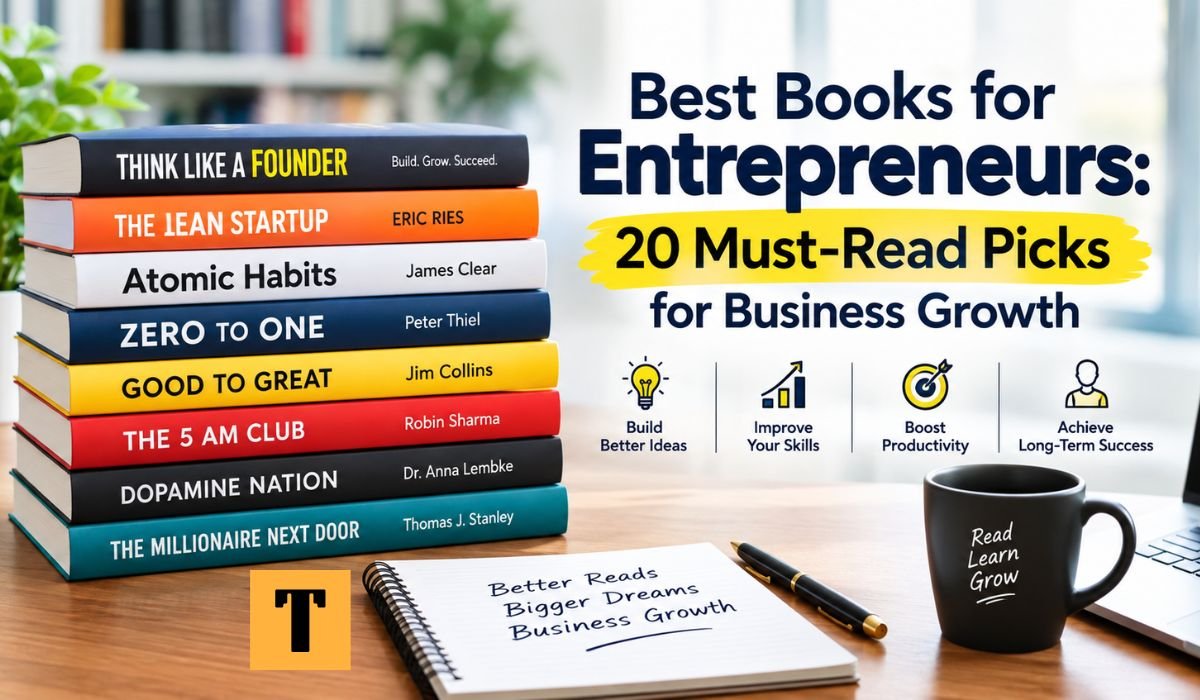
Introduction: Why The Best Books For Entrepreneurs Still Matter
Running a business rarely means knowing exactly what comes next. One day, an entrepreneur might be testing a new idea, and the next could bring a difficult hiring decision, a cash-flow concern, a demanding customer, or an unexpected market change. The right book can’t solve every problem, but it can offer a fresh perspective, a useful framework, or lessons drawn from someone else’s experience.
That’s where the Best Books For Entrepreneurs can make a real difference. The right business book can help a founder understand a complicated subject, question an old assumption, or approach a familiar challenge in a completely different way.
This guide brings together 20 books covering Startups, Leadership, Finance, Scaling, Artificial Intelligence, Productivity, Habits, and Entrepreneurial Mindset. They’re arranged around different stages of the business journey, making it easier to find a title that fits your current needs. You don’t need to read all 20. In fact, choosing one book that speaks directly to the challenge in front of you may be a much better place to start.
Quick Bio Information
Book Collection: Best Books For Entrepreneurs
Total Books Covered: 20
Main Focus: Entrepreneurship, Business Growth, Leadership, Finance, Productivity, Scaling, And Personal Development
Startup Books: Build The Damn Thing, Million Dollar Weekend, The Greater Good, The Lean Startup, And 48-Hour Start-up
Leadership Books: Dare To Lead, Primal Leadership, Move Fast And Fix Things, And Virtual Freedom
Finance Book: Financial Intelligence
Scaling Books: The Art Of Principled Entrepreneurship, The Outsiders, And The Science Of Scaling
AI And Business Strategy: Competing In The Age Of AI
Productivity Book: Work Smarter
Personal Development Books: Atomic Habits, The 5 Types Of Wealth, And The 7 Habits Of Highly Effective People
Entrepreneurial Memoirs: Shoe Dog, Burn Rate, And The Hard Thing About Hard Things
Featured Authors: Kathryn Finney, Noah Kagan, Eric Ries, Brené Brown, James Clear, Phil Knight, Ben Horowitz, And Other Business Writers
Ideal Readers: Aspiring Entrepreneurs, Startup Founders, Business Owners, Managers, And Established Entrepreneurs
Key Topics: Business Ideas, Customer Validation, Leadership, Financial Literacy, Team Building, Delegation, Artificial Intelligence, Scaling, Habits, And Long-Term Success
Reading Goal: Gain Practical Ideas And Different Perspectives That Can Be Applied To Real Business Challenges
Best Approach: Choose Books Based On Your Current Business Stage And The Challenge You’re Trying To Solve
How To Choose The Right Entrepreneur Book
Not every business book will be useful to every entrepreneur. A first-time founder searching for product-market fit has very different needs from an experienced business owner trying to manage a larger organization. That’s why context matters when choosing what to read.
The books in this guide cover several sides of entrepreneurship. Some are practical startup guides, others focus on leadership or financial literacy, while several are memoirs that provide a firsthand look at the realities of building a company. There are also books about productivity, habits, purpose, and long-term success.
A useful book should give you something you can understand and potentially apply. That could be a method for testing an idea, a better way to interpret financial information, a leadership principle, or a system for managing your time. At the same time, no author’s advice should be treated as a universal formula. Business conditions differ, and a strategy that works for one company may not work for another.
Best Books For Starting A Business
For someone standing at the beginning of an entrepreneurial journey, the biggest challenge is often turning an idea into something tangible. Build The Damn Thing by Kathryn Finney addresses the process of building a business while discussing areas such as business plans, product development, team growth, investors, and access to resources. Its perspective is particularly relevant to founders who may feel that traditional business systems weren’t designed with people like them in mind.
Million Dollar Weekend by Noah Kagan and Tahl Raz takes a more action-focused approach. Rather than encouraging aspiring entrepreneurs to spend endless amounts of time researching every possible “how,” it pushes them toward testing ideas and solving real problems. The Greater Good by Madeleine Shaw adds another dimension by exploring Social Entrepreneurship, purpose, personal values, and social impact.
Taken together, these books address some of the earliest questions a founder faces: What problem am I solving? Who needs the solution? How can I test the idea? And what does it actually take to get started?
Best Books For Testing Ideas And Launching
Starting quickly is useful, but moving quickly without learning can create its own problems. The Lean Startup by Eric Ries offers a framework for dealing with that uncertainty through what it calls validated learning. Instead of assuming that an idea will work, entrepreneurs are encouraged to test their assumptions, gather customer feedback, measure meaningful results, and adapt when the evidence points in another direction.
That approach can help reduce the risk of spending too much time and money developing a product before discovering whether customers actually want it. The emphasis is on experimentation and learning rather than trying to predict every outcome in advance.
48-Hour Start-up by Fraser Doherty takes a more rapid, hands-on approach to moving from an idea toward a launch. It focuses on practical tools, product development, promotion, and ways to overcome the hesitation that often keeps aspiring founders stuck in the planning stage.
The two books approach entrepreneurship differently, but they share a useful principle: an idea becomes much more meaningful once it meets the real world. Testing, learning, and adjusting can tell you far more than planning in isolation.
Best Books For Entrepreneurial Leadership
As a business grows, the founder’s role changes. Early on, you might handle sales, customer service, marketing, operations, and product development yourself. Eventually, other people become responsible for important parts of the company. At that point, leadership isn’t simply about getting work done. It’s about helping other people do their best work, too.
Dare To Lead by Brené Brown examines leadership through ideas such as courage, vulnerability, accountability, and values. Primal Leadership by Daniel Goleman, Richard E. Boyatzis, and Annie McKee approaches leadership through Emotional Intelligence, including empathy, motivation, and collaboration.
Both books offer a useful reminder that leadership isn’t defined only by authority or a job title. The way a founder communicates, handles difficult conversations, builds trust, and responds to other people’s needs can shape the working environment of an entire company.
Best Books For Understanding Business Finance
A business can have a strong product and loyal customers and still run into serious trouble if its owner doesn’t understand the financial side of the operation. Entrepreneurs don’t necessarily need to become accountants, but they should have enough financial knowledge to understand what their numbers are telling them.
Financial Intelligence by Karen Berman and Joe Knight is designed to make financial concepts more accessible to managers and business owners. Rather than treating financial statements as complicated documents meant only for specialists, the book focuses on understanding what the numbers actually mean.
That knowledge can help entrepreneurs ask more informed questions about revenue, expenses, profitability, and other financial decisions. It can also make conversations with accountants, financial professionals, investors, and business partners easier.
Reading a finance book isn’t a substitute for professional accounting or financial advice. Still, developing basic financial literacy gives business owners a stronger foundation for making decisions and understanding the consequences of those decisions.
Best Books For Building Strong Teams
Once a business starts hiring, growth brings a new set of challenges. Communication becomes more complicated, responsibilities have to be divided, and the founder can no longer personally oversee every detail.
Move Fast And Fix Things by Frances Frei and Anne Morriss looks at solving difficult organizational problems while maintaining trust and strong leadership. Its central ideas are especially relevant to businesses dealing with rapid change, where speed can sometimes come at the expense of communication or employee confidence.
Virtual Freedom by Chris Ducker focuses on delegation, outsourcing, and virtual teams. For many founders, learning to delegate is one of the hardest parts of growth. It’s tempting to believe that doing something yourself is faster or safer, but that approach eventually creates a bottleneck.
Building a capable team allows entrepreneurs to spend more time on strategy, customers, products, and other responsibilities that require their direct attention. Strong teams aren’t created simply by hiring more people. They also require clear responsibilities, trust, communication, and effective delegation.
Best Books For Building A Values-Driven Company
Business growth often brings decisions that don’t have simple answers. Founders may have to balance financial goals with company culture, customer expectations, employee needs, and the values they want the organization to represent.
The Art Of Principled Entrepreneurship by Andreas Widmer explores entrepreneurship through values, people, culture, and long-term value creation. The book uses the entrepreneurial story of Art Ciocca to examine how business activity can connect with a broader sense of purpose.
This perspective is particularly relevant for founders who don’t want company growth to be measured only by revenue or size. Financial performance matters, but so do the relationships a company builds and the principles that guide its decisions. As a business becomes larger, those choices can have an increasingly visible effect on employees, customers, and the organization’s identity.
Best Books For Scaling A Business
Starting a company and scaling one are two very different jobs. A small business may depend heavily on the founder’s personal effort, while a larger organization needs repeatable processes, capable managers, disciplined decision-making, and thoughtful resource allocation.
The Outsiders by William N. Thorndike Jr. examines eight unconventional CEOs and focuses particularly on capital allocation and long-term business performance. Rather than concentrating on executive image or popular management trends, the book looks at how these leaders approached important business decisions.
The Science Of Scaling by Benjamin Hardy and Blake Erickson takes a more direct look at growth. It discusses business models, growth pathways, people, blind spots, and the systems required to expand.
Together, these books encourage entrepreneurs to look beyond the excitement of increasing sales. Sustainable growth requires an organization that can actually handle the additional customers, employees, expenses, decisions, and operational complexity that come with expansion.
Best Books For Entrepreneurs Using AI
Artificial Intelligence has quickly become part of the business conversation, but adopting an AI tool isn’t the same as developing an effective AI strategy.
Competing In The Age Of AI by Marco Iansiti and Karim R. Lakhani examines how Artificial Intelligence, algorithms, and digital networks can change business operations and strategy. The book also considers the risks and organizational responsibilities associated with AI.
For entrepreneurs in 2026, that broader perspective is especially useful. AI can support areas such as customer service, analysis, automation, content production, and internal workflows, but the technology still needs to fit the actual business. Entrepreneurs may need to think about data, costs, security, employee roles, processes, and infrastructure before deciding where AI belongs.
The more useful question isn’t simply, “How can I add AI?” It’s, “Where can AI solve a genuine business problem or improve an existing process?”
Best Books For Productivity And Smarter Work
Time is one resource entrepreneurs can’t create more of. That’s why productivity becomes increasingly important as responsibilities grow.
Work Smarter by Nick Loper focuses on online resources covering areas such as productivity, communication, project management, networking, and outsourcing. Its broader lesson is straightforward: entrepreneurs don’t have to solve every problem from scratch or personally handle every task.
Sometimes the smarter decision is to use an existing tool, outsource specialized work, automate a repetitive process, or remove a task that doesn’t add enough value. That doesn’t mean working less carefully. It means being more deliberate about where your attention goes.
Good productivity isn’t about filling every available hour with work. It’s about making sure your limited time is being spent on activities that genuinely move the business forward.
Best Books For Habits And Personal Effectiveness
Entrepreneurs often spend so much time building business systems that they overlook their own personal systems. Yet daily habits can influence how consistently a founder works, plans, communicates, and follows through.
Atomic Habits by James Clear focuses on how small behaviors and effective systems can support lasting change. Its practical approach is particularly relevant for entrepreneurs who want to build consistency without relying entirely on motivation.
The 7 Habits Of Highly Effective People by Stephen R. Covey takes a broader, principle-centered approach to personal and professional effectiveness. It examines habits and principles that can influence priorities, relationships, decisions, and personal responsibility.
The value of both books lies partly in their emphasis on consistency. Big goals can feel overwhelming, but smaller actions are easier to repeat. Over time, those repeated behaviors can become part of a much stronger personal and professional routine.
Books That Show The Reality Of Entrepreneurship
Business advice can sometimes make entrepreneurship look much cleaner than it really is. Real companies are built through uncertainty, mistakes, setbacks, difficult decisions, and plenty of moments when the outcome isn’t obvious.
Shoe Dog by Phil Knight provides a firsthand account of the early development of Nike. It describes the uncertainty, sacrifices, mistakes, and challenges that accompanied the company’s journey.
Burn Rate by Andy Dunn offers another personal perspective through the story of building Bonobos. The memoir explores the pressure surrounding startup growth and the difficulties that can arise when professional ambition begins to affect personal boundaries.
The Hard Thing About Hard Things by Ben Horowitz focuses directly on the difficult side of running a company. It deals with situations where there isn’t a simple answer or a convenient playbook to follow.
These books aren’t universal instruction manuals, and their experiences shouldn’t automatically be treated as rules for every founder. Their value comes from showing the human and uncertain side of entrepreneurship that isn’t always visible in conventional business advice.
How To Choose A Book For Your Business Stage
The right book depends largely on what your business needs right now. Someone who has only an idea may benefit more from The Lean Startup, Million Dollar Weekend, or 48-Hour Start-up than from a book about managing a large organization.
A founder who is building a team may find Dare To Lead, Primal Leadership, or Virtual Freedom more relevant. An established business owner thinking about expansion can turn to The Science Of Scaling or The Outsiders, while someone exploring Artificial Intelligence may want to examine Competing In The Age Of AI.
Personal development matters, too. If consistency and routines are the problem, Atomic Habits may be a better fit. If you’re looking for a firsthand account of entrepreneurial uncertainty, Shoe Dog, Burn Rate, or The Hard Thing About Hard Things offers a different kind of learning.
Choosing a book based on a current challenge makes reading more purposeful. You’re not simply collecting business knowledge; you’re looking for information that can help you think through something you’re actually dealing with.
How To Get More Value From Business Books
Reading more books isn’t automatically the same as learning more. The real value comes from what you remember, question, discuss, and eventually apply.
Before opening a new book, think about what you want to learn from it. If you’re struggling with customer demand, for example, focus on ideas related to testing and validation. If your biggest issue is team management, pay closer attention to leadership, communication, and delegation.
Take notes as you read, but don’t feel the need to highlight every interesting sentence. Look for ideas that could change the way you approach a real problem. When something stands out, turn it into a specific action rather than leaving it as a nice idea on a page.
It’s also perfectly reasonable to stop reading a book that isn’t helping you. Entrepreneurs have limited time, and forcing yourself through a book simply because it’s popular isn’t always the best use of it.
Final Thoughts: Turning Reading Into Business Growth
The Best Books For Entrepreneurs aren’t necessarily the titles with the boldest promises. The most useful books are often the ones that help you see a familiar problem differently, understand a subject you previously avoided, develop a stronger habit, or make a more thoughtful decision.
These 20 books cover a broad range of entrepreneurial needs. They address starting a business, testing ideas, understanding finances, leading teams, delegating work, scaling operations, navigating Artificial Intelligence, improving productivity, and thinking about personal success.
You don’t need to read the entire list. Start with the book that matches the challenge you’re facing today. Read actively, question what you learn, and test useful ideas in the real world.
A business book only becomes truly valuable when its lessons leave the page and influence what you do next.
FAQs About The Best Books For Entrepreneurs
What Are The Best Books For Entrepreneurs?
There isn’t one book that works equally well for every entrepreneur. The Lean Startup focuses on experimentation and validated learning, Financial Intelligence deals with business finance, Dare To Lead explores leadership, and Atomic Habits focuses on personal systems and consistency. The most suitable choice depends on your business stage, experience, and current challenge.
Which Book Is Best For A New Entrepreneur?
New entrepreneurs can begin with books that address launching and testing ideas. The Lean Startup, Million Dollar Weekend, 48-Hour Start-up, and Build The Damn Thing each approach the early stages of entrepreneurship differently. The best starting point is usually the book that addresses the problem currently holding you back.
What Is A Good Book For Entrepreneurial Leadership?
Dare To Lead and Primal Leadership are useful choices for readers interested in becoming stronger leaders. They explore subjects such as communication, accountability, empathy, motivation, and Emotional Intelligence. These qualities become increasingly important as a founder moves from working independently to managing a team.
Which Book Helps Entrepreneurs Understand Business Finance?
Financial Intelligence is specifically aimed at helping managers and business owners understand financial information. It can be useful for entrepreneurs who want to become more comfortable with business numbers and understand the meaning behind financial statements. Professional accounting and financial advice may still be necessary for specific business decisions.
Which Books Help With Business Scaling?
The Science Of Scaling focuses directly on growth and scaling, while The Outsiders examines unconventional CEOs and capital allocation. Competing In The Age Of AI adds another perspective by exploring technology, Artificial Intelligence, and modern operating models. Each book addresses a different part of the scaling challenge.
Are Entrepreneurial Memoirs Worth Reading?
They can be valuable because they show the less polished side of building a business. Shoe Dog, Burn Rate, and The Hard Thing About Hard Things provide firsthand perspectives on uncertainty, setbacks, pressure, and difficult decisions. Their stories are individual experiences, so readers should take the lessons as perspectives rather than universal rules.
How Many Business Books Should An Entrepreneur Read?
There isn’t a required number. Reading one relevant book and applying several useful ideas can be more valuable than rushing through a long reading list without putting anything into practice. A sustainable routine built around your interests and current business needs is usually more practical.
How Can Busy Entrepreneurs Find Time To Read?
Short reading sessions can make the habit much easier to maintain. You might set aside a few minutes in the morning or evening, listen to an audiobook during an appropriate commute or routine activity, or read only the chapters that address your current challenge. Consistency matters more than trying to create a perfect reading schedule.
Learn more and explore exciting content on: ChamberFX Review: Is This Forex Broker Safe and Legit?







Leave a Reply