
There has never been more information available to someone who wants to learn software engineering. Open a browser and you’ll find tutorials on JavaScript, databases, algorithms, APIs, system design, Git, backend development, and almost every programming language imaginable. Yet having unlimited information doesn’t necessarily make learning easier. For many beginners, it creates a different problem: figuring out what to study first and how all those subjects fit together.
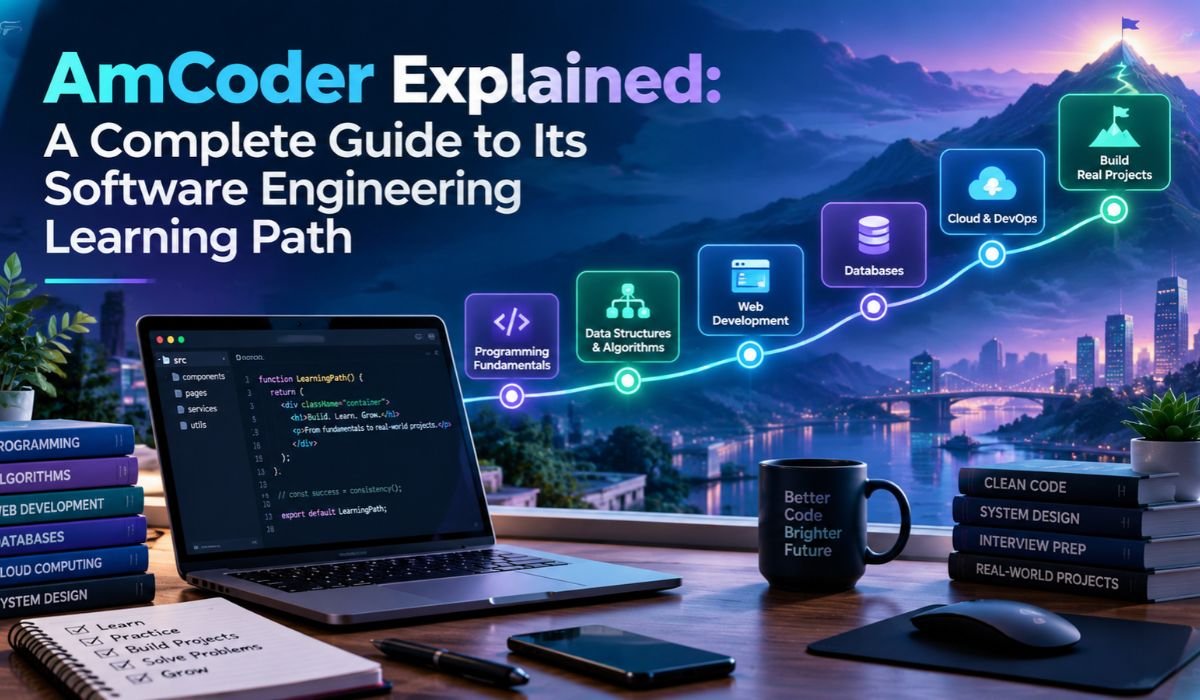
That’s the challenge AmCoder attempts to address. Rather than presenting software development as a collection of unrelated technologies, its broader learning approach places the major concepts within a structured software engineering path. Computer science fundamentals lead into problem solving and data structures; those ideas connect with databases and APIs, which in turn support frontend, backend, and system design concepts.
AmCoder’s public presentation also gives practical problem solving a prominent role. Coding and architecture challenges, focused working sessions, assessment criteria, and records of completed work are part of that picture.
For anyone researching AmCoder in 2026, though, there’s an important distinction to keep in mind. A well-organized roadmap can show students what they should learn, but it doesn’t by itself demonstrate teaching quality, employment outcomes, certificate recognition, or career success.
This guide looks closely at the AmCoder software engineering learning path, the subjects it covers, its practical engineering focus, and the questions prospective learners should ask before deciding whether it suits their goals.
What Is AmCoder?
AmCoder is an education-focused software engineering learning and practice platform associated with AmCoder.in. Its approach reaches beyond the basic task of learning programming syntax and looks at the wider knowledge developers need to understand software systems.
The broader roadmap covers computer science fundamentals, algorithms, data structures, databases, APIs, frontend and backend development, system design, and tools used in collaborative engineering environments.
Practical work also features in AmCoder’s public positioning. Coding and architecture problems give learners an opportunity to move beyond simply reading explanations or following instructions. That’s an important distinction. In real software development, knowing a concept and being able to apply it independently are two different abilities.
A learner might understand what a database index does, for example, yet struggle to recognize when one is needed. Similarly, someone may know the definition of caching without being able to explain where a cache should sit within an application.
It’s also important not to assume that every subject mentioned in AmCoder’s educational roadmap is necessarily offered as a complete standalone course. The roadmap describes a broader learning direction, while the current interactive catalogue represents the exercises and experiences actually available on the platform.
AmCoder Quick Bio Information
| Information | Details |
|---|---|
| Platform Name | AmCoder |
| Platform Type | Software Engineering Learning And Practice Platform |
| Associated Domain | AmCoder.in |
| Main Subject | Software Engineering |
| Learning Style | Structured And Practical |
| Intended Learners | Aspiring And Developing Software Engineers |
| Core Foundation | Computer Science Concepts |
| Problem-Solving Areas | Algorithms And Data Structures |
| Data Topics | Databases, SQL, And Storage |
| Application Topics | APIs, Frontend, And Backend Development |
| Programming Coverage | Includes JavaScript Within The Broader Roadmap |
| Advanced Learning | Software Architecture And System Design |
| Scaling Concepts | Caching, Traffic, Failure, And Load Balancing |
| Engineering Tools | Git, GitHub, Jira, And Figma |
| Professional Skill | Reading Existing Code |
| Practical Focus | Coding And Architecture Problems |
| Evaluation Approach | Published Assessment Criteria Are Emphasized |
| Pricing | Should Be Confirmed From Current Platform Information |
| Certification And Placement | Should Be Independently Verified |
| Guide Context | 2026 |
How the AmCoder Learning Path Is Structured
The most useful way to understand the AmCoder software engineering roadmap is to look at how one subject leads into another.
Computer science concepts provide the underlying context. Algorithms teach learners how to approach problems systematically, while data structures introduce different ways of organizing information. Databases then show how applications can store information beyond a single program session, and APIs explain how separate pieces of software exchange data.
From there, frontend and backend development begin to make more sense as connected parts of an application rather than isolated skills. System design widens the view even further by asking what happens when an application grows, traffic increases, components fail, or performance becomes a concern.
There’s a practical advantage to this order. A learner who understands why databases and APIs exist is in a better position to understand how a modern web application works from end to end.
AmCoder’s challenge-based elements add another layer. Independent problems can expose gaps that aren’t obvious while following a tutorial. When the instructions no longer tell you exactly what to type next, you have to decide how to approach the problem yourself.
That transition—from following a solution to making engineering decisions—is an important part of becoming a capable developer.
Computer Science Fundamentals Build the Foundation
It’s possible to write useful programs without knowing everything happening underneath them. Modern programming languages and frameworks deliberately hide enormous amounts of complexity. Still, understanding some of those underlying systems can make a developer much better at diagnosing problems and reasoning about software.
AmCoder’s broader roadmap introduces topics such as hardware, software, operating systems, memory, instructions, and processes.
These aren’t merely academic concepts.
A running application needs memory. The operating system manages processes and computing resources. Persistent storage allows information to remain available after an application closes. Instructions ultimately have to be executed by physical computing hardware.
Once those relationships become clearer, many later software concepts stop feeling arbitrary.
Memory usage, application performance, concurrency, storage, and process management all become easier to discuss when learners have a basic picture of what the computer is actually doing.
That doesn’t mean a beginner needs to become a hardware engineer before writing software. The point is to develop enough foundational knowledge to understand the environment in which software operates.
Algorithms and Data Structures Develop Problem-Solving Skills
Knowing programming syntax tells you how to express a solution. Algorithms and data structures help you think about what that solution should be.
An algorithm is essentially a defined method for solving a problem. A data structure determines how information is organized so that software can work with it effectively.
The AmCoder learning path discusses familiar structures such as arrays, stacks, queues, trees, and graphs. Each solves different organizational problems and comes with its own strengths and limitations.
This is where memorization can become misleading. Knowing the textbook definition of a queue isn’t nearly as valuable as recognizing a situation where queue-like behavior makes sense.
Efficiency matters as well. Developers use ideas such as time and space complexity to reason about how computational work and memory requirements change as inputs grow.
Code that performs perfectly well with a few dozen records may become painfully inefficient when faced with millions.
That change in perspective is significant. The question is no longer simply, “Does this code produce the correct answer?” It becomes, “Does this solution remain appropriate as the problem changes or grows?”
That’s much closer to the way engineers need to think.
Databases and SQL Connect Software With Real Data
Useful applications usually need to remember things.
An online store needs product and order information. A social platform needs user accounts and posts. A messaging service needs conversations. Business software may need customer records, invoices, permissions, and years of historical data.
AmCoder’s broader roadmap introduces relational databases, schemas, SQL, and storage concepts to explain how persistent application data can be organized and managed.
Relational databases arrange structured information into tables and establish relationships between those tables. SQL gives developers a way to query and modify that information.
Take an online store as a simple example. Customers, products, and orders can be stored separately while still being connected through defined relationships. A good database design helps preserve those relationships and maintain consistent information.
As learners progress, the subject becomes deeper. Indexes can affect how quickly information is retrieved. Constraints can help prevent invalid data. Query design can influence application performance.
This matters because a slow application isn’t necessarily suffering from poor frontend code. Sometimes the real issue is an inefficient database query or poorly designed data model.
Learning databases therefore isn’t just about memorizing SQL commands. It’s about understanding how applications depend on reliable, well-organized information.
APIs and Backend Development Connect Application Components
Most modern applications aren’t single pieces of software doing everything in one place. They consist of components that communicate with one another.
APIs help make that communication possible.
An Application Programming Interface defines how one piece of software can request information or functionality from another. Backend systems then handle many of the operations users don’t directly see, including application logic, database communication, validation, authentication, and interaction with external services.
Imagine opening a product page in an online store. The visible interface may ask a backend service for information about that product. The backend can retrieve the relevant data, apply necessary rules, and return a response for the frontend to display.
The AmCoder roadmap places APIs and backend fundamentals within this wider application picture.
That’s useful because it encourages learners to stop seeing the frontend, server, and database as unrelated technologies. They are different parts of one system.
Backend development also introduces less glamorous but essential responsibilities. Applications have to handle invalid requests, unexpected errors, authentication failures, unavailable services, and potentially malicious input.
Building a feature that works under ideal conditions is one task. Building one that continues behaving sensibly when things go wrong is a much more realistic engineering challenge.
Frontend Development and JavaScript Complete the User-Facing Layer
Frontend development is where much of a user’s direct interaction with software takes place.
The AmCoder roadmap includes browser behavior, JavaScript, application state, frontend architecture, and communication between the frontend and backend.
JavaScript plays a major role in interactive web applications. It can respond to clicks, validate forms, update interfaces, request data from servers, and change what users see without forcing an entire page to reload.
As applications become more sophisticated, developers also need to think about state.
A shopping cart has to remember which products have been selected. A dashboard may need to preserve filters. An account page may display information retrieved from a backend service and update when the user makes a change.
Managing those interactions becomes increasingly difficult as an application grows.
That’s where frontend architecture becomes important. Instead of putting everything into one large block of code, developers divide responsibilities into manageable components and establish clearer patterns for how information moves through the application.
Understanding that structure gives learners a better picture of frontend engineering than simply memorizing JavaScript syntax.
System Design Introduces Engineering at Scale
A small application running for a handful of users can hide problems that become obvious at scale.
What happens when thousands of people arrive at once? What if one service stops responding? What if the database becomes a bottleneck? What if the same expensive operation is being performed repeatedly?
These are system design questions.
The AmCoder learning path introduces both low-level and high-level design concepts. Low-level design tends to focus more closely on components, responsibilities, relationships, and implementation structure. High-level design considers the larger architecture and the way major pieces of a system interact.
Caching and load balancing are useful examples.
Caching can temporarily store frequently needed information so an application doesn’t repeatedly perform the same expensive work. Load balancing distributes incoming traffic across available computing resources rather than expecting one server or instance to handle everything.
Neither technique should be added simply because it sounds sophisticated.
Good system design is about making appropriate trade-offs. Engineers have to consider performance, reliability, complexity, maintainability, cost, and actual business requirements.
Sometimes the best architecture isn’t the most elaborate one. It’s the simplest design capable of meeting current needs without creating unnecessary problems later.
Git, GitHub, Jira, and Figma Bring Workplace Context
Learning to code alone and working on a professional software team can feel like two very different experiences.
AmCoder’s broader roadmap acknowledges that gap by including Git, GitHub, Jira, and Figma among its engineering tools.
Git allows developers to track changes to source code and work with different versions. GitHub is widely used for hosting repositories and supporting collaborative development workflows, including code review.
Jira is commonly used to organize work such as features, bugs, and development tasks. Figma, meanwhile, plays a major role in interface and product design workflows, allowing developers and designers to collaborate around visual specifications.
Put those tools together and a typical development task becomes easier to picture.
A developer might receive an assigned issue, examine the relevant design, modify the code, test the change, commit the work through version control, and submit it for review.
Specific workplace tools can change from company to company. The more lasting lesson is learning how version control, task management, design collaboration, and code review fit into professional software development.
Practical Challenges Can Test Real Understanding
Tutorials are useful, but they have a weakness: they often show learners exactly what to do.
That can create confidence without necessarily creating independence.
Remove the instructions and the situation changes. The learner now has to interpret the problem, choose an approach, implement a solution, and decide whether that solution is good enough.
This is why AmCoder’s emphasis on practical coding and architecture problems is notable.
Its public presentation describes focused problem-solving sessions and evaluation against stated criteria. Clear assessment criteria can help learners understand what a task expects instead of treating a score as an unexplained judgment.
Challenges can also reveal weaknesses that passive learning hides. A person may discover that they understand a concept when reading about it but struggle to apply it without guidance.
Even so, coding challenges shouldn’t be mistaken for the whole of software engineering.
Professional work also involves unclear requirements, debugging, testing, documentation, security, communication, maintenance, changing priorities, and decisions whose consequences may not become apparent for months.
Challenge-based practice works best when combined with broader project experience.
Reading Existing Code Is an Underrated Engineering Skill
Many tutorials begin with an empty folder and end with a small finished project. Professional software development often starts in exactly the opposite way.
You may open a codebase containing thousands of files written by people you’ve never met.
Before changing anything, you need to understand enough of the existing system to avoid damaging it.
That means tracing functions, examining dependencies, learning naming conventions, identifying architectural patterns, and working out how one change might affect other areas.
AmCoder’s broader learning philosophy recognizes reading other people’s code as a meaningful engineering skill.
It’s an important inclusion because software maintenance is a major part of professional development. Engineers don’t spend their entire careers creating brand-new applications from scratch.
Learners can strengthen this ability by exploring established projects, following execution paths, reading change histories, and making small modifications while checking whether existing behavior still works.
Writing code teaches you how to construct software. Reading code teaches you how other people constructed it—and sometimes why they made decisions you wouldn’t have made yourself.
Who Is AmCoder Best Suited For?
AmCoder may be useful to different learners for different reasons.
A beginner overwhelmed by disconnected tutorials may appreciate having a broader software engineering roadmap to follow. Computer science and engineering students may find value in seeing how theoretical subjects connect with application development.
Self-taught programmers can use the roadmap differently. Someone who already knows JavaScript, for instance, may realize that their knowledge of databases, algorithms, architecture, or system design is much weaker.
Developers preparing for technical assessments may be more interested in AmCoder’s practical coding and architecture challenges.
The platform won’t necessarily suit every learning preference.
Anyone looking specifically for intensive one-to-one mentorship, live classroom instruction, an accredited qualification, or guaranteed job placement should first establish whether those services are actually offered.
The right question isn’t simply whether AmCoder is “good.” It’s whether the current platform provides the type of learning experience a particular student needs.
AmCoder vs. Traditional Coding Courses
A conventional coding course and a software engineering roadmap aren’t necessarily trying to solve the same problem.
A dedicated Python, JavaScript, React, or SQL course can go deeply into one technology. That kind of focused instruction remains valuable, particularly when a learner needs practical fluency.
The broader AmCoder software engineering learning path addresses a different concern: how do those individual skills connect?
Its educational structure brings together computing fundamentals, algorithms, data management, application development, architecture, and collaborative engineering practices. Practical challenges can then give learners a way to test whether they can apply some of that knowledge independently.
In practice, learners don’t have to choose only one approach.
A strong learning strategy might combine structured courses, official technical documentation, personal projects, code reading, engineering challenges, and feedback from experienced developers.
No single platform can realistically reproduce every part of professional software engineering experience.
What to Verify Before Joining AmCoder
A promising curriculum is only one part of evaluating an educational platform.
Before joining AmCoder, prospective learners should check the current pricing structure, registration requirements, access conditions, available problems, support options, and learning format.
Certificates deserve particular scrutiny.
If a platform offers a completion certificate, that doesn’t automatically make it an accredited academic qualification or a credential widely recognized by employers. Learners pursuing certification for career reasons should establish exactly what is awarded and what recognition, if any, it carries.
Employment claims require the same caution.
Unless clear, independently verifiable evidence is available, completing AmCoder content shouldn’t be treated as a guarantee of interviews, placements, salary levels, or employment.
The type of feedback offered is another useful question. Learners should determine whether evaluation is automated, human-reviewed, community-based, mentor-led, or delivered through some combination of methods.
These practical details can have a significant effect on learning quality. Two platforms can cover almost identical topics yet provide very different educational experiences.
Is AmCoder Worth Exploring in 2026?
For learners who value structure and independent problem solving, AmCoder presents an interesting proposition.
Its broader roadmap covers many of the areas aspiring software engineers eventually need to understand, from computer science and algorithms to databases, APIs, frontend and backend development, architecture, and system design.
The practical side of the platform adds another dimension by asking learners to work through coding and architecture problems rather than only consume educational material.
That combination makes sense educationally. Learning provides the concepts; practice reveals whether those concepts can actually be used.
Still, prospective users should judge AmCoder by its current offering rather than the ambition of its roadmap alone.
Explore the available catalogue. Look at the difficulty of the problems. Examine how evaluation works. Determine what feedback is available and whether the platform provides enough instructional depth for your level.
There is also a naming issue worth remembering. AmCodr IT Solutions, AmcoderZ Infotech, and other similarly named organizations aren’t automatically connected with the education-focused AmCoder discussed here. Reviews or company information belonging to one organization shouldn’t be attributed to another simply because the names look similar.
Final Thoughts
The modern software engineering learner rarely suffers from a shortage of information. The bigger challenge is turning scattered information into a coherent understanding of how software works.
That’s where the AmCoder learning path becomes interesting.
Computer science fundamentals establish the underlying picture. Algorithms and data structures develop problem-solving ability. Databases explain persistent information. APIs show how systems communicate. Frontend and backend development turn those ideas into applications, while system design introduces questions of architecture, scale, performance, and reliability.
Professional tools and code-reading skills then bring the learning process closer to the realities of collaborative development.
AmCoder may therefore have a useful place in a broader software engineering journey, particularly for learners who want structure alongside practical problem solving.
But a roadmap is still a roadmap. Becoming a capable engineer requires more than moving through a sequence of topics. Learners need to build software, debug failures, read documentation, work through uncertainty, test their assumptions, study other people’s code, and keep improving their technical judgment.
Anyone considering AmCoder should evaluate its current material, exercises, assessment methods, support, and pricing against those needs. Used thoughtfully, a structured learning path can provide direction. The real progress comes from what the learner is eventually able to understand, build, explain, and improve.
FAQs About AmCoder
What Is AmCoder?
AmCoder is an education-focused software engineering learning and practice platform associated with AmCoder.in. Its broader learning path covers computer science fundamentals, algorithms, databases, application development, system design, and professional engineering concepts. Its public positioning also places emphasis on practical coding and architecture challenges.
What Does AmCoder Teach?
The broader AmCoder roadmap includes computing fundamentals, algorithms, data structures, relational databases, SQL, APIs, JavaScript, frontend development, backend concepts, software architecture, system design, and engineering tools. Learners should check the current platform catalogue to see which subjects are presently available as interactive lessons or challenges.
Is AmCoder Suitable for Beginners?
Parts of the AmCoder learning roadmap begin with foundational computer science concepts, making the overall structure relevant to beginners. Complete beginners should still examine the difficulty of current exercises and the amount of instructional guidance available before depending on AmCoder as their only learning resource.
Does AmCoder Teach System Design?
System design is part of AmCoder’s broader educational direction. Topics associated with the roadmap include architecture, component responsibilities, scalability, traffic, caching, load balancing, and failure. The platform’s practical positioning also includes architecture-oriented problem solving.
Is AmCoder Free?
Current pricing and access conditions should be checked before joining because platform offerings can change. Learners should confirm which problems or features can be accessed without payment, whether an account is required, and whether additional functionality is available through paid options.
Does AmCoder Provide Certificates?
The public information considered for this guide isn’t sufficient to establish a broadly recognized certification or formal accreditation program. Learners who need a credential should verify whether AmCoder currently provides a certificate, what requirements must be completed, and whether that certificate carries recognition relevant to their goals.
Can AmCoder Help With Software Engineering Interviews?
Some subjects associated with AmCoder—including algorithms, problem solving, architecture, and system design—overlap with skills commonly assessed during technical hiring. Practicing those areas may support interview preparation, but completing AmCoder material doesn’t guarantee an interview, job offer, or successful hiring outcome.
Is AmCoder the Same as AmcoderZ or AmCodr?
No. Similar names can refer to separate organizations. The AmCoder covered in this guide is the education-focused software engineering platform associated with AmCoder.in. AmcoderZ, AmCodr, and other similarly named businesses should be researched separately so that reviews, services, or claims aren’t accidentally attributed to the wrong organization.
Learn more and explore exciting content on: Whatsontech.co.uk Explained: Features, Safety, and Website Reputation







Leave a Reply