
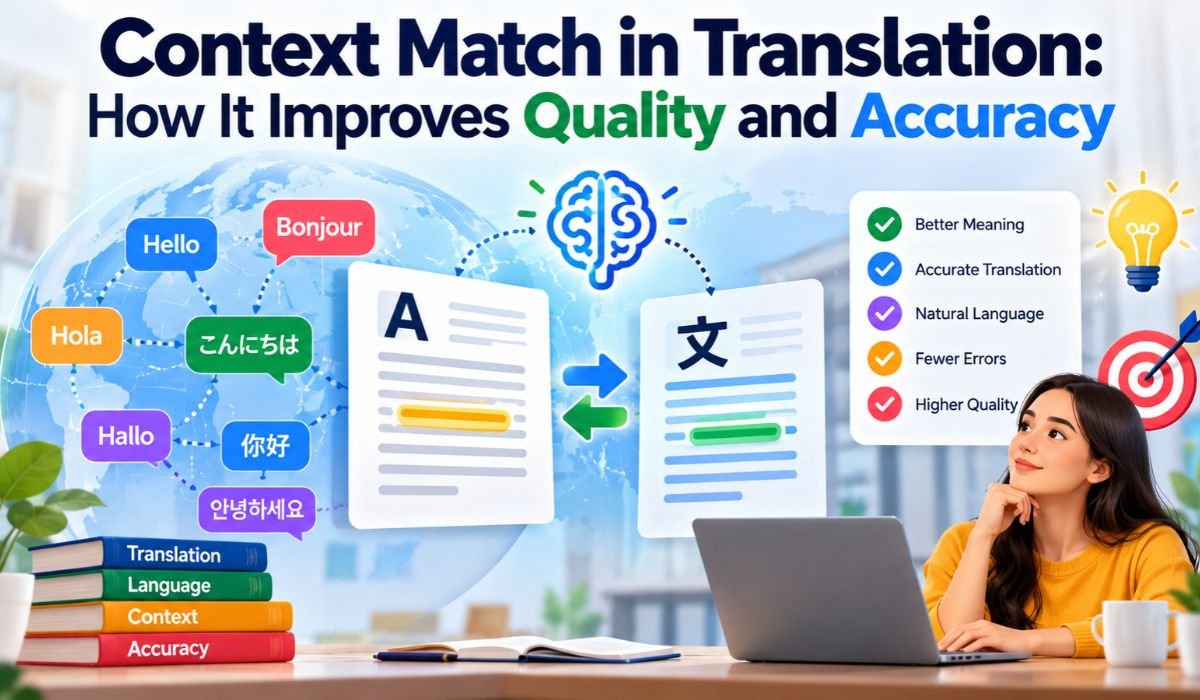
Professional translation has never been as simple as swapping words from one language for their equivalents in another. Meaning depends on context. Translators need to consider terminology, audience, tone, document purpose, and the relationship between one sentence and the next. A translation that works perfectly in one setting may sound confusing—or be completely wrong—in another.
That is one reason Computer-Assisted Translation tools, better known as CAT Tools, have become such an important part of professional translation and localization. These platforms help translators work with previously translated material instead of starting from zero every time familiar content appears.
At the center of that process is Translation Memory. It stores source segments alongside their translations and makes them available for future projects. Context Match takes this idea a step further by considering contextual information associated with a segment rather than relying only on identical source wording.
For translators, that can mean less repetitive work and more dependable suggestions. Localization teams can benefit from greater consistency across software, websites, technical manuals, product information, support content, and other multilingual materials.
Still, there is an important distinction to keep in mind from the beginning. A Context Match isn’t a guarantee that a translation is correct. It tells us that certain matching conditions have been satisfied. Translation Memory quality, terminology, project requirements, and professional judgment continue to matter.
Quick Bio Information
| Detail | Information |
|---|---|
| Main Term | Context Match |
| Main Field | Professional Translation |
| Core Technology | Computer-Assisted Translation |
| Main Resource | Translation Memory |
| Typical Higher Match | 101% In Some CAT Tools |
| Standard Exact Category | 100% Match |
| Partial Similarity | Fuzzy Match |
| Structured Context | Context Key Or Identifier |
| Main Purpose | More Reliable Translation Reuse |
| Quality Benefit | Improved Contextual Consistency |
| Productivity Benefit | Reduced Repetitive Work |
| Business Benefit | More Efficient Localization |
| Supporting Resource | Termbase |
| Common Users | Translators And Localization Teams |
| Typical Content | Software And Documentation |
| Key Requirement | Reliable Translation Memory |
| Main Limitation | Does Not Guarantee Accuracy |
| Human Role | Linguistic Review And Judgment |
| Related Technology | Machine Translation |
| Current Role | Core CAT And Localization Workflow Feature |
What Is A Context Match?
A Context Match is a Translation Memory result where the current source segment matches a stored source segment while also meeting contextual conditions recognized by the CAT Tool.
An ordinary exact match primarily tells the translator that the same source content has appeared in the Translation Memory before. A Context Match adds another piece of evidence: the stored translation was used in a context that the software considers equivalent or relevant to the current one.
What counts as “context” isn’t identical across every platform. The answer can also depend on the file being translated. With ordinary running text, neighboring segments may provide contextual information. Structured content, such as software strings, can instead rely on identifiers or Context Keys. Some environments can work with more than one type of context.
This distinction matters because identical words aren’t always intended to communicate identical ideas. A Context Match helps separate content that simply looks the same from content that is more likely to belong in the same linguistic situation.
How Context Match Works
Most CAT Tools break source material into manageable units known as segments. Depending on the document and its segmentation rules, a segment could be a sentence, heading, table entry, interface string, or another defined piece of text.
Once the content has been segmented, the CAT Tool compares each source segment against entries in the Translation Memory. If it discovers an identical or similar source entry, it can present the associated target translation to the linguist.
Context Matching adds another check.
Rather than relying exclusively on the words inside the segment, the system examines whatever contextual information is available and supported by the workflow. In continuous text, that could involve neighboring segments. In structured files, identifiers or Context Keys may be more informative than the sentences appearing before or after a string.
The exact process depends on the CAT Tool, source format, and project configuration. That’s worth emphasizing because Context Match isn’t a universal measure of translation quality. It’s a match category created according to a particular system’s rules.
Translation Memory And Context
Translation Memory, usually shortened to TM, provides the foundation on which Context Matching operates.
A Translation Memory stores source segments together with their translated target segments. Entries can also contain contextual information and metadata that help translators and CAT Tools determine when an earlier translation may be suitable for reuse.
It’s important not to confuse this with Machine Translation.
Translation Memory primarily retrieves translations that have already been stored. Machine Translation, by contrast, generates translations for source content using a translation model. The technologies may appear together in the same professional workflow, but they’re performing different jobs.
A carefully maintained Translation Memory can become extremely valuable over time. An organization that has accumulated years of professionally translated and reviewed material doesn’t need to repeatedly translate every unchanged sentence from scratch.
That advantage also comes with responsibility. If an incorrect, outdated, or poorly reviewed translation enters a trusted TM, it may be suggested again later. Context Matching doesn’t automatically repair a bad translation simply because its contextual information matches.
Reliable Context Matches therefore begin with reliable Translation Memory data.
What Does A 101% Context Match Mean?
A 101% Match can look puzzling the first time someone encounters it. After all, percentages normally stop at one hundred.
Within CAT Tool terminology, however, the figure isn’t meant to describe literal translation accuracy. In systems that use this convention, it provides a convenient way to distinguish a contextual match from an ordinary exact Translation Memory match.
A 100% result generally represents an exact source match under the tool’s matching rules. A 101% result can indicate that additional contextual requirements have also been satisfied.
It does not mean the translation is 101% accurate.
Think of the figure as a classification rather than a quality grade. The additional percentage point signals that the software has more matching information available than it would for a conventional exact match.
Terminology can vary considerably between CAT platforms. Some environments also distinguish between different levels or types of contextual matching. Translators and project managers should therefore understand what a particular tool means by its match categories instead of assuming that every percentage has an identical industry-wide definition.
Context Match Vs 100% Match
A 100% Match generally means that a source segment is identical to one stored in the Translation Memory according to the CAT Tool’s matching rules.
That sounds conclusive, but language isn’t always that straightforward.
Take the word “Balance.” In an online banking application, it might describe the amount of money available in an account. In instructions for industrial equipment, the same word could refer to physical stability. In accounting material, it may carry another specialized meaning.
The spelling hasn’t changed. The intended meaning has.
An exact source match can identify the identical wording, but it doesn’t necessarily prove that the earlier target translation belongs in the new situation. Contextual information can provide another clue, making a Context Match potentially more dependable for reuse.
Even then, the underlying Translation Memory remains crucial. If the original target segment contains an error, contextual matching may simply retrieve that error with greater confidence.
Context Match Vs Fuzzy Match
A Fuzzy Match is different. It occurs when the current source text resembles an existing Translation Memory entry but isn’t identical to it.
Suppose an older manual contains the sentence “Press The Button To Start The Machine.” A revised edition might say, “Press The Green Button To Start The Machine.” The two sentences are obviously related, so a CAT Tool may present the older translation as a Fuzzy Match.
That suggestion saves the translator from starting with an empty segment, but it still needs careful attention. The changed source wording must be reflected accurately in the target language.
Fuzzy Match percentages can help indicate similarity, yet they shouldn’t be treated as fixed measures of how much editing a translator will need to do. CAT Tools don’t necessarily calculate similarity in exactly the same way. Changes involving terminology, numbers, tags, punctuation, or grammatical structure may also carry very different levels of linguistic significance.
Context Match addresses a different question. Instead of merely showing how similar two source segments are, it provides contextual evidence around content that qualifies under the tool’s matching rules.
Context Match Vs PerfectMatch
Another term professionals may encounter is PerfectMatch, particularly in Trados-related workflows.
Although the names sound similar, PerfectMatch shouldn’t be treated as a universal synonym for Context Match. It is associated with a document-level approach to reusing material from previously translated bilingual documents.
Consider a manufacturer preparing a new edition of a technical manual. Much of the document may be unchanged from the previous release, while certain specifications, warnings, or operating instructions have been updated. A document-level reuse workflow can help identify existing translated material that corresponds to unchanged content in the newer version.
Context Matching and PerfectMatch both aim to make previous translations more useful, but they don’t necessarily arrive at their results in the same way.
For translators, localization managers, and buyers, understanding that distinction is especially important when reviewing CAT Tool analysis reports. Similar-looking match categories can represent different verification methods and therefore shouldn’t automatically be treated as interchangeable.
Why Context Matters In Translation
Context is one of the foundations of accurate translation because individual words rarely tell the whole story.
Consider “Charge.” It might refer to a financial fee, an electrical property, a legal accusation, or the process of supplying power to a battery. “Run” could mean operating software, managing a business, moving quickly, or executing a command.
The same problem can occur with complete sentences. A short instruction used on a software button may need different treatment when the identical words appear inside a detailed paragraph.
Context can influence more than vocabulary. It may affect grammatical agreement, gender, tone, style, terminology, and the level of formality expected by the audience.
Context Matching gives translation technology more information with which to evaluate reusable material. It doesn’t provide the full linguistic understanding of an experienced translator, nor is it intended to. Its strength lies in making Translation Memory reuse more informed.
How Context Match Improves Translation Quality
Consistency is one of the clearest ways Context Match can support translation quality.
Large localization projects often contain recurring warnings, interface labels, technical expressions, product descriptions, instructions, and standard sentences. If each occurrence is translated independently, small and unnecessary variations can creep into the finished material.
Translation Memory already helps solve this problem by making approved language reusable. Context Matching adds another layer by giving the system more information about whether an existing translation fits the current situation.
That can reduce needless rewriting and help maintain terminology across different files or document versions. It also allows translators and reviewers to spend more time on genuinely new, changed, or difficult passages instead of repeatedly solving linguistic problems that have already been addressed.
The benefit becomes particularly noticeable in long-running localization programs. When products and documentation evolve over months or years, dependable reuse can help keep newer releases aligned with established language.
How Context Match Supports Accuracy
Quality and accuracy are closely connected, but they aren’t identical.
A translation can be perfectly consistent and still repeat the same mistake everywhere.
Context Match supports accuracy primarily by reducing the risk of reusing identical source wording in an unsuitable situation. What it doesn’t do is independently determine whether the stored target translation is linguistically correct, factually current, legally appropriate, or consistent with a company’s latest terminology.
That distinction is essential.
Mature localization programs usually rely on more than one quality mechanism. Translation Memory may work alongside terminology management, linguistic review, automated Quality Assurance checks, project instructions, and controlled updates to previously approved language.
Seen this way, a Context Match is best treated as strong evidence that content may be suitable for reuse—not as proof that no further thought is required.
Context Match And Translation Costs
Translation Memory analysis can affect more than linguistic work. It can also influence project planning and pricing.
When a CAT Tool analyzes a file, the resulting report may separate content into categories such as new words, Fuzzy Matches, repetitions, exact matches, and Context Matches. Because these categories can require different amounts of translator effort, some agencies and Language Service Providers use weighted pricing or Net Rate models.
A segment that can be reliably reused may require less work than a completely new sentence. That efficiency can affect both schedules and budgets.
There is, however, no universal pricing rule for Context Matches. A particular percentage discount shouldn’t be assumed simply because a segment falls into a certain category.
Rates can depend on the language pair, subject matter, quality expectations, client agreement, review requirements, Translation Memory condition, and overall project risk.
For translation buyers, an analysis report is therefore best viewed as a planning tool. It reveals how much reusable content may exist, but it doesn’t function as an automatic price list.
Where Context Match Is Most Valuable
Context Matching tends to deliver its greatest value in content that is regularly updated but remains structurally stable.
Software localization is a good example. An application can contain thousands of interface strings, yet only a relatively small portion may change between releases. A dependable Translation Memory allows suitable existing translations to be reused while directing linguistic attention toward the strings that are genuinely new or modified.
The same principle applies to technical manuals, product catalogs, knowledge bases, help centers, websites, and recurring business documentation.
Source-content quality plays an important role here. Organizations that constantly rewrite unchanged sentences, alter terminology unnecessarily, or restructure documents without a clear reason can reduce the amount of useful translation reuse available later.
That leads to a broader lesson: efficient localization begins before the translation stage. Consistent source writing, stable structures, and sensible content management can make downstream translation work significantly easier.
Common Context Match Limitations
For all its usefulness, Context Matching has limits.
A previously approved translation may contain terminology that the organization no longer uses. Brand language can change. Regulations can be revised. Products evolve. An earlier translator may simply have misunderstood the source.
Audience also matters. The same source wording might need different treatment when material originally written for specialists is later adapted for ordinary consumers.
Context itself isn’t represented identically in every file format or CAT Tool either. Structured localization files may benefit from stable identifiers, while ordinary running text may rely more heavily on surrounding segments.
Translation Memories can also contain competing entries in which identical source content has more than one target translation. Those conflicts need careful handling rather than blind acceptance.
The practical response isn’t to distrust Context Matches. It’s to use them within a quality process that reflects the actual risk and purpose of the project.
When Human Review Still Matters
Human review remains especially important when translation errors could affect safety, legal meaning, regulatory compliance, financial decisions, brand reputation, or a user’s understanding of important information.
Legal contracts, medical information, financial documents, regulatory material, and safety instructions deserve particularly careful handling. Creative and marketing content may require substantial human attention for a different reason: emotional effect, style, and audience response often matter just as much as literal meaning.
Even seemingly straightforward Context Matches can contain issues involving variables, numbers, formatting, tags, grammatical agreement, gender, terminology, or references elsewhere in a document.
A good workflow doesn’t ask translators to redo reliable work simply for the sake of doing it again. Instead, automation handles repetitive tasks where appropriate, while human expertise is concentrated on decisions that require interpretation and judgment.
That balance is where CAT technology becomes most useful.
How To Improve Context Match Reliability
A trustworthy Context Match starts with a trustworthy Translation Memory.
Organizations should control which translations are allowed into their primary TMs, particularly when those resources will be reused across future projects. Errors should be corrected when discovered, obsolete terminology should be addressed, and conflicting entries should be investigated rather than allowed to accumulate indefinitely.
Useful metadata and contextual information should also be preserved whenever the workflow supports them.
Terminology management adds another layer of reliability. A carefully maintained Termbase can record approved terminology, definitions, and usage guidance, helping translators remain consistent even when Translation Memory alone isn’t enough.
Source writing matters too. Stable identifiers, consistent templates, predictable structures, and controlled terminology can all improve future reuse.
Over time, these practices turn a Translation Memory into something far more valuable than an archive of old sentences. It becomes a managed linguistic asset that supports translators, reviewers, project managers, and localization technology alike.
Context Keys And Structured Content
One important part of Context Matching is easy to overlook: Context Keys.
Not every translation project consists of paragraphs and complete sentences. Software localization, for example, often involves short strings such as “Open,” “Save,” “Home,” “Back,” or “Cancel.”
On their own, these words may provide very little information about where they’re displayed or what they mean. Neighboring text may not solve the problem either, especially when strings are extracted from software rather than presented in the order users will eventually see them.
Structured files can contain identifiers that help distinguish one string from another. Depending on the CAT environment and file format, those identifiers can provide contextual information for matching.
This becomes especially useful when the same source wording appears in several areas of an application but serves different functions or requires different target translations.
Context Keys also help explain why Context Matching can behave differently in software localization than it does in ordinary documents. The principle remains the same—give the system more information about where content belongs—but the contextual evidence may come from a different source.
Context Match And AI-Assisted Translation
By 2026, professional translation workflows increasingly bring several technologies together.
Translation Memory retrieves previously stored translations. Termbases help control terminology. Machine Translation can generate suggestions for content that hasn’t already been translated. AI-assisted systems can support additional linguistic and workflow tasks.
Although these technologies may appear side by side, they shouldn’t be treated as the same thing.
Traditional Context Matching remains valuable because it draws on reusable translation assets and defined contextual conditions. AI can provide broader language assistance, but it doesn’t remove the need for carefully maintained Translation Memories or reliable terminology.
In practice, strong modern localization workflows don’t depend on a single technology. They combine automation with trusted linguistic resources and experienced professional oversight.
Technology is particularly good at reducing repetitive work and surfacing relevant information quickly. Human translators remain essential when meaning must be interpreted, ambiguity resolved, style adapted, or risk evaluated.
Final Thoughts
Context Match may sound like a small technical feature inside a CAT Tool, but its value becomes much clearer once translation work is viewed at scale.
Organizations rarely want to translate the same reliable content from scratch every time a manual, application, website, or product is updated. Translation Memory solves much of that problem by making earlier translations reusable. Context Matching improves the process by giving the system more information about whether a stored translation belongs in the current situation.
The result can be greater consistency, less repetitive work, and more informed translation reuse.
Yet the technology works best when its limits are understood. A 101% Match—or any other high-confidence category—describes the relationship between current content and stored Translation Memory data according to the CAT Tool’s rules. It isn’t an independent certificate of linguistic quality.
That distinction matters.
The most dependable localization workflows combine Context Match technology with clean Translation Memories, controlled terminology, consistent source content, appropriate Quality Assurance, and experienced human judgment. Each element solves a different part of the problem.
When those pieces work together, Context Match becomes more than another percentage displayed in a translation editor. It becomes a practical way to preserve good work, reduce unnecessary repetition, and build translation processes that remain consistent and manageable as multilingual content continues to grow.
FAQs About Context Match
What Is A Context Match In Translation?
A Context Match is a Translation Memory result where the current source content matches a stored entry and also satisfies the contextual requirements defined by the CAT Tool. Those requirements can vary. Depending on the platform and file type, they may involve surrounding segments, identifiers, Context Keys, or other contextual information.
What Does A 101% Match Mean?
In CAT Tools that use this convention, a 101% Match identifies a Translation Memory result that includes qualifying contextual information in addition to an exact source match. The figure is a match classification. It doesn’t mean the target translation has somehow been measured as 101% accurate.
Is Context Match Better Than A 100% Match?
A Context Match can provide additional confidence because more than source-text identity has been considered. That doesn’t automatically make the stored translation correct, however. Its reliability still depends on the quality and relevance of the underlying Translation Memory entry.
Is Context Match The Same As Fuzzy Match?
No. A Fuzzy Match identifies source text that is similar but not identical to a stored Translation Memory segment. Context Match deals with matching content that also satisfies contextual conditions recognized by the CAT Tool. The two categories serve different purposes within a translation workflow.
Does Context Match Guarantee Translation Accuracy?
No. It can reduce the risk of inappropriate reuse, but it can’t guarantee linguistic accuracy. If an incorrect, obsolete, or unsuitable target translation is already stored in the Translation Memory, the CAT Tool may still retrieve it. Good TM maintenance and appropriate review remain essential.
Do Context Matches Need Human Review?
That depends on the project’s risk, content, workflow, and quality requirements. Some organizations may pre-translate, confirm, or lock trusted high-confidence matches under controlled conditions. Sensitive, high-risk, creative, or context-dependent content may still require professional linguistic review.
Can Context Match Reduce Translation Costs?
It can reduce repetitive translation work and make localization more efficient. Whether that produces a lower price depends on factors such as the provider’s pricing model, language pair, subject matter, review requirements, Translation Memory quality, and client agreement.
Do All CAT Tools Handle Context Match The Same Way?
No. CAT Tools can differ in how they store, calculate, label, and evaluate contextual information. Neighboring-segment rules, identifiers, Context Keys, match percentages, and terminology can vary between platforms. Users should therefore understand the settings and definitions of the CAT Tool used for their particular project.
Learn more and explore exciting content on: File Content Conversion: Types, Uses, Benefits, and Best Practices














Leave a Reply