
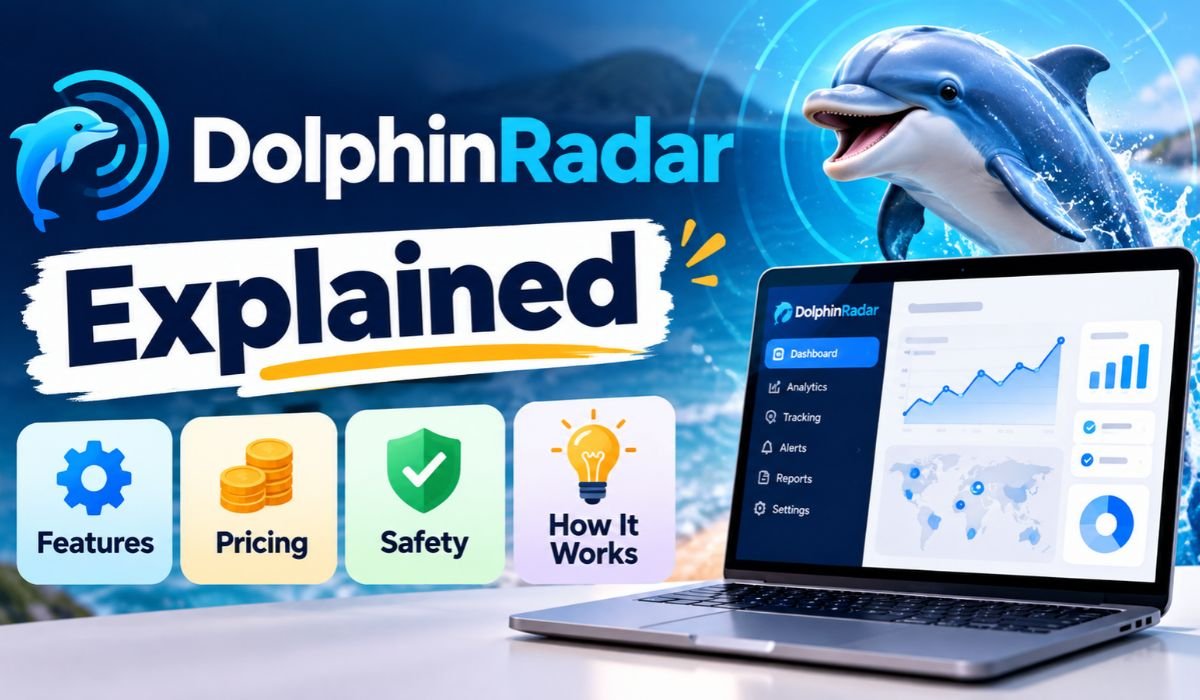
Keeping track of activity on Instagram sounds simple until you actually try to follow an account over time. Stories disappear, follower lists change, posts can be removed, and new interactions may come and go before you notice them. DolphinRadar aims to make that process easier by collecting and organizing certain types of publicly available Instagram activity.
As of 2026, DolphinRadar operates as a third-party Instagram viewing and analytics service. Its tools cover areas such as public Story viewing, account activity monitoring, follower changes, historical reports, and automated analysis. Some features are available without payment, while more advanced tracking and reporting tools require a subscription.
There is an important point to understand before going any further. DolphinRadar isn’t Instagram, nor is it owned, sponsored, or endorsed by Instagram or Meta. The service relies on information that is publicly accessible and on its own ability to collect that information. As a result, its reports shouldn’t be mistaken for a complete record of everything happening on an Instagram account.
For anyone considering the service, the important questions are fairly practical: What can DolphinRadar actually track? How frequently does it update? How much does it cost? And what should users know about privacy and safety? Those are the questions this guide addresses.
What Is DolphinRadar?
DolphinRadar is a browser-based platform built around viewing and analyzing publicly accessible Instagram activity. Instead of requiring someone to repeatedly check the same profile, the service attempts to organize selected public information into a more convenient format.
Its available functions vary depending on the tool and subscription. DolphinRadar describes features involving Stories, Highlights, posts, follower changes, following activity, likes, interactions, historical reports, and other public signals.
The emphasis on public information matters.
DolphinRadar states that it doesn’t provide access to private Instagram profiles, private Stories, direct messages, or information that isn’t otherwise publicly available. In practical terms, that means the platform is better described as a public-data viewing and monitoring service than a way of getting around Instagram’s privacy settings.
Understanding that distinction from the outset helps set realistic expectations for everything else the platform offers.
Quick Bio Information
| Quick Fact | DolphinRadar Information |
|---|---|
| Platform Name | DolphinRadar |
| Service Category | Instagram Viewing And Analytics |
| Main Purpose | Public Instagram Activity Analysis |
| Access Method | Web Browser |
| Official Instagram Product | No |
| Primary Information | Public Instagram Activity |
| Private Profile Access | Not Supported |
| Direct Message Access | Not Supported |
| Story Viewing | Available For Supported Public Content |
| Highlights Tools | Available |
| Activity Monitoring | Available |
| Story And Highlight Checks | Described As Daily |
| Activity Analytics | Generally Weekly |
| Historical Analytics | Up To 36 Weeks Advertised |
| AI Insights | Available With Certain Paid Features |
| Social Insights Tracking | One Account Per Subscription |
| Monthly Social Insights Price | $4.49 Listed In 2026 |
| Quarterly Price | $10.99 Listed In 2026 |
| Annual Price | $32.99 Listed In 2026 |
| Subscription Renewal | Automatic Unless Cancelled |
These details reflect DolphinRadar’s published information in 2026. Prices, features, availability, and subscription conditions can change, so anyone considering a purchase should confirm the latest terms before paying.
How DolphinRadar Works
The basic idea behind DolphinRadar is straightforward. A user searches for a public Instagram username, and the service attempts to collect supported information associated with that account.
For someone using a basic viewer, the experience is largely about seeing content that is currently publicly accessible. Tracking is more involved. DolphinRadar has to observe an account over time before it can identify changes and build a useful activity history.
According to DolphinRadar, its Activity Analytics feature requires an initial collection period before the first report is ready. Broader activity reports generally operate on a weekly schedule, while Stories and Highlights are described as being checked daily.
That schedule is worth paying attention to because it changes what users should expect from the service. DolphinRadar isn’t best understood as a second-by-second monitoring system. If something appears and disappears between scheduled checks, there’s a possibility it won’t be reflected in the resulting data.
For that reason, a DolphinRadar report is better viewed as an organized record of the public activity its system captured, rather than an unquestionable history of everything that happened on an account.
DolphinRadar Features
DolphinRadar has grown beyond the idea of a simple anonymous Instagram Story viewer. Its broader service combines individual viewing tools with ongoing account monitoring and analysis.
Activity reports may contain public signals related to follows, unfollows, likes, tagged accounts, interests, interactions, and other observable account activity. The platform also provides dashboard-style features intended to make accumulated information easier to understand over time.
Other DolphinRadar tools focus on Stories, Highlights, posts, followers, unfollowers, and downloadable information. For people conducting legitimate research or social media analysis, downloadable reports can be particularly useful because they make it easier to organize information outside the platform.
The important detail is that DolphinRadar isn’t one single feature with one universal access level. Different products and subscriptions can unlock different capabilities.
Users should therefore look closely at the current plan description before subscribing. Paying for one DolphinRadar product shouldn’t automatically be assumed to provide unrestricted access to every feature advertised elsewhere on the platform.
Anonymous Instagram Story Viewing
Anonymous Instagram Story viewing is one of the features most closely associated with DolphinRadar. The service presents its Story Viewer as a way to view supported Stories from public Instagram accounts without using a personal Instagram profile through Instagram’s normal Story interface.
For some users, that’s the main attraction. They may want to review publicly available content without their own Instagram username being involved in the ordinary viewing process.
Still, the word anonymous needs to be interpreted carefully.
Viewing an Instagram Story without connecting your Instagram identity isn’t necessarily the same thing as becoming completely anonymous online. DolphinRadar operates its own website and account system, and its privacy documentation describes the processing of information that can include email addresses, account details, feature usage, analytics information, and general location inferred from technical information such as an IP address.
There are therefore two separate privacy questions. The first is whether the Instagram account owner sees your personal Instagram identity through the normal Story viewer. The second is what information DolphinRadar itself may process while you’re using its website. Those shouldn’t be treated as the same thing.
Stories And Highlights Tracking
Stories are naturally difficult to monitor because they aren’t designed to remain permanently visible in the ordinary Story feed. DolphinRadar addresses this by offering tools for viewing supported public Stories and Highlights, along with monitoring features intended to retain certain content captured during tracking.
That can make the service appealing to users who need to follow public content over a longer period rather than checking Instagram manually throughout the day.
There are limits, though.
DolphinRadar describes its Story and Highlight monitoring as following a daily collection cycle, not a continuous one. That means the system’s ability to preserve temporary content depends on when the content is available and when DolphinRadar checks the account.
Historical reporting also has boundaries. DolphinRadar indicates that Stories and Highlights can’t simply be reconstructed retroactively in the same way that some historical activity reports may be available.
This is particularly important for anyone considering DolphinRadar mainly as an archive. Tracking can help preserve supported content captured after monitoring begins, but it shouldn’t be expected to recover every Story an account posted before that point.
Followers And Instagram Activity Tracking
Follower and following changes are another major part of DolphinRadar’s appeal. By comparing publicly accessible account information over time, the platform can identify certain changes involving follows, unfollows, mutual connections, and other activity.
For marketers, researchers, or people studying public creator activity, those changes can provide useful context. They may reveal how a public account’s network develops or how its visible interactions change over a period of time.
The data needs to be interpreted carefully, however.
An unfollow tells you that a detectable relationship changed between observations. It doesn’t tell you why. A like doesn’t prove friendship or romantic interest. Repeated interactions don’t automatically establish a business relationship or reveal someone’s private intentions.
This is an important principle when working with any social media analytics tool. Observable activity and explanations for that activity are two different things. Keeping those categories separate makes the resulting analysis more credible and reduces the risk of turning ordinary social media behavior into unsupported conclusions.
AI Insights And Automated Analysis
DolphinRadar has also introduced AI-based analysis as part of selected paid functionality. These features attempt to turn collected public signals into broader summaries and interpretations.
Depending on the available product, the platform describes AI Insights involving interests, public activity patterns, lifestyle indicators, notable topics, engaged accounts, and other inferred characteristics. Certain features may also produce personality-style estimates.
This is where users need to distinguish between collected data and generated interpretation.
A recorded public follow, for example, is an observable event if it was accurately captured. A conclusion about someone’s personality based on that activity is an inference. The two don’t carry the same level of certainty.
DolphinRadar’s own privacy documentation acknowledges this distinction. It warns that AI-generated material can be approximate, incomplete, or inaccurate and shouldn’t be considered a psychological diagnosis or verified statement of fact.
That makes AI Insights better suited to exploratory analysis than firm conclusions. They shouldn’t be used as evidence of a person’s mental state, personality, intentions, relationships, or suitability for important opportunities.
DolphinRadar Pricing And Plans
DolphinRadar combines free functionality with paid monitoring services. For users interested in Social Insights, the pricing information published in 2026 lists a monthly subscription at $4.49, a quarterly plan at $10.99, and an annual option at $32.99.
Spread across the subscription period, the quarterly plan works out to roughly $3.66 per month, while the annual option comes to about $2.75 per month.
There is an important practical restriction to consider. One Social Insights subscription is intended to monitor one Instagram account. Someone who needs ongoing monitoring across several accounts may therefore have to pay for additional subscriptions, which changes the overall cost considerably.
DolphinRadar also describes paid subscriptions as automatically renewing unless they are cancelled. Cancellation generally prevents the next renewal rather than immediately ending access that has already been paid for.
Prices and subscription structures can change over time. Before completing a purchase, users should check the final checkout price, included features, tracked-account allowance, renewal terms, applicable taxes, and current refund conditions.
Historical Reports And Data Accuracy
Historical reporting gives DolphinRadar another layer beyond simple public-content viewing. The service advertises access to as many as 36 previous weekly reports in supported situations, potentially allowing users to examine public account activity across a much longer period.
That’s useful, but it doesn’t turn the platform into a perfect archive of Instagram.
Social media profiles are constantly changing. A user can delete a post, change a username, switch a profile between public and private, alter a follower relationship several times, or remove content before a third-party monitoring service captures it.
Temporary content creates another challenge. If something disappears before a scheduled collection takes place, the resulting history may have a gap.
For these reasons, DolphinRadar’s historical reports are more accurately described as structured records of public signals successfully captured by its system. They shouldn’t be presented as forensic evidence or a complete history of everything an Instagram account has ever done.
That distinction is especially important whenever someone plans to use the information for research or decision-making.
Is DolphinRadar Safe And Legit?
Questions about whether DolphinRadar is safe or legitimate are common, but neither can be answered meaningfully with a single yes or no. Safety can refer to Instagram credentials, payment information, personal data, browsing privacy, or the reliability of the information being presented.
From an Instagram credential perspective, DolphinRadar’s public viewing tools advertise the ability to work without connecting a personal Instagram account. Not having to provide Instagram login credentials removes one common concern associated with third-party social media services.
Using DolphinRadar can still involve sharing information with DolphinRadar itself. Registering, subscribing, and using dashboard features may involve account, technical, analytics, or billing-related data.
The company publishes Terms of Use and privacy documentation explaining its practices and restrictions. Having those policies available gives prospective users information they can evaluate, but it shouldn’t be interpreted as proof that any online service is completely risk-free.
Users should read the current policies, understand the renewal terms, protect their account credentials, and decide whether the service’s privacy practices fit their own comfort level.
Privacy And Data Retention
Privacy deserves more than a passing mention because DolphinRadar handles information associated with both its customers and the public profiles being analyzed.
According to its 2026 privacy documentation, account information can remain stored while an account is active and for a period after deletion. Generated tracking reports can also be retained for a limited period after a subscription ends. Some transaction and billing records may need to be kept longer where tax, accounting, or other legal obligations apply.
DolphinRadar also describes technical and organizational measures intended to protect information, including safeguards for data while it is being transmitted.
As with virtually any online platform, those measures shouldn’t be mistaken for an absolute guarantee. No internet-based service can reasonably promise that security risks will never occur.
Users who care strongly about privacy can reduce unnecessary exposure by providing only required information, choosing strong and unique credentials, understanding retention periods, and reviewing the latest privacy terms before committing to long-term use.
What DolphinRadar Cannot Do
Knowing what DolphinRadar can’t do is just as useful as understanding its features.
The service states that it doesn’t provide access to private Instagram accounts, private Stories, direct messages, or information that isn’t available publicly. Someone shouldn’t therefore subscribe with the expectation that DolphinRadar will unlock a private profile or reveal another person’s private conversations.
Nor should the service be confused with guaranteed real-time surveillance.
DolphinRadar describes Story and Highlight checks as daily, while broader Activity Analytics generally follow a weekly reporting schedule. Those intervals naturally create room for gaps or delays.
A Story might appear and disappear between checks. An account could become private. A post could be removed before collection. A username could change. Instagram itself could alter how public information is displayed or made accessible.
Those limitations are normal considerations when dealing with third-party monitoring. By contrast, any service promising guaranteed access to another person’s private messages or locked profile content deserves considerable skepticism.
Regional Availability And Responsible Use
DolphinRadar isn’t necessarily available under identical conditions everywhere. Its 2026 Terms identify excluded jurisdictions and regional restrictions, making it important for prospective customers to check current eligibility before purchasing a subscription.
Availability is only part of the issue. How the service is used matters too.
DolphinRadar’s policies restrict activities involving stalking, harassment, intimidation, certain forms of surveillance, and inappropriate monitoring of minors. There are also restrictions around using collected information or AI-generated inferences for consequential decisions involving areas such as employment, housing, insurance, or credit.
These boundaries are worth taking seriously. Information being publicly visible doesn’t automatically make every form of collection, aggregation, interpretation, or use appropriate.
For marketers, businesses, researchers, and ordinary users, the sensible approach is to work with public information for legitimate purposes, follow applicable laws, respect privacy boundaries, and avoid using social media analytics as a substitute for verified personal information.
Who Should Use DolphinRadar?
DolphinRadar is likely to be most useful when a person’s needs match what the platform can realistically provide.
A marketer, for example, might study publicly visible activity from creators or competitors. A social media professional could follow changes in public engagement and account relationships. Researchers may find structured historical reports more practical than repeatedly checking individual profiles by hand.
Casual users may not need those advanced capabilities at all. If the goal is simply to view supported public content occasionally, the available viewing tools may be enough.
A paid subscription becomes easier to justify when someone genuinely needs recurring reports, ongoing monitoring, historical information, alerts, or more detailed analysis.
On the other hand, DolphinRadar isn’t suitable for anyone expecting access to private accounts, direct messages, guaranteed minute-by-minute monitoring, or definitive explanations of someone’s personal behavior.
The more useful question, then, isn’t simply whether DolphinRadar works. It’s whether the information the platform can legitimately collect matches the job a particular user wants it to perform.
Final Thoughts
DolphinRadar is most accurately viewed as a third-party platform for collecting, organizing, and interpreting certain forms of public Instagram activity. It isn’t a tool for breaking through Instagram’s privacy controls, and treating it that way would create unrealistic expectations from the start.
Its combination of public Story viewing, follower activity monitoring, historical reporting, downloadable information, and AI-assisted analysis gives it a broader role than a basic Instagram viewer. For marketers, researchers, social media professionals, creators, and other users with legitimate reasons to study public activity, having those signals organized in one place may save considerable time.
The limitations deserve equal attention. Monitoring isn’t guaranteed to happen in real time. Temporary activity can potentially be missed. Private accounts and direct messages remain outside the service’s stated capabilities, while AI-generated insights are interpretations rather than established facts about a person.
Accuracy also depends on context. A follow, unfollow, like, or interaction can be a useful data point, but it rarely explains someone’s motives on its own. Responsible analysis means recognizing where the observable evidence ends and speculation begins.
Before paying for DolphinRadar, prospective users should consider three practical questions. Is the information they need publicly available? Is DolphinRadar’s collection schedule fast enough for their purpose? And are they comfortable with the current subscription, renewal, privacy, and data-retention terms?
For the right use case, DolphinRadar can make public Instagram activity easier to review and understand. The key is approaching it as an analytics and viewing service with defined boundaries, rather than assuming it can reveal everything happening behind an Instagram account.
FAQs About DolphinRadar
What Is DolphinRadar?
DolphinRadar is a third-party Instagram viewing and analytics service centered on publicly available information. Depending on the tool or subscription, it can organize supported data involving Stories, Highlights, follower changes, following activity, interactions, and other public signals.
Is DolphinRadar Free?
Some DolphinRadar functionality is available without a paid subscription, particularly certain public viewing tools. Continuous tracking, historical reports, advanced analytics, and other premium capabilities may require payment. Because plans can change, users should check the current feature list before subscribing.
Can DolphinRadar See Private Instagram Accounts?
No. DolphinRadar states that it doesn’t access private Instagram profiles, private Stories, direct messages, or information that isn’t publicly available. It shouldn’t be considered a method for bypassing Instagram’s privacy controls.
Is DolphinRadar Tracking Real Time?
Not in the strict sense of the term. DolphinRadar describes Story and Highlight monitoring as occurring daily, while broader Activity Analytics generally follows a weekly schedule. A delay can therefore exist between activity taking place on Instagram and appearing in DolphinRadar.
Does DolphinRadar Require An Instagram Login?
DolphinRadar promotes its public viewing tools as working without connecting a personal Instagram account. Some paid monitoring and dashboard features may still require a separate DolphinRadar account.
How Much Does DolphinRadar Cost?
For Social Insights, pricing published in 2026 lists a monthly plan at $4.49, a quarterly plan at $10.99, and an annual subscription at $32.99. Other products may be priced differently, and current checkout information should always be checked before purchasing.
Can DolphinRadar Read Instagram DMs?
No. DolphinRadar states that it doesn’t access private Instagram direct messages. More broadly, people should be cautious about any third-party website claiming it can freely reveal someone else’s private conversations.
Is DolphinRadar Completely Anonymous?
DolphinRadar can provide a way to view supported public Instagram content without using a personal Instagram account through Instagram’s normal viewing interface. That doesn’t make a visitor completely anonymous online. DolphinRadar itself may process account, technical, and analytics information in accordance with its privacy practices.
Learn more and explore exciting content on: Startup Booted Guide: Funding Strategies for Growing Startups














Leave a Reply