
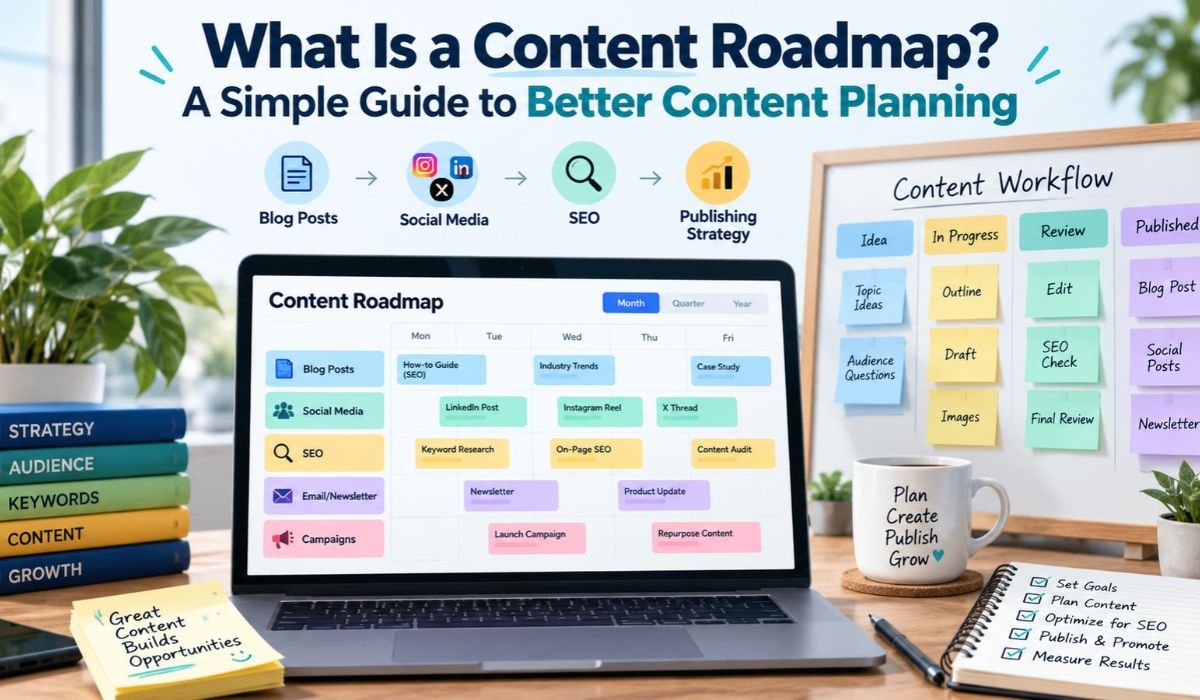
Publishing more content doesn’t necessarily produce better results. A company can turn out articles, landing pages, videos, newsletters, and social posts every week and still struggle to reach the right people or support meaningful business goals. In many cases, the problem isn’t a shortage of ideas. It’s the lack of a clear way to decide which ideas are worth pursuing.
That’s where a Content Roadmap earns its place.
Rather than treating every content request as equally important, a roadmap connects Content Planning with Audience Needs, Business Goals, available resources, distribution, and measurable outcomes. It shifts the conversation from “What should we publish next?” to a much more useful question: “What should we prioritize, and what do we expect it to accomplish?”
That distinction is especially important in 2026. People discover information through traditional search engines, websites, newsletters, social platforms, video, online communities, and AI-powered answer experiences. Trying to chase every channel or trend can quickly scatter a content team’s attention.
A well-designed Content Roadmap brings those moving parts together. For marketers, editors, SEO professionals, and business owners trying to understand What Is a Content Roadmap, the simplest answer is this: it provides a practical framework for creating the right content for the right audience, with a clear reason behind every major decision.
Quick Content Roadmap Information
| Content Roadmap Element | Practical Meaning |
|---|---|
| Main Purpose | Connect Content Priorities With Business And Audience Needs |
| Planning Level | Strategic |
| Typical Timeframe | Months, Quarters, Or Longer |
| Primary Focus | Priorities And Direction |
| Audience Foundation | Customer Problems, Needs, And Intent |
| Business Foundation | Defined Organizational Objectives |
| Research Foundation | Existing Content, Customer Evidence, Search Data, And Gaps |
| SEO Role | Identifies Relevant Search Opportunities |
| Strategy Connection | Converts Content Strategy Into Prioritized Work |
| Calendar Connection | Feeds Individual Assets Into Publishing Schedules |
| Ownership | Content, Marketing, Editorial, Or Digital Leadership |
| Workflow | Research, Creation, Review, Approval, Publication, And Maintenance |
| Distribution | Websites, Search, Email, Social, Apps, And Other Relevant Channels |
| Maintenance | Updating, Consolidating, Reusing, Or Retiring Content |
| Measurement | Audience, Business, And Operational Performance |
| AI Search | An Additional Discovery Consideration |
| Review Process | Ongoing Measurement And Periodic Strategic Review |
| Main Benefit | More Focused And Accountable Content Planning |
What Is a Content Roadmap?
A Content Roadmap is a strategic plan that identifies the major content priorities an organization intends to pursue over a defined period. It connects Business Goals with Audience Needs, Content Topics, Formats, Resources, Responsibilities, Distribution Channels, and Performance Measures.
What separates a roadmap from an ordinary publishing plan is the reasoning behind it. It doesn’t simply show what will be produced. It helps explain why certain initiatives deserve time, money, and attention.
Consider a software company that wants customers to become comfortable with its product more quickly. Its roadmap might prioritize beginner guides, onboarding resources, product documentation, FAQs, tutorials, and improvements to outdated support pages.
A company focused on generating qualified leads would probably make different choices. Comparison content, case studies, original research, product education, and resources answering high-intent buying questions could receive greater attention.
There’s no single format that every organization needs to follow. A small business might maintain its roadmap in a straightforward spreadsheet or planning document. A multinational organization could require a more sophisticated system covering several products, brands, countries, languages, and approval processes.
The tool itself isn’t the most important part. What matters is whether the roadmap makes priorities clear enough that everyone involved understands what the organization is trying to achieve and how its content contributes to that goal.
Why A Content Roadmap Matters
Most established content teams don’t struggle to generate ideas. They struggle to decide which ideas matter most.
SEO specialists may spot a promising search opportunity. Sales teams may request a comparison page. Product managers might need educational resources for a new feature, while senior leadership wants content supporting a wider company initiative.
Without a shared framework, the newest or loudest request can easily become the top priority.
A Content Roadmap introduces discipline into that process. Instead of relying on instinct alone, teams can evaluate potential projects according to Audience Value, Business Impact, urgency, existing coverage, available expertise, and the amount of work involved.
It can also expose unnecessary duplication. Before commissioning another article about a familiar subject, a team can check whether an existing page would be more valuable if it were updated, expanded, combined with another resource, or adapted for a different audience.
The benefits become even clearer in larger organizations. Regional teams and individual brands can see which information should remain consistent globally, what needs localization, and where genuinely separate content is necessary.
Ultimately, a roadmap is about focus. Publishing volume alone says very little about whether a content program is successful. What matters is whether the organization is creating useful material that supports a defined purpose.
Content Roadmap Vs. Content Strategy
Content Strategy and a Content Roadmap are closely related, but they aren’t interchangeable.
Content Strategy provides the broader direction. It considers who the audience is, what the organization wants to achieve, how the brand communicates, how quality is governed, which channels matter, and what role content plays throughout the Customer Journey.
A Content Roadmap takes those strategic decisions and turns them into priorities that people can actually work on.
Suppose a software company’s Content Strategy identifies customer education as an important way to encourage product adoption. Its roadmap could translate that goal into a series of priorities, such as improving onboarding material, creating instructional resources, expanding product FAQs, developing tutorials, and reviewing outdated documentation.
Put simply, the strategy establishes the direction and reasoning. The roadmap identifies the major work needed to move in that direction.
The relationship works both ways. A roadmap without a strong strategy can quickly become a collection of disconnected ideas. A strategy without a roadmap may sound impressive but never meaningfully influence what the team creates.
Content Roadmap Vs. Content Calendar
A Content Calendar goes one level deeper into execution.
It usually tracks individual articles, videos, emails, campaigns, deadlines, publication dates, channels, and contributors. A Content Roadmap sits above those daily and weekly details.
For example, a roadmap might establish “Improve Beginner Product Education” as a major priority for the quarter. The Content Calendar would then schedule the tutorials, articles, emails, videos, and page updates needed to make that priority happen.
Understanding this distinction makes both tools more useful.
Moving an article from Tuesday to Thursday changes the calendar, but it probably doesn’t affect the roadmap. A major change in product strategy, customer behavior, available resources, or company priorities could require the roadmap itself to be reconsidered.
For most mature content operations, the two tools work best together. The roadmap establishes where the team is going; the calendar manages the individual pieces of work required to get there.
What Should A Content Roadmap Include?
A Content Roadmap needs enough detail to support decisions, but not so much that maintaining it becomes a job in itself.
Its foundation normally includes Business Goals, Target Audiences, customer problems, major Content Priorities, topic areas, intended formats, ownership, approximate timelines, Distribution Channels, dependencies, and Success Metrics.
The Customer Journey also deserves attention.
Someone who has only just discovered a problem will usually need different information from someone comparing possible solutions. Early-stage audiences may benefit from educational material, while people closer to a decision may want product information, case studies, detailed comparisons, pricing explanations, or answers to specific buying questions. Existing customers may need onboarding, troubleshooting, support, or more advanced educational material.
For large organizations, the roadmap can include additional layers such as languages, countries, brands, localization requirements, approval processes, regulatory considerations, and rules governing content reuse.
Whatever its size, a good roadmap should answer a few fundamental questions. Who are we trying to help? What do they need from us? Which work deserves priority? Why does it matter? Who owns it? Where will it appear? And how will we know whether it worked?
If those answers are easy to find, the roadmap is doing its job.
Start With Clear Business Goals
The strongest roadmaps begin with outcomes, not a list of article ideas.
Before deciding what to create, ask what the organization actually wants its content to influence. The answer will vary. One business may want to generate qualified demand, while another needs better customer education. Other priorities could include supporting product adoption, entering a new market, increasing retention, or helping customers solve common problems without contacting support.
Once that larger objective is understood, it can be translated into a more practical Content Objective.
“Publish more articles,” for instance, describes activity rather than success. “Improve Coverage Of Common Customer Onboarding Questions” gives a team something far more useful to work with. The organization can identify those questions, examine its current resources, address important gaps, and then measure whether the new or improved material is helping.
Clear goals also make it easier to say no.
That’s an underrated part of Content Planning. Time, money, and expertise are limited, and not every interesting idea deserves immediate production. A genuine roadmap requires trade-offs. If everything is a priority, nothing really is.
Understand Your Target Audience
After defining the goals, attention should turn to the people the content is supposed to serve.
Effective Audience Research goes well beyond basic information such as age, location, or job title. Teams need to understand what people are trying to accomplish, what frustrates them, which questions they repeatedly ask, what influences their decisions, and what information they need at different stages of the Customer Journey.
Reliable insights can come from customer interviews, website analytics, CRM information, Search Console data, internal site searches, support tickets, surveys, sales conversations, and product feedback.
Using several sources is important. A persona built entirely around assumptions may look polished while bearing little resemblance to real customers.
Larger organizations may also distinguish between an Ideal Customer Profile and Audience Personas. An ICP generally describes the type of organization that represents a suitable customer. Personas focus on the individuals who research, recommend, purchase, implement, or use a product or service.
First-hand Experience becomes particularly valuable here. Customer service teams hear the questions people struggle with every day. Sales representatives know which objections repeatedly slow decisions. Subject-Matter Experts understand where seemingly simple topics become complicated.
Bringing that knowledge into the roadmap helps ensure that content reflects real audience needs rather than assumptions made inside a marketing department.
Audit Existing Content Before Creating More
Before adding another page to a website, it is worth finding out what is already there.
A Content Audit examines existing assets for accuracy, usefulness, relevance, performance, accessibility, freshness, duplication, ownership, and potential reuse.
Traffic alone doesn’t tell the whole story. A page with modest visitor numbers may answer an important question for existing customers. Another article may attract substantial traffic but contain outdated information or serve an audience that has little connection to the organization’s goals.
That context matters.
After reviewing an asset, the team can decide what should happen next. Some content deserves to remain as it is. Other material may need improvement, consolidation, repurposing, localization, or retirement.
Imagine two older articles answering almost the same customer question. Rather than producing a third article, the better option may be to combine the strongest information into one comprehensive resource. Similarly, an established guide with solid performance may need only updated facts and examples rather than a complete replacement.
This mindset changes Content Planning for the better. Existing material becomes something to manage and improve, not disposable inventory that must constantly be replaced by something new.
Research Topics, Keywords, And Content Gaps
Keyword Research still plays an important role in modern Content Strategy, but Search Volume shouldn’t be allowed to dictate the entire roadmap.
Useful topic selection combines several signals: Search Intent, Audience Needs, Business Relevance, existing coverage, competitive information, and evidence from real customer interactions.
Long-tail searches can be especially revealing. Their individual search volumes may be smaller, but they often expose specific problems and detailed questions. Sales calls, support conversations, internal search data, product feedback, and relevant community discussions can uncover opportunities that conventional keyword research may miss.
Once those opportunities are identified, related ideas can be organized into Content Pillars and Topic Clusters.
Doing so gives the site logical depth around important subjects rather than producing a series of disconnected articles that happen to target different keywords.
Content gaps need careful interpretation as well. Just because a competitor has a page targeting a particular term doesn’t mean your site automatically needs one. Sometimes an existing resource can answer the question perfectly well after being expanded or clarified.
The aim isn’t to own a separate page for every conceivable search query. It is to build genuinely useful coverage around subjects that matter to your audience.
Prioritize Content And Choose The Right Format
Research usually produces more ideas than a team can realistically create. Prioritization is what turns that collection into a roadmap.
Audience Value and Business Impact should sit near the center of the decision. Teams can also consider urgency, production effort, existing coverage, available expertise, strategic importance, and how long the content is likely to remain useful.
This broader view prevents Search Volume from becoming the deciding factor in every conversation.
A relatively low-volume question might deserve immediate attention if customers repeatedly struggle with it during an important stage of their journey. By contrast, a high-volume keyword may offer little strategic value if the people searching for it are unlikely to need what the organization provides.
Format matters just as much as topic selection.
A complex process may be easier to understand through a detailed tutorial or video. A straightforward definition might need only a concise explanation. Buyers comparing alternatives may benefit from a transparent comparison, while a case study can show how a solution works in a real setting.
The format should serve the reader’s task, not the latest content trend.
Build A Clear Editorial Workflow
Even an excellent roadmap won’t achieve much if content repeatedly gets stuck between idea and publication.
An Editorial Workflow defines what happens after a project receives approval. Depending on the organization, that can include research, briefing, creation, editing, fact-checking, Subject-Matter Expert review, legal or compliance approval, publication, maintenance, and eventual retirement.
Responsibility needs to be clear throughout that process.
Writers should know who can verify technical claims. Editors need to understand when specialist review is required. Stakeholders should know who has final authority when different reviewers disagree.
For smaller teams, a straightforward ownership system may be enough. More complex organizations can use a RACI Framework to clarify who is Responsible, Accountable, Consulted, and Informed.
Not every piece of content should be forced through the same process, either. A highly regulated product page may need several layers of approval. A routine editorial update probably doesn’t.
Designing workflows according to the level of risk helps protect quality without turning ordinary publishing into an unnecessarily slow process.
Plan Distribution And Content Reuse
Pressing “publish” isn’t the finish line.
A Content Roadmap should consider how useful information will reach the people who need it. Depending on the audience, Distribution may involve Organic Search, websites, newsletters, social channels, apps, regional properties, partner platforms, or other relevant destinations.
Good source material can also have a life beyond its original format.
Research from an in-depth guide could inform a newsletter, presentation, short video, FAQ, sales resource, or social discussion. That doesn’t mean copying and pasting the same text everywhere. Effective repurposing adapts the information to the expectations and context of each channel.
The issue becomes more complex for organizations operating across several brands or markets.
Those businesses need clear rules about which information is globally controlled, what regional teams can adapt, who owns the original source, and how important updates are reflected across reused versions.
Good governance reduces unnecessary duplication while lowering the risk that customers encounter conflicting or outdated information.
How AI Search Changes Content Planning
AI-powered discovery has introduced another dimension to Content Planning in 2026.
People still use traditional Search Results, but they can also encounter information through conversational interfaces and AI-generated answers. For content teams, this means valuable information may influence a reader before that person ever reaches the organization’s website.
That change doesn’t make established SEO principles irrelevant. If anything, it reinforces the importance of clear, trustworthy information.
Descriptive headings, straightforward definitions, direct answers, logical organization, accurate claims, transparent authorship, and meaningful updates make a page easier for people to understand. They can also make its information easier for automated systems to interpret.
This broader area is sometimes described as Answer Engine Optimization, or AEO. It is better viewed as an extension of good information architecture and SEO than as a replacement for them.
Structured data can provide machines with explicit information about certain page elements when a suitable supported type exists. However, markup must accurately represent the visible content, and its presence doesn’t guarantee special search treatment.
The same caution applies to AI citations. No publisher can guarantee that ChatGPT, Google AI experiences, or another AI system will cite a particular page.
A more durable strategy is to become a genuinely useful and trustworthy source instead of attempting to write primarily for an algorithm.
Using AI In The Content Workflow
AI isn’t only changing how information is discovered. It can also support parts of the Content Workflow itself.
Teams may use AI-assisted tools to organize large sets of customer questions, identify recurring themes, summarize research notes, compare content inventories, develop preliminary briefs, or suggest ways approved source material might be repurposed.
Those uses can save time, particularly when teams are dealing with large amounts of information. They don’t remove the need for human judgment.
Facts still need to be checked. Subject-Matter Experts should review information when specialized knowledge matters. Editors need to assess originality, context, permissions, tone, usefulness, and whether the finished material actually answers the reader’s question.
In other words, AI can support editorial work, but it shouldn’t become the editorial authority.
Efficiency only matters when the resulting content remains accurate, useful, and trustworthy.
Measure And Improve The Roadmap
A roadmap shouldn’t end with publication. Teams need to know whether their priorities are producing the intended results.
Measurement should therefore connect directly to the goals established at the beginning.
If customer education is the objective, useful indicators might include engagement with educational resources, completion of important tasks, product adoption signals, or reductions in recurring support questions where reliable measurement is available.
A demand-generation program may focus more heavily on qualified Organic Traffic, conversions, leads, or content-assisted opportunities.
The health of the production process matters as well. Editorial Cycle Time, Publishing Velocity, Content Freshness, reuse rates, approval delays, and revision patterns can reveal whether the operation is sustainable.
Organizations experimenting with AI Search Measurement may also track brand appearances or citations across a defined set of relevant prompts. Those figures require careful interpretation because generative responses can vary between platforms, users, and individual queries.
Measurement shouldn’t exist merely to fill a dashboard. Its purpose is to improve future decisions.
When the evidence shows that an initiative is working, teams can build on it. When a priority repeatedly fails to deliver value, the roadmap should be flexible enough to change.
Common Content Roadmap Mistakes
One of the easiest ways to weaken a Content Roadmap is to fill it with every good idea the team has.
A roadmap is useful because it forces choices. When everything is marked as important, the document stops providing direction.
Other common problems include vague Business Goals, weak Audience Research, unrealistic production targets, unclear ownership, excessive dependence on Search Volume, poor Distribution Planning, and failure to maintain existing resources.
Publishing volume can also create a false sense of progress. Producing dozens of new pages may look productive, but the number itself says little about whether readers found the content useful or whether it supported the goal for which it was created.
Artificial freshness is another trap. Changing a date without meaningfully reviewing or improving the underlying information doesn’t make a resource more valuable.
Finally, teams should resist building a planning system so complicated that nobody wants to maintain it. If managing the roadmap consumes more energy than using it to make decisions, simplification is overdue.
Best Practices For Better Content Planning
The most effective Content Planning combines evidence, expertise, and enough flexibility to respond when circumstances change.
Start with genuine Audience Needs and clearly defined Business Goals. Treat Search Data as one source of evidence rather than the entire strategy. Bring in people who understand customers and the subject matter. Maintain strong existing resources instead of constantly chasing new URLs. Establish clear ownership, fact-checking standards, and appropriate editorial review.
Distribution should be intentional as well. Great content that never reaches the right audience has limited value.
When resources are tight, prioritization becomes even more important. Improving an established resource or solving a high-value customer problem may produce more value than publishing several new articles simply to maintain output.
A roadmap should also remain alive.
Products evolve. Customer questions change. Search environments shift. New channels appear, and old assumptions stop being useful.
The goal isn’t to predict every future development. It is to create enough strategic stability for a team to work confidently while leaving room to respond when credible evidence suggests a better direction.
Strengthening Experience, Expertise, Authority, And Trust
E-E-A-T is most useful when it shapes editorial quality rather than being treated as a collection of SEO phrases to add to a page.
Experience can come through genuine practical knowledge, original examples, first-hand observations, or insights from people who regularly perform the work being discussed.
Expertise is demonstrated through accurate, nuanced explanations and appropriate involvement from Subject-Matter Experts. Authority tends to develop over time as an organization consistently publishes useful material and earns a reputation for understanding its subject.
Trust holds those qualities together.
Readers should be able to understand who created or reviewed important information, when it was meaningfully updated, and why the source deserves their confidence. Claims should be accurate. Errors should be corrected. Credentials should be genuine rather than invented or exaggerated.
For an article explaining What Is a Content Roadmap, practical examples, realistic planning advice, clear definitions, and transparent editorial information are far more convincing signals of quality than repeatedly mentioning SEO terminology.
The aim should always be to leave the reader better informed than when they arrived.
Final Thoughts
Understanding What Is a Content Roadmap becomes much easier once it is separated from the idea of a simple publishing schedule.
A roadmap is ultimately a decision-making framework. It connects what an organization wants to accomplish with what its audience genuinely needs, then helps teams decide where their limited time and resources should go.
The strongest roadmaps bring together Audience Research, Content Audits, SEO, Topic Planning, Editorial Workflows, Distribution, ownership, measurement, and emerging discovery channels without allowing any one of those elements to dictate the entire strategy.
They also don’t need to be complicated.
A useful roadmap should make difficult decisions easier. It should help a team understand what deserves attention now, what can wait, what existing material needs improvement, and what success should look like.
That principle matters even more as content discovery continues to change. Search engines, AI-powered experiences, social platforms, and other channels will keep evolving, but the underlying challenge remains remarkably consistent: people want information that helps them understand something, solve a problem, or make a better decision.
Teams that understand those needs, apply genuine expertise, prioritize carefully, maintain their strongest resources, and measure meaningful outcomes are far better positioned to create content that remains valuable regardless of how the next discovery channel develops.
FAQs About Content Roadmaps
What Is A Content Roadmap?
A Content Roadmap is a strategic plan that identifies an organization’s major Content Priorities and connects them with Audience Needs, Business Goals, ownership, distribution, and measurement. It gives teams a shared understanding of what deserves attention and why.
What Is The Main Purpose Of A Content Roadmap?
Its main purpose is to give content work direction. Instead of creating disconnected articles, videos, or campaigns, teams can prioritize initiatives that solve meaningful audience problems while supporting defined organizational objectives.
What Is The Difference Between A Content Roadmap And A Content Calendar?
A Content Roadmap focuses on broader strategic priorities, often across months or quarters. A Content Calendar deals with execution, including individual assets, assignments, deadlines, publication dates, and channels. The roadmap sets the direction; the calendar schedules the work.
What Is The Difference Between Content Strategy And A Content Roadmap?
Content Strategy defines the larger approach, including audiences, goals, editorial principles, governance, positioning, and channels. A Content Roadmap translates that strategy into prioritized initiatives that teams can plan and execute.
Who Should Own A Content Roadmap?
There is no single ownership model that works for every organization. Content, Marketing, Editorial, Product Marketing, or Digital leadership may manage the roadmap, while SEO, Analytics, Sales, Product, Customer Service, Legal, and Subject-Matter Experts contribute where their knowledge is relevant.
How Long Should A Content Roadmap Cover?
There is no universal timeframe. Quarterly planning works well for many teams because it provides meaningful direction without making the plan too rigid. Organizations with longer product, budget, or campaign cycles may also maintain annual priorities supported by more frequent reviews.
How Often Should A Content Roadmap Be Updated?
Teams can monitor performance regularly and conduct deeper strategic reviews periodically, such as quarterly or after meaningful changes in products, resources, Audience Behavior, market conditions, or Business Priorities. Changes should be driven by evidence rather than the desire to make a roadmap appear constantly new.
Can AI Help With A Content Roadmap?
Yes. AI can assist with organizing research, clustering customer questions, identifying patterns, summarizing information, comparing inventories, and preparing early briefs. Human expertise remains essential for strategic decisions, factual verification, originality, context, editorial judgment, and final approval.
Learn more and explore exciting content on: ID God Explained: What It Is, How It Works, and Key Facts













Leave a Reply