
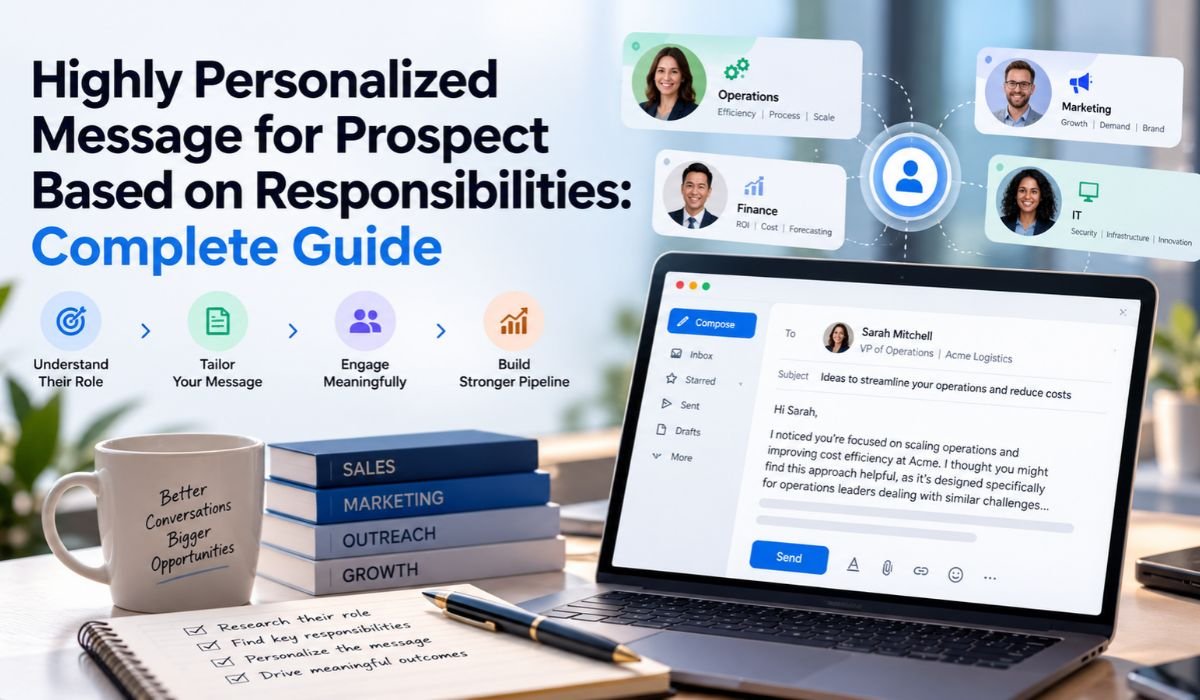
Most busy professionals see a steady stream of sales emails, connection requests, partnership pitches, and business proposals. Many of those messages have one thing in common: they could have been sent to almost anyone.
Adding a first name, company name, or job title may technically qualify as personalization, but it doesn’t necessarily make a message relevant. A Highly Personalized Message for Prospect Based on Responsibilities goes further. It connects the reason for reaching out with the recipient’s actual professional world—the work they’re responsible for, the priorities surrounding their role, and the business context in which they operate.
That distinction matters because different people evaluate value in different ways. A sales leader may be thinking about pipeline quality, forecasting, conversions, and team productivity. A technology leader could be more concerned with security, integrations, scalability, reliability, and technical workload. Even two people with exactly the same title may have very different responsibilities depending on their organizations.
Good personalization, then, doesn’t begin with a template. It begins with understanding. The aim isn’t to demonstrate how much information you’ve gathered about a prospect. It’s to learn enough about their professional situation to explain, clearly and respectfully, why your message may be worth their time.
Quick Information
| Information | Details |
|---|---|
| Main Topic | Responsibility-Based Prospect Personalization |
| Primary Purpose | Create More Relevant Professional Outreach |
| Common Users | Sales And Business Development Teams |
| Other Users | Founders, Recruiters, Consultants, And Marketers |
| Core Principle | Research Before Writing |
| Main Personalization Area | Professional Responsibilities |
| Best Starting Point | Verified Professional Information |
| Useful Context | Role, Company, Industry, And Current Initiatives |
| Main Writing Goal | Connect Responsibilities With Relevant Value |
| Recommended Tone | Natural, Professional, And Respectful |
| Opening Focus | Recipient Context |
| Value Focus | Relevant Outcomes |
| Essential Principle | Separate Facts From Assumptions |
| Strongest Evidence | Genuine And Relevant Results |
| CTA Approach | Clear And Low Friction |
| Follow-Up Approach | Add New Context Or Value |
| AI Role | Research Support And Draft Assistance |
| Human Role | Verification, Judgment, And Editing |
| Privacy Principle | Use Professional Data Responsibly |
| Success Focus | Meaningful Business Conversations |
What Is A Highly Personalized Message For Prospect Based On Responsibilities?
A Highly Personalized Message for Prospect Based on Responsibilities is professional outreach built around meaningful aspects of the recipient’s work. Those details might include their responsibilities, current business priorities, company developments, public professional activity, or an initiative that has a genuine connection with what you’re offering.
Consider the difference between two approaches. Writing, “Hi Sarah, I noticed you’re the Marketing Director at ABC Company,” uses personalized information, but it doesn’t reveal much understanding. The same sentence could easily be generated from a contact database.
A stronger message would connect a verified development at Sarah’s company with something relevant to her professional area. If the business has publicly announced an expansion into new international markets, for instance, a company offering localization services might have a legitimate reason to start a conversation about managing marketing across those markets.
That’s the heart of meaningful personalization. It isn’t about collecting the largest possible amount of information about someone. It’s about finding the small amount of professional context that makes the conversation genuinely relevant.
Why Responsibility-Based Personalization Matters
A prospect doesn’t need to study an entire email before deciding whether it deserves attention. In many cases, the first few lines reveal whether the sender understands why they’re reaching out.
Responsibility-based personalization makes that connection easier to see. When outreach refers to a real initiative, relevant professional responsibility, or verified business development, the recipient has a clearer reason to continue reading.
It can also signal preparation. There’s a noticeable difference between a message created for thousands of recipients and one written with a particular professional situation in mind.
That doesn’t mean personalization guarantees replies, meetings, or sales. No responsible outreach strategy can make that promise. A carefully researched message can still arrive at the wrong moment, address a low-priority issue, or offer something the prospect simply doesn’t need.
The real benefit is more fundamental: personalization can make business communication clearer, more relevant, and more respectful of the recipient’s time.
Understand The Prospect Before Writing
Strong personalization starts before the first sentence is drafted. The research stage is where you establish whether there’s actually a relevant conversation to have.
Begin with the basics: the person’s current role, organization, industry, level of seniority, and publicly visible professional priorities. Company leadership pages, public job descriptions, official announcements, interviews, conference appearances, company reports, and professional posts can all provide useful context.
The harder part is interpreting that information correctly.
A job title offers clues, but it doesn’t tell the entire story. A marketing leader at a small business might oversee advertising, content, analytics, partnerships, social media, and brand strategy. Someone with an identical title inside a multinational company could manage one specialized function with a large team around them.
For that reason, role knowledge should be treated as a starting point rather than proof. Verified information tells you what you know. General knowledge about a role tells you what might be relevant. Keeping the two separate helps prevent inaccurate personalization.
Research Responsibilities Without Making Assumptions
The most useful prospect research usually looks beyond the title and considers what’s happening around the person and their organization.
Suppose a company publicly announces plans to enter several new markets. That development could create new considerations around marketing, recruitment, customer support, operations, technology, logistics, or compliance. The expansion itself is a verified fact. Whether a particular prospect is personally responsible for one of those areas may be less certain.
Your wording should reflect that difference.
Telling someone, “I know you’re struggling to manage the expansion,” makes two assumptions: that they’re directly responsible for it and that they’re struggling.
A more careful approach might be: “With the company’s recent expansion, I wondered whether managing X across new markets is becoming more important for your team.”
The message is still personalized, but it doesn’t pretend to know what happens behind closed doors. That restraint isn’t a weakness. It’s part of writing credible outreach.
Match The Message To Professional Priorities
Job responsibilities provide valuable context because different roles often evaluate the same business issue from different perspectives.
A founder or CEO may look at growth, profitability, risk, operational efficiency, and strategic execution. Sales leaders commonly work with questions involving revenue, pipeline health, forecasting, conversions, and team performance. Customer success leaders may pay close attention to adoption, customer experience, renewals, and retention.
Technology leaders often approach decisions through another lens, considering security, integrations, scalability, reliability, implementation requirements, and technical overhead.
These patterns are useful, but they’re not universal rules.
One of the easiest prospecting mistakes is to build a buyer persona and then assume every real person with that title matches it perfectly. A stronger approach combines broad knowledge of the role with specific evidence about the company and individual.
Instead of asking only, “What do sales directors usually care about?” ask a more useful question: “What appears relevant to this sales director at this company right now?”
That small change in perspective can dramatically improve the quality of the message.
Connect Your Solution With Their Responsibilities
Research only becomes useful when it helps you decide what to say.
This is where many prospecting messages lose focus. Sellers naturally know a great deal about their own products, so there’s a temptation to explain every feature, capability, integration, and benefit at once. Unfortunately, that often turns a personalized opening into a generic product pitch.
A better approach is to identify the part of your offer that has the clearest connection with the prospect’s work.
Imagine a platform that automates reporting. An operations manager might care about reducing repetitive administrative work. A department leader could be more interested in visibility across the team, while a senior executive may value faster access to information for decision-making.
Nothing about the product has changed. What’s changed is the perspective from which its value is explained.
Effective personalization doesn’t require altering or exaggerating what your solution can do. It means choosing the truthful benefit that’s most relevant to the person reading the message.
Write An Opening That Establishes Relevance
The opening line has one main job: give the recipient a credible reason to continue reading.
Professional developments often provide useful starting points. A new role, company expansion, product launch, hiring initiative, public interview, presentation, funding announcement, or publicly discussed project can create natural context when it relates directly to your reason for reaching out.
What doesn’t work nearly as well is generic admiration.
Statements such as “I love what your company is doing” or “I came across your impressive profile” sound personalized, but they rarely communicate anything substantial. They’re easy to write and equally easy for a recipient to dismiss.
Specificity works better when it serves the conversation. Mention the relevant development, explain its connection to your message, and move forward.
You also don’t need to reveal every piece of research you’ve done. Too many personal references can make a professional message feel uncomfortable. The best opening establishes relevance without turning the email into a demonstration of your research skills.
Build The Message Around A Simple Framework
Once you’ve established context, the rest of the message should follow naturally.
A practical sequence begins with a relevant observation, connects that observation with professional context, introduces a possible challenge or opportunity, explains useful value, provides credible evidence where appropriate, and ends with a straightforward next step.
Imagine you’re contacting a customer success leader at a company that has publicly reported rapid customer growth. It would be risky to write, “Your support team must be overwhelmed.” You don’t know that.
Instead, you could acknowledge the growth and explain that expanding customer bases can sometimes put additional pressure on onboarding or service workflows. From there, you can briefly show how your solution addresses that particular area.
The difference may seem subtle, but it’s important. One version invents an internal problem. The other identifies a reasonable possibility and gives the prospect room to decide whether it applies.
Good personalization is specific without becoming presumptuous.
Use Evidence To Strengthen Trust
Personalization may win attention, but evidence can make the underlying proposition more credible.
If your company has genuinely helped another organization solve a similar problem, a concise customer example can provide useful context. Evidence may be especially relevant when it involves a comparable role, business model, industry, or operational challenge.
Accuracy is essential.
Customer names, testimonials, percentages, performance improvements, partnerships, and case-study results should never be invented or embellished. A dramatic statistic might make a message look stronger at first glance, but questionable evidence can destroy trust far more quickly than a modest claim can build it.
If you don’t have a relevant verified result, say what your solution does accurately and clearly. There’s no need to manufacture authority.
This is also where E-E-A-T principles become useful from a content-quality perspective. Expertise should be demonstrated through accurate explanations and practical understanding, while authority and trust depend on evidence that can withstand scrutiny.
Add Practical Experience To The Message
A prospect can often tell the difference between someone who understands a workflow and someone who has simply learned the vocabulary surrounding it.
Rather than writing, “We understand the challenges customer success teams face,” demonstrate that understanding through the problem you’re discussing. Customer information might be scattered across several systems. Reporting may require repetitive manual work. Onboarding processes may become harder to maintain consistently as a company grows.
Those examples reveal practical familiarity with the type of work being discussed.
They shouldn’t, however, be presented as facts about the prospect unless you’ve verified them. That’s an important distinction. Showing that you understand a possible operational problem is useful; telling someone they definitely have that problem when you don’t know is something else entirely.
Specific knowledge tends to be more convincing than broad claims of expertise. Instead of saying, “We help companies succeed,” explain the particular workflow you understand and the outcome your solution is designed to support.
Keep Personalized Messages Natural And Focused
Deep research doesn’t mean writing a long email.
In fact, the more information you discover, the more selective you should become. Mentioning every relevant article, interview, announcement, job change, and professional post can quickly make an otherwise thoughtful message feel intrusive.
Choose the one or two details that best explain why you’re reaching out.
Language matters too. Use straightforward sentences and avoid unnecessary jargon, exaggerated problems, or dramatic claims designed purely to create urgency.
Instead of saying, “Your team is wasting countless hours every week on manual reporting,” you might write, “If manual reporting is taking significant time, there may be an opportunity to simplify the process.”
The second version is less aggressive and, importantly, more accurate when you haven’t seen the prospect’s internal workflow.
The best personalized messages feel like one professional beginning a relevant conversation with another. They shouldn’t read like a database showing off everything it knows.
Personalize The Entire Message For The Role
A personalized opening followed by a generic sales pitch isn’t truly personalized outreach.
The recipient’s responsibilities should influence the entire message: the problem you raise, the benefits you emphasize, the proof you select, the terminology you use, and even the next step you propose.
A CEO, for example, may have little interest in a detailed explanation of minor product functions during an initial conversation. Strategic impact, efficiency, risk, or business outcomes may be more appropriate. An operations manager could reasonably want greater detail about workflows and implementation. A technology leader may immediately consider security, scalability, integrations, reliability, and technical requirements.
This is why responsibility-based personalization is more substantial than changing an opening sentence.
A genuinely Highly Personalized Message for Prospect Based on Responsibilities maintains relevance from the first line through the call to action. Every part of the message should make sense for the person receiving it.
Personalize Cold Email And Professional Outreach Carefully
The same principles can be applied across email and professional networking platforms, although the format should suit the channel.
Email generally provides more room for context, evidence, and explanation. Direct messages on professional platforms often benefit from being shorter, especially because recipients may be reading them quickly on a phone.
Whatever the channel, personalization doesn’t remove the need for responsible outreach practices.
Privacy, electronic marketing, and data-protection requirements differ between countries and can also depend on the type of recipient, the communication method, and how contact information was obtained. Businesses shouldn’t assume that every form of B2B outreach is governed by identical rules.
Communication preferences matter as well. If someone asks not to receive further messages, that request should be respected in accordance with applicable requirements. Thoughtful research can’t compensate for excessive or unwanted contact.
Use AI Without Losing Human Judgment
AI has become a practical part of many prospecting workflows. In 2026, it can help teams organize public research, summarize company developments, identify possible role-related themes, create draft variations, and simplify overly complicated language.
Used carefully, these tools can save substantial preparation time.
They also create a new accuracy problem. AI can produce confident statements that are outdated, incomplete, misunderstood, or simply incorrect. It may confuse people with similar names, misread a company announcement, or infer responsibilities that haven’t been established.
That’s why human review remains essential.
Before sending personalized outreach, verify important details such as the recipient’s current position, relevant company developments, quotations, customer evidence, and any claims about responsibilities.
AI is best treated as an assistant. It can accelerate research and drafting, but the responsibility for deciding what’s accurate, relevant, appropriate, and worth sending still belongs to the person conducting the outreach.
Scale Personalization Without Making It Generic
For teams handling larger volumes of outreach, spending extensive time researching every contact may not be practical. That doesn’t mean the only alternative is mass messaging.
A more sustainable approach is to create responsibility profiles for frequently targeted roles. These can document common objectives, terminology, workflows, decision criteria, and potential challenges. Research frameworks can then help team members identify the most relevant information consistently.
Templates also have a place. They can provide a reliable structure while leaving room for verified individual context.
Problems arise when those systems begin replacing research rather than supporting it.
Knowing that customer success leaders commonly care about retention doesn’t prove that a particular company has a retention problem. Knowing that CTOs often consider security doesn’t tell you which security issues matter to one particular CTO.
Scalable personalization works best when systems make good research faster without turning assumptions into facts.
Avoid Personalization That Feels Intrusive
There’s a point at which personalization stops feeling thoughtful and begins feeling uncomfortable.
Using a prospect’s name, position, employer, and relevant public professional work is one thing. Bringing unrelated personal activities, family information, private circumstances, or sensitive details into a sales conversation is quite another.
A useful test is simple: does this information have a legitimate professional connection to the reason for contacting the person?
If it doesn’t, leave it out.
It’s also worth remembering that information being publicly accessible doesn’t automatically make it appropriate for a sales message. Professional judgment still matters.
The recipient should ideally come away thinking, “This person understands why this might matter to my work.” They shouldn’t be wondering, “Why has a stranger researched this much about me?”
That boundary is central to responsible personalization.
Follow Up By Adding Something New
A follow-up message should earn its place in the conversation.
Simply sending “Just following up” several times adds little value. If the original outreach didn’t receive a response, a subsequent message can clarify the proposition, introduce a different relevant benefit, share genuine evidence, or ask a simpler question.
Suppose the first email focused on reducing repetitive manual work. A later message might provide a useful implementation detail or briefly reference a verified customer result that makes the original point easier to evaluate.
Even then, restraint matters.
Silence isn’t necessarily an invitation to keep sending messages. The prospect may be busy, uninterested, or focused on other priorities. Follow-up practices should respect reasonable boundaries, communication preferences, opt-out requests, and the rules that apply to the outreach.
The purpose is to continue a potentially useful conversation—not to wear someone down until they answer.
Measure Meaningful Outreach Outcomes
It’s easy to focus on reply rates because they’re visible and straightforward. But a reply isn’t automatically a successful outcome.
A negative response still counts as a reply. By contrast, a conversation that develops into a qualified business opportunity has substantially greater value.
Depending on the purpose of the outreach, meaningful measures may include positive responses, qualified conversations, meetings, opportunities created, movement through the sales process, and eventual conversions.
Measurement can also improve personalization itself.
Teams can compare different approaches to understand which themes resonate with particular audiences. One group may respond more strongly to operational efficiency, while another may care more about strategic outcomes or implementation simplicity.
The goal isn’t merely to increase sending volume or chase one metric. It’s to learn which messages create genuinely useful conversations and use those lessons to improve future outreach.
Privacy, Compliance, And Ethical Personalization
Responsible personalization requires more than good writing. It also requires an understanding of boundaries, privacy, and applicable marketing rules.
Those rules aren’t identical everywhere. In the United States, commercial email can be subject to CAN-SPAM requirements. In the United Kingdom, electronic marketing requirements can differ depending on whether a recipient is a corporate subscriber or an individual subscriber, while data-protection obligations may still apply when personal data is being processed.
That makes sweeping claims about the legality of “B2B cold email” unreliable. The answer can depend on where the sender and recipient are located, who is being contacted, how the information was obtained, and which communication channel is being used.
Organizations should understand the requirements that apply to their campaigns, identify themselves appropriately, avoid deceptive messaging, and respect applicable opt-out or objection rights.
Ethical personalization should go beyond doing the minimum required by law. Information should be used proportionately and for a genuine professional purpose.
A Practical Check Before Sending
The final review is one of the simplest ways to improve a personalized message.
Read the outreach from the recipient’s perspective rather than the seller’s. Is every personal or professional detail accurate? Does each one genuinely help explain why you’re contacting this person? Have you accidentally turned a reasonable assumption into a statement of fact?
Then look at the value proposition. Does it describe an outcome that’s relevant to the recipient, or has the message slipped into a long list of product features?
Check the evidence as well. Any customer result, statistic, testimonial, partnership, or performance claim should be genuine. The call to action should also make sense for the stage of the relationship. Asking a stranger for a large commitment immediately may create unnecessary friction.
Finally, remove anything that doesn’t help the reader understand why the conversation could matter.
That final edit often makes a personalized message shorter, clearer, and considerably more credible.
Final Thoughts
A Highly Personalized Message for Prospect Based on Responsibilities isn’t successful because it sounds clever or contains an impressive amount of personal information. Its strength comes from something simpler: relevance.
Good outreach shows that the sender understands enough about the recipient’s professional environment to have a legitimate reason for starting a conversation. Getting there requires careful research, but it also requires restraint. Not every detail you discover belongs in the message, and not every responsibility associated with a job title should be treated as a confirmed fact.
Experience and expertise become visible when the message reflects a practical understanding of the recipient’s work. Authority becomes stronger when claims are supported by genuine evidence. Trust grows when the sender is accurate about what they know, transparent about what they don’t, and respectful in how information is used.
AI and automation can make this process considerably faster in 2026, particularly when researching companies, organizing information, and preparing drafts. They don’t remove the need for verification or professional judgment. If anything, easier access to automated personalization makes careful human review even more important.
Before sending any prospecting message, three questions are worth asking: Why am I contacting this particular person? Why could this subject genuinely matter to their work? What reasonable next step am I asking them to take?
When those answers are clear, truthful, and useful, outreach stops feeling like a mass sales pitch dressed up with a first name. It becomes what effective prospecting should have been all along: a relevant professional conversation with a clear reason for beginning.
FAQs About Highly Personalized Message For Prospect Based On Responsibilities
What Is A Highly Personalized Message For A Prospect?
It’s professional outreach tailored around meaningful aspects of a recipient’s work. That can include responsibilities, priorities, verified company developments, current initiatives, or professional goals. Effective personalization connects this context with a legitimate reason for reaching out instead of simply placing someone’s name inside a standard template.
How Do You Personalize A Message Based On Responsibilities?
Start by researching the prospect’s role and organization. Identify reliable information that’s relevant to your offer, then determine how your solution connects with the person’s work. Build the message around that connection. If a particular responsibility, challenge, or priority hasn’t been confirmed, present it as a possibility rather than a fact.
What Information Should You Research Before Contacting A Prospect?
Useful information can include the person’s current role, organization, industry, relevant public professional activity, company announcements, publicly discussed initiatives, and stated priorities. The objective isn’t to collect as much information as possible. Focus on details that have a legitimate professional connection with the reason you’re contacting them.
How Long Should A Personalized Prospecting Message Be?
There’s no universal word count that works for every prospect or channel. The message should be long enough to establish context and explain why the conversation may be useful, but concise enough to understand quickly. Generic introductions, excessive product descriptions, and irrelevant research can usually be removed without weakening the message.
Can AI Write Personalized Prospecting Messages?
AI can assist with organizing research, identifying possible themes, producing draft variations, and improving wording. It shouldn’t be treated as an unquestioned source of factual information. Important claims about a prospect’s position, responsibilities, company, achievements, or business challenges should be checked before the message is sent.
What Makes Responsibility-Based Personalization Effective?
Its main advantage is relevance. Rather than describing a product in broad terms, the sender explains why a particular capability or outcome may matter within the recipient’s professional context. Accuracy, useful evidence, clear language, appropriate restraint, and a reasonable next step all contribute to a stronger message.
How Can Businesses Personalize Outreach At Scale?
Businesses can develop role profiles, reusable research frameworks, message structures, and review processes. These systems reduce repetitive work while preserving room for individual research. A role profile should help a team understand what to investigate; it shouldn’t be treated as proof that every prospect with that title has the same goals or problems.
What Should You Avoid In Personalized Outreach?
Avoid invented facts, false compliments, unsupported assumptions, fabricated customer results, irrelevant personal details, misleading claims, repetitive follow-ups, and unnecessarily aggressive calls to action. Personalization should make professional communication more relevant and useful without making it intrusive.
Learn more and explore exciting content on: Ashley Aoban: Biography, Career, Social Media, and Personal Life












Leave a Reply