
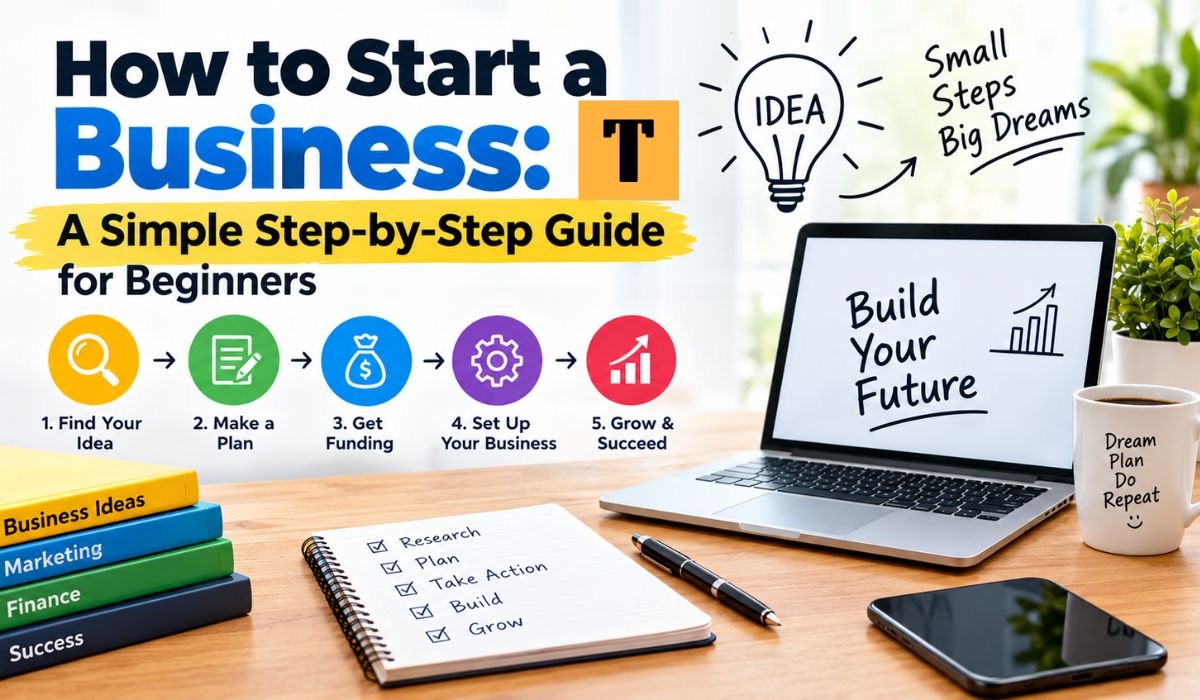
Learning How to Start a Business can feel overwhelming, especially when you’re faced with questions about money, customers, registration, taxes, marketing, and day-to-day operations. The good news is that you don’t have to solve everything at once. Starting a business becomes far more manageable when you break the process into clear, practical steps.
A successful business doesn’t necessarily begin with a large investment or a groundbreaking invention. It can grow from a useful skill, a local service, a digital product, or a better way of solving a problem people already have. What matters is whether customers genuinely need what you’re offering and whether you can deliver it at a sustainable cost.
The process involves more than simply choosing a business name and opening a website. You’ll need to research the market, understand your target customers, develop a workable business model, plan your finances, address legal requirements, and think about how you’ll attract and retain customers.
Whether you’re considering a small online business, freelance service, consulting company, retail operation, or another type of venture, the goal is to turn an idea into something practical and sustainable. Here’s how to approach that journey, step by step.
Quick Bio Information
Business Idea: A strong business idea usually addresses a specific customer need or problem.
Market Research: Market research helps entrepreneurs understand customers, demand, competitors, and market conditions.
Target Audience: Your target audience consists of customers who are most likely to need and purchase your offering.
Business Plan: A business plan provides a roadmap for starting, operating, and growing a company.
Business Model: A business model explains how a business creates value and generates revenue.
Startup Costs: Startup costs are expenses associated with establishing and preparing a business to operate.
Fixed Costs: Fixed costs generally remain relatively stable regardless of short-term changes in sales volume.
Variable Costs: Variable costs generally change as production or sales activity changes.
Break-Even Point: The break-even point occurs when total revenue equals total costs.
Business Structure: A business structure affects important legal, ownership, administrative, and tax considerations.
Business Registration: Registration requirements vary according to the business structure, location, and activities.
Licenses And Permits: Certain businesses and industries require government licenses or permits before operating.
EIN: An Employer Identification Number is a federal tax identification number used by qualifying U.S. businesses and organizations.
Business Banking: Separating business finances can make financial management and recordkeeping easier.
Bookkeeping: Bookkeeping involves recording and organizing business financial transactions.
Business Insurance: Business insurance can help protect eligible businesses against certain covered risks.
Marketing: Marketing connects a business’s products or services with potential customers.
Customer Feedback: Customer feedback can reveal problems, preferences, and opportunities for improvement.
Start With A Business Idea That Solves A Problem
Every business needs a reason to exist. A useful place to start isn’t with the question, “What business should I start?” Instead, ask yourself, “What problem can I solve, and who needs that solution?”
That shift in perspective can lead to better ideas. Your opportunity might come from your professional experience, personal interests, technical knowledge, or an everyday problem you’ve noticed. Someone with strong writing skills, for example, could offer copywriting services. An experienced accountant might build a bookkeeping business. Other possibilities include tutoring, cleaning, photography, web design, consulting, landscaping, personal training, and digital services.
There’s also no rule saying a successful business must invent something completely new. Many businesses operate in established markets but stand out by offering better service, greater convenience, specialized expertise, higher quality, customization, or a more focused customer experience.
Before moving ahead, consider whether people actually need the solution and whether they’re likely to pay for it. A promising idea needs more than personal enthusiasm. It needs a customer and a realistic path to revenue.
Identify Your Target Customers
Once you have a business idea, figure out who is most likely to buy it. These people make up your target audience, and understanding them will influence almost every part of your business.
Think about where they live, what they do, what problems they’re trying to solve, and what they currently use. Depending on the type of business, factors such as age, occupation, income range, interests, location, and purchasing habits may also be important.
You don’t need to create a complicated customer profile. The aim is to develop a clear picture of the people you’re trying to reach. What do they value? What frustrates them about existing options? What might persuade them to try something new?
Trying to sell to everyone can make your marketing vague and ineffective. A more focused audience gives you an opportunity to create products, services, messages, and offers that feel specifically designed for the people you want to serve. As your business grows, you can always expand into additional customer groups when the evidence supports it.
Research The Market
Market research is one of the most important steps to complete before putting significant money into a business. It helps you understand whether there is demand for your idea and gives you a clearer picture of the people you’re hoping to serve.
You can learn a great deal by talking directly with potential customers, reading reviews of competing products, comparing prices, studying industry trends, and examining the questions people regularly ask. Surveys can also provide useful feedback, although one-on-one conversations may uncover more detailed problems and expectations.
The purpose of this research is to answer practical questions. Are enough people interested in the product or service? What are they willing to pay? What alternatives are already available? What do customers like or dislike about those alternatives? Is there a particular group whose needs aren’t being met?
Good research can uncover opportunities you hadn’t considered. You might find a niche market, identify an overlooked customer problem, or discover that your original product needs to be changed before launch. Finding these things early can save both money and time.
Analyze Your Competitors
Your competitors can teach you a lot about the market you’re entering. Look at businesses offering similar products or services and pay attention to their prices, customer experience, marketing, positioning, reviews, and service options.
The goal isn’t to copy what another company is doing. It’s to understand what customers already have available and identify where your business could offer something different.
Customer reviews can be particularly useful. Repeated complaints about slow responses, confusing pricing, limited choices, poor communication, or weak customer support may point to opportunities. At the same time, positive reviews can show you which features or experiences customers value most.
Competition isn’t necessarily a sign that your idea won’t work. In many cases, established competitors demonstrate that customers already spend money in that market. Your task is to find a meaningful reason for customers to choose your business.
Validate Your Business Idea Before Launch
An idea is still an assumption until you have evidence that customers want it. That’s why validation should happen before you commit substantial money to a new business.
You can test an idea in relatively simple ways. Talk to potential customers, offer a sample service, create a prototype, run a small pilot, accept preorders, or test a limited version of the product. A service provider might begin with a handful of clients instead of immediately building a large operation.
For example, someone planning a meal-preparation business could test a small menu with a limited customer group before investing in a larger kitchen or significant inventory. A freelance designer could work with several early clients to discover which services generate the most interest.
Validation won’t guarantee success, but it can reveal weaknesses while they’re still relatively inexpensive to fix. Customers may want a different feature, a different price, or a simpler solution than you originally imagined. Learning that before launch can prevent costly mistakes.
Decide How Your Business Will Make Money
A good product isn’t enough. You also need a business model that explains how the company will generate revenue.
Think about what you’re selling, who will pay for it, how much they’ll pay, how often they may purchase, and what it costs you to deliver the offering. Depending on the business, revenue might come from one-time purchases, subscriptions, memberships, commissions, project fees, retainers, or recurring services.
This is also where you need to understand the difference between revenue and profit. Revenue is the money a business receives from sales and other income sources. Profit is what remains after relevant expenses are deducted.
A company can generate impressive sales while still struggling financially if its expenses are too high or its pricing is poorly designed. Understanding the business model early helps you make more informed decisions about pricing, marketing, staffing, technology, and funding.
Create A Business Plan
A business plan turns a business idea into a more organized strategy. It gives you a place to explain what you’re building, who you want to serve, how the business will operate, and how you expect it to make money.
A practical business plan can cover the business concept, products or services, target market, competitor analysis, marketing strategy, operations, financial expectations, and long-term goals. If you’re seeking outside financing or investors, you’ll generally need more detailed financial and market information.
For a small business, however, the plan doesn’t have to become a massive document. Its real value comes from making you examine your assumptions.
Writing down your expected customers, costs, pricing, competition, and revenue model can expose problems that aren’t obvious when everything exists only in your head. It also gives you something to revisit as the business develops.
Choose Your Business Structure
Choosing a business structure is an important legal and financial decision. Common structures in the United States include sole proprietorships, partnerships, corporations, and limited liability companies. Different structures can affect ownership, taxes, liability, administration, and reporting obligations.
A sole proprietorship is generally a straightforward option for an individual owner, while partnerships involve multiple owners. Corporations are separate legal entities, and LLCs are structures created under state law.
There isn’t one structure that’s right for every entrepreneur. Your location, business activities, ownership arrangements, tax situation, liability concerns, and future plans all matter. Rules also differ between jurisdictions.
For that reason, don’t select a structure simply because another business owner uses it. If your circumstances are complicated, professional legal or tax advice can help you understand the consequences of your choice.
Register Your Business And Handle Legal Requirements
Making your business official can involve several different requirements. The exact process depends on where you operate, how your business is structured, what you do, and which industry you’re in.
Depending on your circumstances, you may need to register a legal entity, register a trade name, obtain tax registrations, secure local permits, or obtain industry-specific licenses. Businesses in regulated industries can face additional requirements.
It’s also important to understand that business registration and federal tax identification aren’t the same thing. In the United States, an Employer Identification Number, or EIN, is required in certain circumstances, including many businesses with employees and certain entities such as partnerships and corporations. Not every business automatically needs an EIN.
Requirements can also differ at the state and local levels. A business operating in food service, healthcare, construction, childcare, financial services, or another regulated field may face requirements that don’t apply to a general consulting business.
Before opening your doors or accepting customers, check the rules that apply to your specific business and location.
Separate Your Business Finances
Financial organization should begin early, even if your business is small. Keeping business and personal finances separate can make bookkeeping, financial analysis, and tax reporting much easier.
Depending on your structure and circumstances, opening a dedicated business bank account may be appropriate. You should also establish a consistent method for tracking sales, expenses, invoices, receipts, payments, and other financial transactions.
Good records do more than make tax preparation easier. They tell you whether the business is actually making money and where that money is going. Without accurate records, it’s easy to mistake strong sales for strong profitability.
You should also keep an eye on cash flow. A business can appear profitable on paper and still experience financial pressure if money comes in later than bills need to be paid. Regularly reviewing your accounts gives you a better chance of spotting problems early.
Calculate Startup Costs And Funding
Before launching, work out how much money you’ll need. Startup costs can include equipment, inventory, software, website development, professional services, licenses, permits, insurance, marketing, deposits, and other expenses.
Separate one-time expenses from recurring costs. Buying equipment may be a one-time expense, for example, while software subscriptions, rent, payroll, utilities, and marketing can continue month after month.
This distinction matters because launching a business isn’t only about having enough money to open. You also need enough working capital to keep operating while sales are still developing.
If you need outside funding, possible sources include personal savings, business loans, grants, investors, crowdfunding, and other financing arrangements. Each option has different costs, conditions, risks, and eligibility requirements.
Starting small can reduce the amount of capital required. A service business may be able to begin from home using equipment you already own, while an online business might test demand before investing in a larger operation.
Set Prices And Understand Break-Even
Pricing affects both customer demand and the financial health of your business. Setting a price simply because it looks competitive can be risky if you haven’t calculated what it actually costs to deliver your product or service.
For physical products, consider production, packaging, shipping, payment processing, marketing, and other costs connected to each sale. Service businesses should account for time, software, travel, equipment, overhead, taxes, and other operating expenses.
You also need to understand your break-even point. Break-even analysis estimates how much you need to sell before total revenue covers total costs. A basic break-even calculation uses fixed costs divided by the difference between the selling price and variable cost per unit.
The calculation won’t tell you exactly what will happen in the future, but it gives you a useful financial target. It can also show you when your pricing or cost structure may need another look.
Protect Your Business From Common Risks
Every business faces risks, but those risks aren’t the same across industries. A consultant, restaurant, construction company, online retailer, and software company may have very different insurance and risk-management needs.
Depending on the business, relevant insurance may include general liability, commercial property, professional liability, business income, cyber-related, or specialized coverage. The right protection depends on the business’s activities, property, employees, customers, contracts, and location.
Insurance isn’t the only way to reduce risk. Written customer agreements can clarify responsibilities, while secure data practices can reduce exposure to privacy problems. Regular backups, financial controls, workplace procedures, and appropriate internal policies can also protect the business.
Before choosing coverage, consider the risks your company could realistically face and review the requirements that apply to your industry and location.
Build Your Brand, Website, And Marketing
Once the business foundation is in place, it’s time to make the company easier for customers to discover and understand. Your business name, messaging, visual identity, website, and customer communication should work together.
A new business doesn’t need an elaborate website. It does need a clear one. Visitors should quickly understand what you offer, who you serve, why your offering may be useful, and how they can contact you or make a purchase.
Social media can provide another way to reach customers and communicate with them, but there’s no need to maintain an account on every platform. Concentrate on the channels your target audience actually uses.
Your marketing strategy should begin with the customer. Think about where potential buyers search for information, what questions they have, and what kind of content or communication helps them make decisions. Depending on the business, useful channels can include search marketing, content, email, social media, referrals, partnerships, local promotion, and paid advertising.
Most importantly, track the results. Marketing isn’t simply about being visible. It should help you understand which activities bring qualified customers and generate worthwhile returns.
Get Your First Customers And Launch
Finding the first customers is one of the most important moments in the journey from idea to operating business. Start with people who have a genuine need for what you’re selling rather than trying to reach everyone at once.
Referrals, professional contacts, local communities, partnerships, direct outreach, useful content, social media, email marketing, and targeted advertising can all play a role. Your approach should match the audience and the type of business you’re running.
A smaller launch can be useful because it allows you to test the business in the real world without immediately taking on unnecessary scale. Early customers can show you what works, where people get confused, and what they value most.
Once you launch, pay attention to the numbers. Sales, expenses, cash flow, customer acquisition, repeat purchases, conversion rates, and customer feedback can all reveal how the business is performing.
The goal isn’t simply to open the business. It’s to learn from actual customer behavior and use those lessons to improve your product, service, operations, and marketing.
Common Mistakes To Avoid
One of the most expensive mistakes a new entrepreneur can make is spending heavily before confirming that customers actually want the product or service. It’s tempting to buy equipment, build an elaborate website, rent a large space, or invest heavily in branding before demand has been tested. In many cases, a smaller experiment can provide more useful information at a fraction of the cost.
Another problem is trying to serve everyone. When a business doesn’t have a clear target customer, its products and marketing can become too general. Competitor research is also easy to overlook, yet failing to understand existing alternatives can make it harder to explain why customers should choose you.
Pricing deserves careful attention as well. A low price may attract customers, but if it doesn’t cover costs and leave room for profit, it isn’t a sustainable strategy. Similarly, confusing personal and business finances can make it difficult to understand the company’s actual financial position.
Legal and administrative responsibilities shouldn’t be postponed indefinitely. Depending on the business, registration, permits, licenses, taxes, insurance, contracts, and recordkeeping can all matter.
Finally, don’t mistake activity for progress. A large social media following, an attractive logo, or a busy website doesn’t automatically mean the business is healthy. Pay closer attention to customer demand, sales, expenses, cash flow, retention, and customer satisfaction.
How To Grow Your Business
Growth should usually come after you’ve learned that your business model works. Once you have consistent customers and a reliable way to deliver your product or service, you can consider expanding.
Growth can take many forms. You might improve an existing product, introduce related services, increase repeat purchases, enter a new market, develop partnerships, or expand your marketing efforts.
Hiring may become appropriate when the workload consistently exceeds what you can manage or when the business needs skills you don’t have. However, employees also create additional costs and legal responsibilities, so hiring should be based on a genuine operational need.
As the business gets larger, organization becomes increasingly important. Document recurring processes, monitor cash flow, understand which products or services generate healthy margins, and continue paying attention to customer feedback.
The aim isn’t simply to make the company bigger. Sustainable growth means building a business that can handle additional customers without allowing costs, quality, or customer service to get out of control.
Final Thoughts
Knowing How to Start a Business isn’t about following one perfect formula. It’s about making thoughtful decisions in a sensible order.
Begin with a real customer problem. Identify the people who experience it, research the market, study competitors, and test your idea before committing significant resources. Then build a practical business plan, select an appropriate structure, handle the legal requirements that apply to your situation, organize your finances, understand your costs, and consider the risks your business could face.
When you’re ready to launch, concentrate on finding the right customers and learning from them. Track your sales and expenses, listen to feedback, and make changes based on what the evidence tells you.
You don’t need to have every answer before taking the first step. A new business develops through testing, learning, serving customers, and improving over time. With a clear understanding of your market, disciplined financial management, and a willingness to adapt, a simple idea can become the foundation for a sustainable business.
FAQs About How To Start A Business
How Much Money Do I Need To Start A Business?
There’s no universal startup amount because costs vary dramatically between businesses. A freelance service may require relatively little upfront capital, while a restaurant, manufacturing company, retail operation, or technology venture may require considerably more. Start by estimating one-time expenses, recurring costs, expected revenue, and the amount of cash you’ll need while the business gets established.
Can I Start A Business With Little Money?
Yes. Some business models require far less upfront capital than others. Freelancing, consulting, tutoring, writing, bookkeeping, and certain digital services can often begin with fewer resources than businesses that require inventory, specialized equipment, or physical premises. Starting part-time or testing an idea on a small scale can also help reduce early costs.
Do I Need A Business Plan?
A business plan can be valuable because it makes you think carefully about customers, competitors, operations, marketing, costs, revenue, and goals. It doesn’t necessarily need to be a long document. A small business may need only a concise plan, while a company seeking significant outside funding may require detailed financial projections and market information.
Should I Register My Business?
That depends on your location, business structure, industry, and activities. Some businesses require formal registration, while others may have different obligations. You may also need permits, licenses, tax registrations, or trade-name registration. Check the rules that apply specifically to your business before beginning operations.
Do I Need An EIN?
Not every business automatically needs an EIN. In the United States, the IRS requires an EIN in specific situations, including many businesses with employees and certain entities such as partnerships and corporations. Some other businesses may obtain one for particular tax or business purposes. Check the current requirements that apply to your circumstances before applying.
How Do I Get My First Customers?
Start by identifying people who genuinely need what you’re offering. Referrals, professional contacts, local outreach, partnerships, useful content, social media, email marketing, search visibility, and targeted advertising can all help. Early customers can also provide feedback and testimonials that help build credibility with future buyers.
What Is The Best Business Structure?
There isn’t one business structure that’s suitable for everyone. Sole proprietorships, partnerships, corporations, and LLCs can have different legal, tax, ownership, and administrative consequences. The available structures and rules also differ between jurisdictions. Consider your ownership, liability, taxes, administrative needs, and long-term plans before choosing.
How Long Does It Take To Start A Business?
The timeline can range from relatively short to quite lengthy. A straightforward service business may be able to begin quickly, while a business requiring financing, product development, commercial premises, specialized permits, or regulatory approval can take much longer. Your location, industry, business structure, and preparation all affect the timeline.
Learn more and explore exciting content on: Best Books for Entrepreneurs: 20 Must-Read Picks for Business Growth









Leave a Reply