
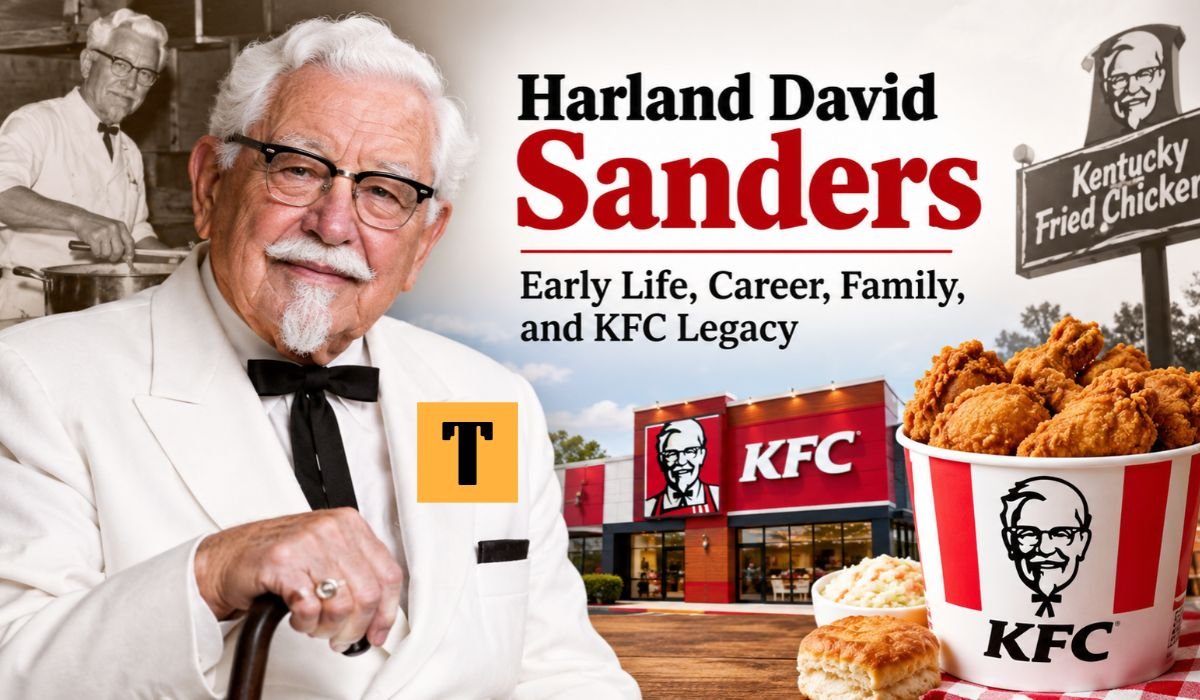
Harland David Sanders, widely known as Colonel Sanders, became one of the most recognizable names in American food history. His white suit, black string tie, goatee, and familiar expression eventually became closely linked with Kentucky Fried Chicken. Yet the man behind that famous image took a long and winding road before his name became synonymous with fried chicken.
Born in 1890 in Henryville, Indiana, Sanders spent much of his early life trying different jobs and searching for financial stability. He worked in transportation, insurance, service stations, and other fields before establishing himself in the restaurant business. Along the way, he learned to cook, developed a distinctive method for preparing chicken, and discovered how to turn a food idea into a repeatable business system.
His biggest breakthrough didn’t come when he was young. It arrived when he was already in his sixties, after a major setback threatened the restaurant business he had spent years building. Instead of walking away, Sanders took his cooking method on the road and began convincing other restaurant owners to sell his chicken. That decision helped transform a local food business into the franchise operation that became KFC.
The story of Harland David Sanders is therefore about far more than a famous recipe. It’s a story of changing careers, adapting to setbacks, building a recognizable personal brand, and finding a new direction late in life.
Harland David Sanders Quick Bio Information
| Quick Bio | Details |
|---|---|
| Full Name | Harland David Sanders |
| Famous Name | Colonel Sanders |
| Born | September 9, 1890 |
| Birthplace | Henryville, Indiana |
| Died | December 16, 1980 |
| Age At Death | 90 |
| Profession | Entrepreneur And Restaurateur |
| Best Known For | Founding The Kentucky Fried Chicken Business |
| Main Business | Kentucky Fried Chicken |
| Honorary Title | Kentucky Colonel |
| Major Restaurant | Sanders’ Café |
| Main Business Location | Corbin, Kentucky |
| Signature Food | Fried Chicken |
| Famous Recipe | Original Recipe |
| First KFC Franchise | 1952 |
| Early Franchise Partner | Pete Harman |
| KFC Sale | 1964 |
| Reported Sale Price | $2 Million |
| First Wife | Josephine King |
| Second Wife | Claudia Ledington Sanders |
Early Life And Family Background
Harland David Sanders was born on September 9, 1890, on a farm near Henryville, Indiana. His childhood changed dramatically when his father died while Sanders was only six years old. His mother was left to support the family, and Sanders began taking on responsibilities at home while he was still a child.
Among those responsibilities was helping care for his younger brother and sister. He also learned how to prepare food for the family. Sanders didn’t attend culinary school or receive formal training as a chef. Instead, his earliest cooking experience came through everyday necessity and practice.
That detail is easy to overlook when looking at the later Colonel Sanders story. The man who eventually became famous for a closely guarded chicken recipe first learned his way around a kitchen because his family needed him to help.
His childhood was a long way from the polished public image that would emerge decades later. At the time, Sanders was simply a young boy growing up in a family facing financial pressure and learning to become independent.
Education And Early Jobs
Sanders left school while he was still young and entered the workforce. From there, his career took a surprisingly unpredictable course. He worked as a farmhand and later held positions connected with transportation, railroads, insurance, and service stations.
At different points, he worked as a streetcar conductor, a railroad fireman, and an insurance salesman. None of these jobs became his lasting profession, but each exposed him to a different side of working life.
His varied employment history is an important part of the Harland David Sanders biography because it challenges the idea that he was always destined to become a restaurant entrepreneur. He spent decades trying different occupations before finding a business that suited his skills.
Those years also gave Sanders practical experience. He dealt with customers, learned about sales, handled equipment, and became familiar with the demands of running a business. Much of what he eventually used in his restaurant career had been developed long before the Colonel Sanders image existed.
Military Service And The Colonel Title
Sanders also spent a short period in military service. As a teenager, he enlisted in the United States Army and served as a wagoner in Cuba.
That part of his life is sometimes confused with the origin of his famous title. Sanders wasn’t a military colonel. The title came later, when Kentucky Governor Ruby Laffoon designated him a Kentucky Colonel in 1935.
The Kentucky Colonel title was honorary rather than a military rank. Sanders embraced it, however, and gradually made “Colonel Sanders” an important part of his public identity.
Over time, the name became much more than a title. Sanders developed a carefully recognizable appearance, complete with a white suit, black string tie, and goatee. The look helped create the gentlemanly Colonel persona that eventually became one of the most recognizable identities in restaurant advertising.
The Beginning Of His Restaurant Career
Sanders’ serious connection with the food business began in Kentucky. Around 1930, he was operating a service station in Corbin when he began preparing meals for travelers who stopped there.
The arrangement was modest at first. Customers could stop for gasoline and also get a home-style meal. Sanders served Southern-inspired dishes, including country ham, vegetables, biscuits, and fried chicken.
The food quickly became an important part of the business. Travelers weren’t simply stopping because they needed fuel; many came because they had heard about Sanders’ cooking.
It was a simple but effective business idea. The roadside location brought potential customers directly to him, while good food gave them a reason to stay and return. As his reputation grew, the food operation expanded beyond the service station and became the beginning of a much larger restaurant business.
Sanders’ Café And The Rise Of His Chicken
With growing demand came expansion. Sanders developed his food operation into Sanders’ Café, which became increasingly well known for its fried chicken.
The restaurant benefited from the flow of travelers through the area, but location wasn’t the only reason for its success. Sanders was also becoming increasingly focused on consistency. He wanted his chicken to have a particular flavor and texture, and he kept experimenting with ways to improve the cooking process.
His reputation eventually extended beyond Corbin. Sanders’ Café gained recognition as a destination for travelers looking for a substantial Southern-style meal. The attention helped establish Sanders as a serious restaurateur.
More importantly, the restaurant gave him a place to test ideas. Before he could build a franchise business, he needed a food product and cooking method that could be reproduced consistently. Sanders’ Café became the testing ground for that process.
How Harland Sanders Developed His Fried Chicken
Fried chicken became the defining product of Sanders’ career, but getting there involved considerable experimentation. By around 1940, he had developed the recipe associated with KFC’s famous 11 herbs and spices and had refined a pressure-cooking method for preparing the chicken.
The pressure method solved a practical restaurant problem. Traditional frying could take considerable time, which wasn’t ideal when customers were waiting for their meals. Sanders’ approach allowed the chicken to cook more quickly while helping retain the moisture and texture he wanted.
That innovation mattered because Sanders wasn’t simply trying to create a tasty recipe. He needed a method that could work in a busy commercial kitchen.
This distinction became increasingly important as his business grew. A successful franchise requires more than a good idea; the product needs to be repeatable. Sanders’ cooking method provided a foundation that could eventually be taught to restaurant operators outside Kentucky.
The Setback That Changed His Future
For years, Sanders’ restaurant benefited from travelers passing through Corbin. Then transportation patterns changed. New highway routes reduced the traffic reaching his restaurant, and the business suffered.
It was a major blow to a restaurant whose success depended heavily on its location.
Sanders had already spent years building the operation, but the changing road network demonstrated how vulnerable a location-based business could be. He eventually sold the restaurant and faced an uncertain future.
At this point, Sanders could have walked away from the food business. Instead, he changed the way he thought about it.
Rather than waiting for customers to come to him, he began taking his chicken to other restaurant owners. That shift—from running one restaurant to helping other businesses sell his product—would ultimately become the foundation of his greatest commercial success.
How Harland Sanders Started Franchising
In the early 1950s, Sanders began traveling to restaurants and presenting his chicken concept to owners. He carried the equipment, seasoning, and knowledge needed to demonstrate his cooking method.
The idea was straightforward. Restaurant owners could prepare and sell his chicken, while Sanders provided the cooking method and business concept. Instead of paying for Sanders to build and operate every location himself, the franchise system allowed other restaurant operators to participate in the expansion.
His first major franchise agreement came in 1952 with Pete Harman, a restaurant owner in the Salt Lake City area.
The partnership proved that Sanders’ chicken could succeed outside Kentucky. From there, the franchise network began expanding.
Sanders was already in his sixties during this crucial period, making the timing of his breakthrough particularly unusual. His most important business expansion came after decades of work rather than during the early part of his career.
Pete Harman And The Growth Of KFC
Pete Harman became an important figure in the early development of Kentucky Fried Chicken. His restaurant helped demonstrate that Sanders’ chicken and cooking method could work in another market.
The partnership also helped establish the Kentucky Fried Chicken name as a recognizable brand. As more restaurants adopted the concept, consistency became increasingly important.
Customers needed to know what to expect when they ordered the chicken, regardless of which franchise they visited. Sanders’ method therefore became part of a larger system involving preparation, cooking, branding, and franchise relationships.
Historical records show just how quickly the network expanded. By 1964, more than 600 franchise locations were operating.
That growth transformed Sanders’ original restaurant idea into something much larger. He had moved from being a restaurant operator who sold food directly to customers to becoming the creator of a system that other restaurant owners could reproduce.
The Colonel Sanders Brand
The food made Sanders successful, but his image helped make him unforgettable.
His white suit, black string tie, goatee, and carefully maintained Colonel persona created an appearance that customers could immediately recognize. He didn’t hide behind the company name. Instead, he placed himself directly in front of the brand.
Sanders appeared in advertisements, visited restaurants, met customers, and continued promoting the business. His personality became part of the product’s identity.
This was a remarkably effective form of personal branding. The company wasn’t represented by an abstract logo alone. It had a recognizable person attached to its story.
That connection between the individual and the business has become one of the most enduring parts of the Colonel Sanders legacy. Even decades after his death, the Colonel’s likeness remains closely associated with KFC.
The Sale Of KFC
By 1964, Sanders’ business had expanded dramatically. More than 600 franchised restaurants were operating, and Sanders was 74 years old.
That year, he sold his interest in the company to a group of investors for a reported $2 million.
The sale didn’t completely remove him from KFC. Sanders continued to appear publicly and represent the brand, remaining one of its most recognizable figures.
For Sanders, the transaction represented another major transition. He had moved from operating a small roadside food business to building a large franchise network and then selling his ownership stake in the company.
KFC continued expanding under its new ownership. Sanders no longer controlled the business, but his name and image remained deeply connected to it.
Harland David Sanders’ Family And Personal Life
The public usually remembers Sanders as the Colonel in the white suit, but his personal life was considerably more complicated.
Sanders married Josephine King, and the couple had three children: Margaret, Harland Jr., and Mildred. Their marriage eventually ended in divorce.
In 1949, Sanders married Claudia Ledington, who had worked with him and later became an important part of his personal and business life. She remained his wife until his death.
Claudia was more than a spouse in Sanders’ later story. She was involved in his business activities and became part of the operation surrounding the Colonel’s growing public presence.
His family history adds another dimension to the biography. Sanders’ career involved long periods of uncertainty, demanding work, and major changes in both his professional and personal life. The famous Colonel image doesn’t capture all of those experiences.
His Later Years And Death
Selling KFC didn’t mean Sanders simply disappeared from public life. He continued visiting restaurants, appearing at events, and promoting the brand.
His recognizable appearance made him an effective ambassador for the company, and he remained closely associated with KFC even though he was no longer its owner.
Sanders died in Louisville, Kentucky, on December 16, 1980. He was 90 years old.
By then, the small food operation he had started decades earlier had become an international restaurant business. The man himself had also become a cultural symbol, with his appearance recognized by generations of customers.
Colonel Sanders’ Legacy And KFC Today
The legacy of Harland David Sanders rests on several connected achievements. He developed a recognizable fried chicken product, refined a practical cooking method, created a franchise system, and turned his own identity into a memorable brand.
KFC has continued to grow and evolve since Sanders’ death. In 2026, the company reported having more than 34,000 restaurants across more than 150 countries. Its modern operations are vastly different from Sanders’ original roadside restaurant, but the Colonel remains central to the brand’s identity.
The continued presence of his image is significant. Sanders died decades ago, yet the character he created remains part of KFC’s visual language. The Original Recipe identity and the Colonel’s likeness continue to connect the modern company with its historical roots.
For business historians, Sanders’ career is especially notable because his greatest expansion came relatively late in life. He spent decades moving between careers before turning his restaurant experience into a scalable franchise model.
Final Thoughts
The story of Harland David Sanders is a story of reinvention as much as it is a story about fried chicken.
He left school young, worked in numerous occupations, learned to cook through necessity, built a roadside restaurant, developed a faster cooking method, and eventually faced the collapse of the business because changing highways altered customer traffic. Instead of treating that setback as the end of his career, Sanders found another way to use what he had built.
Franchising gave his chicken a path beyond one restaurant. His cooking method helped create consistency, while his distinctive public image gave the business a human face. Together, those elements turned Sanders from a Kentucky restaurateur into a globally recognized business figure.
The most interesting part of the Harland David Sanders biography may be its timing. His biggest opportunity didn’t arrive early. It came after years of work, career changes, personal challenges, and business setbacks.
Today, Colonel Sanders remains one of the most recognizable figures in restaurant history. His story continues to offer a fascinating look at how food, franchising, and personal branding came together to create one of the world’s best-known restaurant businesses.
FAQs About Harland David Sanders
Who Was Harland David Sanders?
Harland David Sanders was an American entrepreneur and restaurateur best known for developing the fried chicken business that became Kentucky Fried Chicken. He began serving food in Kentucky, refined his fried chicken preparation method, and later expanded the business through franchising.
Why Was He Called Colonel Sanders?
Sanders received the honorary title of Kentucky Colonel from Kentucky Governor Ruby Laffoon in 1935. It wasn’t a military rank. Sanders later incorporated the title into his public identity, eventually making Colonel Sanders one of the most recognizable names in restaurant advertising.
When Did Harland Sanders Start KFC?
Sanders’ first major franchise arrangement came in 1952 with Pete Harman in the Salt Lake City area. His earlier restaurant operation in Corbin, Kentucky, had already established the chicken and cooking method that formed the basis of the franchise business.
How Old Was Colonel Sanders When KFC Became Successful?
Sanders was already in his sixties when he began focusing heavily on franchising. His major commercial breakthrough therefore came later in life, following decades of work in different industries and years spent developing his restaurant business.
Who Was Colonel Sanders’ Wife?
Sanders was first married to Josephine King, and they had three children: Margaret, Harland Jr., and Mildred. After their divorce, Sanders married Claudia Ledington in 1949. Claudia remained his wife until his death and was also involved in his later business activities.
When Did Colonel Sanders Die?
Harland David Sanders died on December 16, 1980, in Louisville, Kentucky. He was 90 years old. At the time of his death, he remained strongly associated with the KFC brand.
Why Is Colonel Sanders Still Famous?
Colonel Sanders remains famous because his appearance and personality became part of KFC’s identity. His white suit, goatee, string tie, chicken business, franchise strategy, and unusual late-career success created a legacy that has continued long after his death.
What Is Harland David Sanders’ Greatest Legacy?
Sanders’ most significant business legacy is the franchise system that allowed his chicken concept to expand far beyond his original Kentucky restaurant. His combination of standardized food preparation, franchising, and personal branding helped shape the development of modern fast-food business.
Learn more and explore exciting content on: Who Is Brian Williams? Inside His Career, Family, and Life as a Grandfather














Leave a Reply