
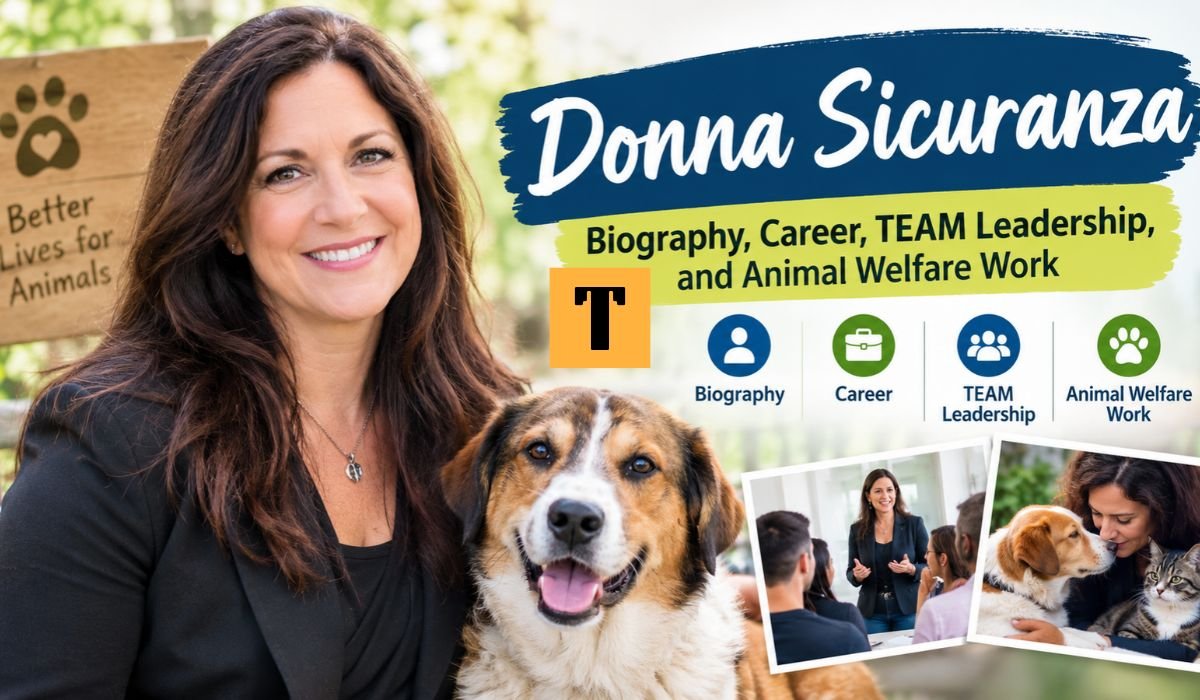
Donna Sicuranza has spent much of her professional life working behind the scenes in animal welfare rather than in the spotlight. Based in Connecticut, she is closely associated with Tait’s Every Animal Matters, better known as TEAM, a nonprofit organization in Westbrook that focuses on feline spay, neuter, and vaccination services.
Today, TEAM identifies her professionally as Donna Sicuranza Marconi and lists her as its Executive Director. Earlier records commonly refer to her as Donna Sicuranza or Donna J. Sicuranza. Her name is particularly connected with TEAM’s mobile feline clinic, a program that has brought veterinary services to Connecticut communities since the late 1990s.
There’s a useful distinction to make at the outset. Sicuranza is an executive and nonprofit professional, not a veterinarian. The cats treated through TEAM’s programs receive their medical care from veterinary professionals. Her documented contribution lies in leadership and her long-term involvement with the organization.
Much of her private biography remains difficult to verify. Her exact birth date, age, personal net worth, and several details about her family life aren’t firmly established in reliable public records. Her professional history, however, offers a much clearer picture of her career and her connection to feline welfare.
Quick Bio Information
| Detail | Information |
|---|---|
| Professional Name | Donna Sicuranza Marconi |
| Commonly Used Name | Donna Sicuranza |
| Other Recorded Name | Donna J. Sicuranza |
| Profession | Nonprofit Executive |
| Organization | Tait’s Every Animal Matters |
| Organization Name | TEAM |
| Current Role | Executive Director |
| Professional Base | Westbrook, Connecticut |
| Main Field | Animal Welfare |
| Primary Focus | Feline Welfare And Population Control |
| Major Program | TEAM Mobile Feline Spay/Neuter Clinic |
| Clinic Planning | 1996 |
| Clinic Launch | March 1, 1997 |
| Reported Cats Served | More Than 225,000 |
| Veterinary Role | Executive Leadership, Not Clinical Veterinary Practice |
| Earlier Career | Writing, Editing, And Public Relations |
| Education | Professional Records Associate Her With Fairfield University And Trinity College-Hartford |
| Date Of Birth | Not Reliably Confirmed |
| Exact Age | Not Reliably Confirmed |
| Net Worth | Not Publicly Confirmed |
Who Is Donna Sicuranza?
Donna Sicuranza is a Connecticut nonprofit executive whose public career is closely tied to Tait’s Every Animal Matters. TEAM’s current staff information lists her as Executive Director under the name Donna Sicuranza Marconi and places her among the organization’s administrative leadership.
Her professional story is quite different from that of an entertainment celebrity. She became known through nonprofit and animal-welfare work, particularly through TEAM’s efforts to make feline veterinary care more accessible. The organization’s mobile clinic travels to Connecticut communities and provides sterilization and vaccination services for cats.
It’s also important to describe her role correctly. TEAM lists veterinary professionals separately from its administrative leadership, and Sicuranza isn’t identified as a veterinarian. She shouldn’t therefore be described as personally performing the surgeries or vaccinations provided through the clinic.
Instead, her career is best understood through nonprofit leadership, organizational continuity, communication, and her long association with TEAM’s animal-welfare mission. That distinction gives readers a more accurate picture of why her name appears in connection with the organization’s work.
Donna Sicuranza Marconi And Her Professional Name
Anyone researching Donna Sicuranza may notice that her name appears in several forms. TEAM’s current staff information uses Donna Sicuranza Marconi, while older references use Donna Sicuranza and, in some cases, Donna J. Sicuranza.
The available professional record indicates that these names belong to the same person associated with TEAM. The change in surname, however, shouldn’t be used as an invitation to speculate about her personal life. Publicly available information doesn’t establish precisely when or why she began using the Marconi surname.
For that reason, the most accurate approach is to use Donna Sicuranza Marconi when discussing her current professional identity and Donna Sicuranza when referring to the name used throughout much of the historical record.
This is more than a minor naming detail. It can help readers make sense of apparently different records that actually relate to the same nonprofit executive.
Early Life, Family, And Education
There isn’t a large body of reliable public information about Donna Sicuranza’s childhood or early years. Some historical records connect Donna J. Sicuranza with the Sicuranza family in Westbrook, Connecticut. Her family connection is also notable because TEAM’s current staff information identifies Dina Sicuranza as a Senior Veterinary Technician.
Those records provide some useful context, but they don’t support a detailed account of Donna’s childhood, birthplace, upbringing, or early interests. Rather than filling those gaps with assumptions, it’s more accurate to acknowledge that much of this part of her life remains private.
Her educational background is somewhat easier to trace, although the available information isn’t completely consistent. Professional records associate her with Fairfield University and Trinity College-Hartford. One employment database describes a bachelor’s degree from Fairfield University and a master’s degree from Trinity College-Hartford, while the strongest organizational information doesn’t provide a complete academic biography.
That means specific claims about degrees, majors, or individual academic achievements should be treated cautiously unless supported by a primary record. What the available professional information does show is that Sicuranza pursued higher education before developing a career that eventually moved into communications and nonprofit leadership.
Donna Sicuranza’s Career Before TEAM
Donna Sicuranza didn’t begin her professional career in veterinary medicine. Earlier employment information describes her as a freelance writer, editor, and public-relations specialist.
That background provides an interesting piece of context for her later nonprofit career. Communication is an important part of running a nonprofit, particularly one that depends on public awareness and community participation. Organizations need people who can explain their mission clearly, communicate with supporters, work with communities, and present complicated issues in language ordinary people can understand.
Those skills are especially relevant in animal welfare, where organizations often have to explain why preventive services matter and why community participation is essential.
Her career can therefore be viewed as a progression from communication-focused work into long-term nonprofit leadership. There is no need to suggest that her earlier work directly caused her move into animal welfare, but it provides a useful professional foundation for understanding the skills she brought into nonprofit work.
What Is Tait’s Every Animal Matters?
Tait’s Every Animal Matters, or TEAM, is a Connecticut animal-welfare organization based in Westbrook. While its broader mission concerns animal welfare, its most recognizable long-running program is its mobile feline spay and neuter clinic.
The clinic was created around a practical problem. Cats, particularly homeless, feral, and community cats, can reproduce quickly, while owners and caretakers may face financial or transportation barriers when trying to obtain veterinary services.
TEAM’s approach is to bring services directly into communities. Its mobile clinic provides sterilization and vaccination services and serves both domestic and feral cats in Connecticut.
That organizational mission is central to understanding Donna Sicuranza. Her public career isn’t simply associated with an animal charity in a general sense. It is specifically connected to a nonprofit that has spent decades working on feline population control and access to preventive veterinary care.
The Beginning Of The TEAM Mobile Feline Clinic
One of the clearest parts of Donna Sicuranza’s professional history is her connection to the creation of TEAM’s mobile feline clinic.
According to TEAM’s historical account, plans for the mobile clinic developed in 1996 under the direction of veterinarian John A. Caltabiano, who was then TEAM’s president, and Executive Director Donna Sicuranza.
The mobile unit began operating on March 1, 1997. TEAM reports that ten cats were spayed or neutered and vaccinated on the clinic’s first day.
The idea was simple, but it addressed a very real access problem. A traditional veterinary practice operates from a fixed location, which means owners and cat caretakers have to get there. A mobile clinic can move closer to the communities that need its services.
That can make a significant difference for people dealing with transportation difficulties, limited financial resources, or the challenges of caring for multiple feral or community cats.
The clinic’s long history also makes it an important part of Sicuranza’s professional story. She was involved at the development stage and has remained associated with TEAM as the program continued over the decades.
Donna Sicuranza’s Leadership At TEAM
Sicuranza’s role at TEAM is best described as executive leadership. The organization identifies her as Executive Director, while its veterinary staff are separately responsible for medical care.
That distinction is particularly important when discussing TEAM’s reported achievements. The organization says its veterinarians have sterilized and vaccinated more than 225,000 cats since 1997. This is a TEAM-wide accomplishment involving veterinary professionals and the broader organization.
It would therefore be misleading to say that Donna Sicuranza personally sterilized 225,000 cats. She is not publicly identified as the veterinarian performing those procedures.
Her documented connection is instead with the leadership and continuation of the organization. Running a nonprofit over several decades involves much more than one visible program. It requires administration, communication, coordination, community relationships, fundraising, staffing, and maintaining focus on the organization’s mission.
The longevity of TEAM’s program is therefore an important part of understanding Sicuranza’s career.
How The Mobile Clinic Works
TEAM’s mobile clinic is built around two straightforward ideas: bringing veterinary services closer to people and making essential feline care more accessible.
A fixed veterinary clinic requires owners or caretakers to travel to a particular location. For some people, that isn’t easy. Transportation, distance, cost, and the difficulty of handling multiple cats can all become obstacles.
A mobile clinic changes that equation by taking services into communities. TEAM says its clinic serves both domestic and feral cats throughout Connecticut and provides sterilization and vaccination services.
The model is especially relevant to community-cat caretakers. Feral and community cats often live outside conventional household environments, so managing their populations can require organized local efforts rather than individual pet-owner decisions.
The program’s emphasis on prevention is equally important. Spaying and neutering can reduce future unwanted litters, while vaccination provides another element of preventive care. Together, those services support TEAM’s broader animal-welfare mission.
More Than 225,000 Cats Served
TEAM currently reports that its veterinarians have sterilized and vaccinated more than 225,000 cats since 1997.
That figure offers a sense of the program’s reach. A mobile clinic that began with ten cats on its first day has, according to TEAM, gone on to serve a cumulative total exceeding 225,000 cats.
The number should still be presented carefully. It is a figure reported by TEAM and represents the work of the organization’s veterinary professionals and wider team. It isn’t evidence that Donna Sicuranza personally performed those procedures.
For her biography, the figure matters because it demonstrates the scale and longevity of the organization with which she has been associated. The clinic has continued operating for nearly three decades, addressing the same basic challenge that motivated its creation: improving access to feline sterilization and preventive care.
The achievement is therefore best viewed as an organizational milestone that forms an important part of Sicuranza’s professional context.
Why Feline Spay And Neuter Services Matter
The reasoning behind TEAM’s work begins with feline population control. When cats aren’t sterilized, unwanted litters can contribute to growing populations of homeless and community cats.
TEAM’s history connects feline overpopulation with problems including abandonment, illness, injury, abuse, and pressure on animal shelters. The organization’s mobile clinic was developed as a preventive response rather than simply treating problems after they appeared.
Spaying and neutering reduce the possibility of future unwanted litters. This is particularly useful for feral and community cats, which may live outside traditional homes and reproduce without the consistent oversight available to household pets.
Cost is another part of the equation. Veterinary services can be expensive, and some owners or caretakers may delay preventive care because of financial limitations. Programs that provide more affordable services can help remove one of those barriers.
TEAM’s mobile approach adds another layer by addressing access and transportation. The combination of mobility, affordability, sterilization, and vaccination helps explain why the program has remained central to the organization’s mission.
Donna Sicuranza And Connecticut Animal Welfare
Sicuranza’s work has also reached beyond the immediate administration of TEAM’s clinic. A 2019 Connecticut animal-population working-group record identifies Donna Sicuranza as a representative of Tait’s Every Animal Matters.
That participation is useful evidence of her involvement in wider discussions surrounding animal population control. It suggests that her professional role included representing TEAM in conversations extending beyond the organization’s own operations.
At the same time, the record shouldn’t be interpreted more broadly than it supports. Representing TEAM at a working group doesn’t make Sicuranza a state government official, nor does it mean she personally created Connecticut animal-welfare policy.
Her documented role was that of a nonprofit representative. Keeping that distinction clear strengthens the accuracy of the biography and gives readers a better understanding of her place within Connecticut’s animal-welfare community.
Donna Sicuranza And Dr. John A. Caltabiano
Dr. John A. Caltabiano occupies an important place in both TEAM’s history and Donna Sicuranza’s professional story.
Caltabiano was a veterinarian and served as TEAM’s president when plans for the mobile feline clinic were developed in 1996. TEAM’s historical account identifies him as the veterinarian who worked with Executive Director Donna Sicuranza during the clinic’s development.
Their relationship wasn’t limited to professional collaboration. Caltabiano’s obituary identified Donna Sicuranza as his longtime partner. He died in 2009, but the mobile clinic continued as part of TEAM’s animal-welfare work.
His involvement also reinforces an important point about the clinic’s history. The program wasn’t the work of one person. It developed through the combined efforts of veterinary leadership, nonprofit management, staff, supporters, and the wider TEAM organization.
Sicuranza’s role is therefore best understood as part of a larger effort rather than as an individual medical achievement.
Donna Sicuranza’s Personal Life, Age, And Net Worth
Compared with her professional record, Donna Sicuranza’s private life remains relatively undocumented. Public information establishes some family connections and records her relationship with John A. Caltabiano, but many other personal details aren’t reliably available.
Her exact birth date and age remain unconfirmed in strong public sources. This is particularly important because online searches can produce information about another woman with the same or a similar name.
Donna Marie Sicuranza was a different person. She was associated with New York, was born in 1942, worked at the Bank of New York, and died in 2017. Those details shouldn’t be attached to the Connecticut nonprofit executive.
The same caution applies to claims about Sicuranza’s net worth. No reliable public source establishes her personal wealth. Estimates found on biography-style websites shouldn’t be treated as fact simply because they appear repeatedly online.
TEAM’s organizational finances also don’t establish her personal net worth. An organization’s revenue, donations, assets, or operating budget are separate from an executive’s private finances.
For that reason, the most accurate description is that Donna Sicuranza’s exact age, birth date, and net worth haven’t been reliably confirmed.
Donna Sicuranza Vs. Donna Marie Sicuranza
The similarity between the names Donna Sicuranza and Donna Marie Sicuranza is one of the biggest potential sources of confusion for readers.
The Donna Marie Sicuranza associated with New York had a documented history involving the Bank of New York and a 1942 birth date. She died in March 2017. Her family and professional history are separate from that of the Connecticut nonprofit executive.
Donna Sicuranza Marconi, meanwhile, remains associated with Tait’s Every Animal Matters and is currently listed by TEAM as Executive Director.
Keeping these identities separate is essential. Otherwise, information such as the 1942 birth date, banking career, marriage history, and New York family details can easily become part of an inaccurate biography of the TEAM executive.
This identity issue also explains why some online searches may produce contradictory information about Donna Sicuranza. Not every result returned for the name necessarily refers to the same person.
Donna Sicuranza’s Professional Legacy
The strongest way to understand Donna Sicuranza’s legacy is through the longevity of her connection with TEAM.
The mobile feline clinic began operating in 1997 after planning work that involved Sicuranza and veterinarian John A. Caltabiano. Nearly three decades later, TEAM continues to operate the program and reports that its veterinarians have sterilized and vaccinated more than 225,000 cats.
That continuity is significant. Starting a nonprofit initiative is one challenge; keeping a specialized program operating for decades requires sustained organizational effort.
Sicuranza’s public career is therefore less about personal fame and more about long-term nonprofit service. Her name is connected with an organization that has maintained a specific mission: improving access to feline sterilization and preventive veterinary care.
Her earlier communications career also adds another dimension to that story. Writing, editing, public relations, and nonprofit leadership all involve communicating ideas and building relationships, skills that can be valuable in a community-focused organization.
The Future Of TEAM’s Animal Welfare Mission
The animal-welfare challenges that TEAM addresses remain relevant. Communities continue to deal with unwanted litters, feral and community-cat populations, veterinary expenses, and unequal access to preventive care.
A mobile veterinary program can help address some of those challenges by bringing services closer to the people and animals that need them. TEAM continues to describe its clinic as serving Connecticut cats and providing spay, neuter, and vaccination services.
There isn’t enough reliable public information to say what specific projects Donna Sicuranza may pursue in the future. Predicting new clinics, organizational expansion, or leadership changes would go beyond the available evidence.
What is clear in 2026 is that TEAM continues to list Donna Sicuranza Marconi as Executive Director and continues its feline welfare work.
That current role connects her professional story to the same mission that has shaped much of her career.
Final Thoughts
Donna Sicuranza’s public story is ultimately a story of long-term nonprofit work rather than celebrity. Her career is closely tied to Tait’s Every Animal Matters and its mobile feline spay, neuter, and vaccination program, which began operating in Connecticut in 1997.
The clinic’s history provides the clearest measure of the work associated with her career. Plans developed in 1996, the mobile unit treated ten cats on its first day in March 1997, and TEAM now reports more than 225,000 cats sterilized and vaccinated by its veterinary professionals.
Her role should remain clearly defined. Sicuranza is an Executive Director and nonprofit leader, not the veterinarian personally carrying out those procedures. The clinic’s results reflect the combined work of veterinary staff, administrators, supporters, and the wider organization.
There are also limits to what can responsibly be said about her private life. Her exact age, birth date, net worth, and several family details aren’t firmly established. Confusing her with another Donna Marie Sicuranza can produce entirely incorrect biographical information.
What is well documented is her professional connection with TEAM and the organization’s long-running commitment to feline welfare. That record provides a more meaningful understanding of Donna Sicuranza than unsupported claims about wealth, fame, or private life.
Her career illustrates how sustained nonprofit leadership can make a difference through a practical, community-focused mission. For nearly three decades, TEAM’s mobile clinic has continued bringing feline preventive care closer to Connecticut communities, and Sicuranza remains part of that ongoing story.
FAQs About Donna Sicuranza
Who Is Donna Sicuranza?
Donna Sicuranza, currently listed professionally by TEAM as Donna Sicuranza Marconi, is a Connecticut nonprofit executive and the Executive Director of Tait’s Every Animal Matters. Her career is closely associated with the organization’s feline-welfare programs and mobile veterinary clinic.
What Is Donna Sicuranza Known For?
She is best known for her long-standing connection with TEAM and her involvement in the development and continuation of its mobile feline spay and neuter clinic. TEAM reports that its veterinarians have sterilized and vaccinated more than 225,000 cats since 1997.
Is Donna Sicuranza A Veterinarian?
No reliable TEAM record identifies Sicuranza as a veterinarian. She is listed as Executive Director, while TEAM’s veterinary professionals are separately identified. Her documented role is nonprofit leadership rather than clinical veterinary practice.
How Old Is Donna Sicuranza?
Donna Sicuranza Marconi’s exact age and date of birth aren’t reliably confirmed in authoritative public information. A 1942 birth date sometimes associated with the name Donna Sicuranza belongs to another woman, Donna Marie Sicuranza, who lived in New York and died in 2017.
What Is Donna Sicuranza’s Net Worth?
Her personal net worth isn’t publicly confirmed. Online estimates without reliable supporting documentation shouldn’t be treated as established facts, and TEAM’s organizational finances don’t reveal an executive’s personal wealth.
Who Was John A. Caltabiano To Donna Sicuranza?
John A. Caltabiano was a veterinarian and TEAM president who worked with Sicuranza during the development of the organization’s mobile feline clinic. His obituary also identified Donna Sicuranza as his longtime partner.
How Many Cats Has TEAM Helped?
TEAM currently reports that its veterinarians have sterilized and vaccinated more than 225,000 cats since 1997. That figure represents the organization’s reported work and shouldn’t be attributed to Sicuranza as personally performed veterinary procedures.
Is Donna Sicuranza Still With TEAM?
Yes. TEAM’s current staff information identifies Donna Sicuranza Marconi as Executive Director. The organization continues operating its mobile feline spay, neuter, and vaccination program in Connecticut.
Learn more and explore exciting content on: Chas6D: A Complete Guide to the Platform, Features, and How It Works








Leave a Reply