
Artificial Intelligence is changing the way businesses operate, communicate, and make important decisions. From customer service chatbots to advanced financial analysis, AI has become a valuable tool for organizations looking to improve efficiency, reduce repetitive tasks, and remain competitive.
However, introducing AI technology doesn’t automatically lead to successful digital transformation. Many businesses invest in powerful systems and talented professionals, only to discover that their biggest challenges have little to do with technology itself.
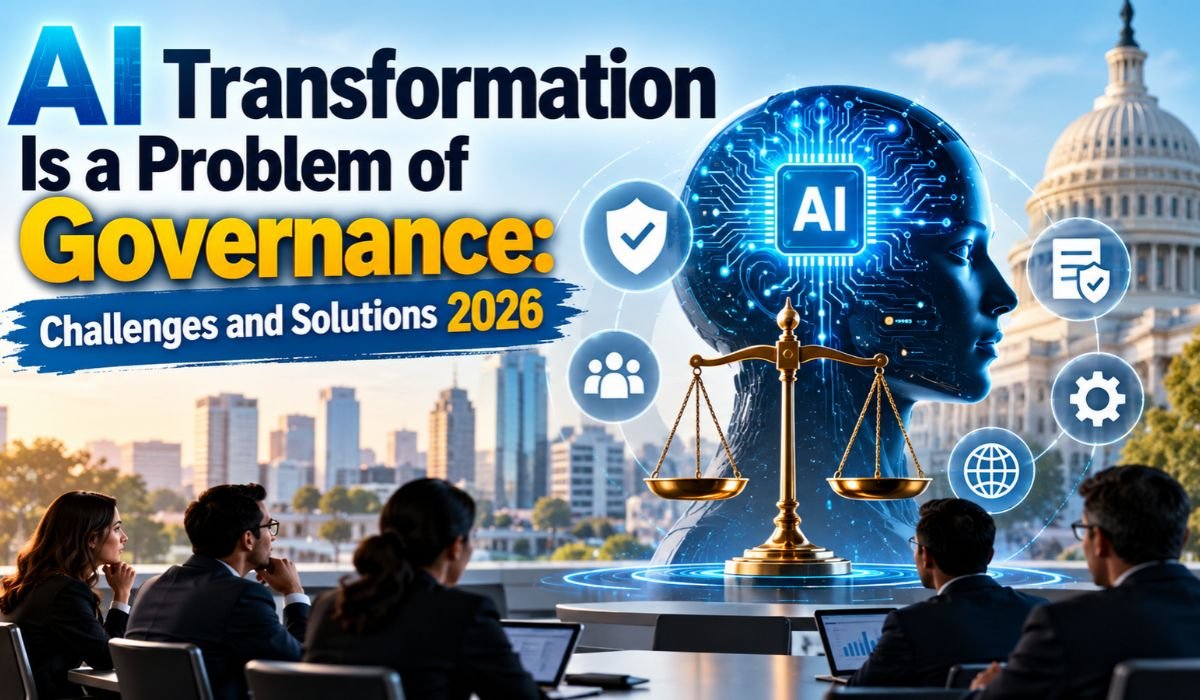
The real difficulties often involve leadership, accountability, decision-making, and organizational oversight. This is why AI Transformation Is a Problem of Governance has become an important topic for business leaders in 2026.
As AI systems become more capable and independent, organizations need clear rules about how these technologies should operate, who is responsible for their decisions, and what happens when something goes wrong.
A strong AI Governance Framework helps businesses address these concerns while encouraging responsible innovation. Understanding this connection is essential for organizations that want AI to deliver lasting value rather than create unnecessary risks.
Quick Information About AI Transformation And Governance
| Information | Details |
|---|---|
| Main Topic | AI Transformation And Governance |
| Central Challenge | Accountability And Organizational Oversight |
| Primary Objective | Responsible And Effective AI Adoption |
| Key Business Benefit | Reliable AI-Enabled Decision-Making |
| Governance Responsibility | Executive Leadership And Designated Owners |
| Technical Responsibility | Engineering And Data Science Teams |
| Operational Responsibility | Business And Product Teams |
| Important Risk | Uncontrolled Automated Decisions |
| Data Requirements | Quality, Privacy, Security, And Traceability |
| Established Framework | NIST AI Risk Management Framework |
| Management System Standard | ISO/IEC 42001 |
| Regulatory Example | European Union AI Act |
| Emerging Technology | Autonomous AI Agents |
| Essential Control | Risk-Based Human Oversight |
| Monitoring Focus | Performance, Incidents, And Changing Risks |
| Ethical Considerations | Fairness, Transparency, And Accountability |
| Governance Approach | Continuous Improvement |
| Long-Term Goal | Sustainable AI Transformation |
What Does AI Transformation Is a Problem of Governance Mean?
The phrase AI Transformation Is a Problem of Governance highlights a simple but important reality: successful AI adoption depends on organizational responsibility just as much as technological capability.
AI Governance refers to the policies, processes, and responsibilities that guide how artificial intelligence is developed, introduced, monitored, and controlled within an organization.
Consider a bank that uses AI to evaluate loan applications. The technology might analyze financial information quickly and identify potential risks. However, the bank still needs to determine whether the recommendations are accurate, fair, and consistent with applicable regulations.
Who approves the system before it begins operating? Who investigates questionable decisions? Who has the authority to suspend it when problems appear?
These questions aren’t primarily about programming. They’re about accountability.
Without clear answers, even an advanced AI system can create confusion, expose businesses to risk, and damage customer confidence.
Why AI Transformation Is a Governance Challenge Rather Than a Technology Problem
When businesses begin their AI journey, they often concentrate on purchasing software, hiring technical specialists, and developing sophisticated models. These investments matter, but they don’t guarantee meaningful results.
An AI application might perform exceptionally well during testing and still struggle in everyday business operations. Employees may not understand how to use it, departments may disagree over responsibilities, or managers may lack procedures for handling unexpected outcomes.
Imagine a company introducing AI-powered recruitment software. The system may identify promising candidates efficiently, but technical accuracy is only part of the picture.
The organization must also consider whether the screening process treats applicants fairly, protects personal information, and allows human recruiters to review important decisions.
These issues require policies, leadership, and accountability.
Ultimately, technology makes AI transformation possible, but governance determines whether that transformation is responsible, reliable, and sustainable.
Understanding AI Governance, AI Management, And AI Technology
AI Technology, AI Management, and AI Governance are closely connected, although each serves a different purpose.
AI Technology includes the software, machine learning models, computing infrastructure, and data systems that make intelligent applications possible. Engineers and data scientists generally handle these technical responsibilities.
AI Management focuses on daily operations. Managers coordinate projects, allocate budgets, monitor performance, and ensure that AI applications support business objectives.
AI Governance provides the broader rules that guide both activities. It establishes acceptable risks, approval procedures, accountability requirements, and oversight responsibilities.
Consider an AI-powered customer service platform. Developers build the system, operations managers supervise its performance, and governance leaders establish rules about customer data, automated responses, and situations requiring human intervention.
When these functions work together, organizations can introduce AI more confidently. When they operate independently, misunderstandings and unnecessary risks become much more likely.
Why AI Governance Matters More Than Ever In 2026
AI Governance has become increasingly important as businesses expand their use of Generative AI and Autonomous AI Agents.
Generative AI tools can draft documents, summarize information, analyze data, and support customer interactions. Yet they can also produce inaccurate statements, misunderstand instructions, or expose confidential information when safeguards are inadequate.
Autonomous AI Agents introduce another level of complexity. Some can interact with business applications, complete workflows, and initiate actions with limited human involvement.
That independence creates opportunities for efficiency, but it also makes oversight essential.
Regulatory expectations are evolving as well. Businesses operating across different countries must understand which legal requirements apply to their AI applications.
Meanwhile, Shadow AI presents a less visible challenge. Employees may use unauthorized AI tools to complete everyday tasks, sometimes sharing sensitive company information without realizing the consequences.
The solution isn’t to discourage every new AI application. Organizations need sensible policies that protect information, establish accountability, and allow employees to benefit from approved technologies.
The Biggest AI Governance Challenges Facing Organizations
One of the most persistent AI Governance Challenges is unclear ownership. When several departments contribute to an AI project, responsibility can become scattered across technical teams, managers, and compliance professionals.
This arrangement may work during development, but problems often emerge when an important decision needs approval or an incident requires immediate attention.
Data quality creates another serious concern. AI systems rely on information, and inconsistent or incomplete datasets can undermine their performance. When departments maintain different data standards, identifying the source of an error becomes difficult.
Transparency is equally important. Organizations need to understand the capabilities and limitations of their AI systems, especially when those systems influence consequential decisions.
Another challenge involves turning ethical commitments into everyday practice. A company may promise fairness and accountability, but those principles have limited value without testing procedures, responsible owners, and corrective action.
Effective Enterprise AI Governance brings these responsibilities together through clear leadership, consistent policies, and meaningful oversight.
How Poor AI Governance Affects Business Performance
Weak AI Governance can affect an organization’s finances, operations, reputation, and customer relationships.
Some businesses invest heavily in promising AI pilots that never reach full deployment. The technology may work, but unclear approval procedures, unrealistic expectations, or missing operational responsibilities prevent the project from progressing.
Other organizations deploy AI applications without sufficient monitoring, allowing inaccurate recommendations or unexpected behavior to continue unnoticed.
Consider an AI recruitment system trained on historical hiring information. If that information reflects past discrimination, the system may reproduce unfair patterns unless the organization evaluates and addresses those risks.
Poor governance can also create regulatory exposure, particularly when businesses cannot demonstrate that their systems meet applicable requirements.
Beyond legal concerns, customers may lose confidence when automated decisions appear inconsistent or cannot be reasonably explained.
Strong AI Risk Management helps organizations identify these problems earlier, investigate their causes, and introduce appropriate corrective measures.
Why Traditional IT Governance Is Not Enough For AI
Traditional IT Governance remains essential for protecting business systems. It addresses cybersecurity, access management, infrastructure reliability, software updates, and operational continuity.
However, artificial intelligence introduces challenges that conventional controls may not fully address.
Many AI models produce probabilistic results, meaning their responses aren’t always predictable in the same way as traditional rule-based software.
Model performance can also deteriorate when real-world conditions change. This may involve Data Drift, where incoming information differs from the data used during development, or changes in the relationships a model is intended to predict.
Importantly, a model doesn’t have to learn continuously for its performance to decline.
AI also raises questions about fairness, explainability, and the consequences of automated recommendations.
Businesses shouldn’t abandon established IT Governance practices. Instead, they should strengthen them with AI-specific testing, documentation, monitoring, and human oversight.
Core Principles Of An Effective AI Governance Framework
A reliable AI Governance Framework begins with accountability. Every significant AI application should have a clearly identified owner who understands its intended purpose, operational limitations, and potential risks.
Data Governance is another essential component. Organizations need appropriate standards for information quality, privacy, security, access, and traceability.
Transparency also plays an important role. Employees, managers, and other relevant stakeholders should understand what an AI system can do, where it may fail, and when its outputs require additional review.
Human oversight becomes especially important when automated decisions affect employment, financial opportunities, healthcare, or individual rights.
Risk-based governance helps organizations apply controls proportionately. A simple writing assistant generally doesn’t require the same level of oversight as an AI system supporting medical decisions.
Established guidance can help businesses organize these responsibilities. The NIST AI Risk Management Framework uses four interconnected functions: Govern, Map, Measure, and Manage.
ISO/IEC 42001 provides requirements for establishing, maintaining, and continually improving an Artificial Intelligence Management System.
These approaches help organizations move beyond general principles toward structured, repeatable governance practices.
AI Governance Roles And Leadership Responsibilities
Successful AI Transformation requires more than appointing a single technology leader. Governance responsibilities must be shared appropriately across the organization while maintaining clear accountability.
Executive leadership establishes strategic priorities, determines acceptable risk levels, and ensures that governance receives sufficient attention and resources.
Technology leaders oversee system architecture, technical controls, security, and implementation standards.
Data scientists and engineers evaluate model performance, document limitations, and investigate technical problems.
Legal and compliance professionals help organizations understand applicable regulations and develop appropriate policies.
Business owners remain responsible for how AI applications affect daily operations and the people who rely on their outcomes.
One practical method for clarifying these responsibilities is a RACI Matrix, which identifies who is Responsible, Accountable, Consulted, and Informed.
For instance, a department leader may be accountable for an AI application while engineers conduct testing and compliance specialists review relevant legal obligations.
Clear ownership makes it easier to resolve problems before they become serious.
Understanding The AI Governance Maturity Model
Not every organization approaches AI Governance with the same level of preparation.
An AI Governance Maturity Model provides a useful way to understand how oversight develops as businesses gain experience.
At an early stage, employees may experiment with AI independently, with limited documentation or organizational control.
As adoption increases, businesses typically introduce controlled pilot projects and basic usage policies.
The next stage involves formal governance responsibilities, documented risk assessments, and consistent approval procedures.
More advanced organizations integrate governance into everyday business operations. AI applications are monitored regularly, and departments follow coordinated standards.
At the highest level, governance becomes part of organizational strategy, helping businesses manage risks while building stakeholder confidence.
This five-stage approach is an illustrative assessment model rather than a universal certification requirement.
Its value lies in helping organizations recognize weaknesses and identify practical improvements.
How To Build A Successful AI Governance Strategy
Developing a successful AI Transformation Strategy begins with understanding how artificial intelligence is already being used.
Organizations should identify their existing AI applications, including internally developed systems, third-party services, and tools adopted independently by employees.
Each application should have a documented purpose, responsible owner, and initial risk assessment.
Leadership can then establish policies covering acceptable AI use, data protection, model testing, deployment approval, and incident reporting.
Higher-risk systems may require additional safeguards, including independent validation, human approval checkpoints, and more frequent monitoring.
Businesses should also establish procedures for updating, suspending, or retiring AI applications when circumstances change.
For organizations starting from scratch, an initial 90-day plan can provide direction. The first month might focus on identifying systems and risks, followed by policy development and a controlled implementation pilot.
However, building mature governance is an ongoing process rather than a project that ends after a fixed deadline.
AI Governance Regulations And Compliance Requirements
AI Compliance has become a central concern for organizations adopting artificial intelligence in 2026.
The European Union AI Act establishes a risk-based regulatory approach, with obligations that vary according to the type of system, its intended use, and the organization’s role.
Its requirements have phased application dates. Provisions concerning prohibited AI practices and AI literacy began applying in February 2025, while general-purpose AI provisions began applying in August 2025. Other obligations have later application dates, including those affected by legislative changes in 2026.
Businesses should therefore examine the requirements and deadlines relevant to their particular systems rather than assuming every provision applies in the same way.
Privacy and data protection laws may introduce additional responsibilities involving personal information.
Alongside legislation, established frameworks offer practical guidance.
The NIST AI Risk Management Framework provides voluntary recommendations for identifying, evaluating, and managing AI risks.
ISO/IEC 42001 establishes requirements for an organizational AI Management System and supports continuous improvement.
Although these frameworks can strengthen governance, adopting them doesn’t automatically guarantee compliance with every applicable law.
Organizations operating internationally should assess their obligations according to the jurisdictions and activities involved.
AI Governance For Generative AI And Autonomous Agents
Generative AI and Autonomous AI Agents are expanding what businesses can automate, but they also introduce new governance challenges.
A customer service chatbot might provide incorrect information about company policies. An autonomous agent connected to business software could modify records or initiate actions that require additional authorization.
These possibilities make permissions and operational boundaries particularly important.
Organizations should clearly define which systems AI agents may access, what information they can process, and which actions require human approval.
Sensitive activities may need transaction limits, monitoring, audit logs, and emergency suspension procedures.
Security testing should also consider threats such as prompt injection, where malicious instructions attempt to manipulate an AI system through untrusted content.
Third-party AI providers deserve careful evaluation as well. Businesses should understand how vendors handle confidential information, manage updates, and respond to incidents.
A sensible starting principle is to give AI agents only the permissions necessary for their approved responsibilities.
Measuring AI Governance Success And Preparing For The Future
Good governance should deliver measurable improvements rather than simply produce lengthy policy documents.
Organizations can begin by tracking how many AI applications have documented owners, how consistently risk assessments are completed, and how quickly governance incidents are resolved.
Other useful measures include model reliability, employee training coverage, human override effectiveness, and the completion of corrective actions.
These indicators help leadership determine whether governance procedures are working in practice.
However, collecting information isn’t enough. Organizations must review the results, investigate recurring problems, and improve controls when weaknesses appear.
Small businesses may accomplish this through straightforward policies and regular management reviews. Larger enterprises may require dedicated governance teams, centralized risk registers, and automated monitoring systems.
Looking beyond 2026, increasingly capable AI agents may create greater demand for continuous assurance, transparent decision-making, and clearly defined human authority.
Businesses that develop adaptable governance practices will be better prepared to manage these changes without sacrificing innovation.
Final Thoughts
AI Transformation Is a Problem of Governance because adopting artificial intelligence successfully requires more than powerful algorithms and modern software.
Organizations need leadership that understands AI risks, policies that establish accountability, reliable data practices, and procedures that keep automated systems under appropriate supervision.
The goal isn’t to make innovation unnecessarily complicated. It’s to ensure that businesses can use AI confidently while protecting customers, employees, and organizational interests.
As artificial intelligence becomes more deeply connected to everyday business decisions, effective governance will remain essential for long-term success.
Ultimately, the organizations that benefit most from AI won’t necessarily be those that adopt every new technology first. They’ll be those that understand how to use it responsibly, measure its impact, and remain accountable for the results.
FAQs About AI Transformation And Governance
Why Is AI Transformation A Problem Of Governance?
AI Transformation is a governance challenge because organizations need clear policies, accountability, and oversight to use artificial intelligence responsibly. Even advanced AI systems can create operational or ethical problems when businesses haven’t established who controls their use, monitors outcomes, or responds to mistakes.
What Is The Biggest Challenge In AI Governance?
One of the biggest challenges is assigning clear responsibility across departments. AI projects often involve technical specialists, operational managers, and compliance teams. Without coordinated leadership and defined authority, organizations may struggle to approve systems, investigate problems, or enforce policies consistently.
How Is AI Governance Different From AI Management?
AI Governance establishes the rules, responsibilities, and risk boundaries guiding artificial intelligence. AI Management focuses on the practical operation of AI systems, including project coordination, resource allocation, performance monitoring, and business results. Both are necessary for successful AI Transformation.
Who Is Responsible For AI Governance?
Executive leadership is responsible for establishing appropriate organizational oversight, but effective governance involves several teams. Technology leaders manage technical requirements, compliance professionals assess legal obligations, and business owners supervise operational outcomes. Clear accountability should be assigned for each significant AI application.
What Are The Main Principles Of AI Governance?
The main principles include accountability, transparency, fairness, privacy, security, human oversight, and continuous risk management. These principles help organizations identify potential problems, protect stakeholders, and maintain reliable AI operations. Their implementation should reflect the risks associated with each system.
How Can Small Businesses Implement AI Governance?
Small businesses can begin by identifying their AI tools, assigning responsibility, and establishing straightforward acceptable-use policies. They should also protect confidential information, evaluate higher-risk applications, and provide employees with basic AI training. Effective governance doesn’t always require expensive technology or a large dedicated department.
What Are The Best AI Governance Frameworks?
The NIST AI Risk Management Framework and ISO/IEC 42001 are established approaches to AI Governance. NIST provides voluntary guidance for managing AI risks, while ISO/IEC 42001 specifies requirements for an Artificial Intelligence Management System. Organizations can use these approaches together according to their needs.
What Is The Future Of AI Governance After 2026?
AI Governance is likely to become more closely connected with autonomous systems, continuous monitoring, transparency, and organizational accountability. As businesses introduce more capable AI applications, they’ll need flexible policies that can adapt to technological developments, changing regulations, and emerging operational risks.
Learn more and explore exciting content on: Fameimpact.com Explained: Content, Features, Guest Posting, and More














Leave a Reply