
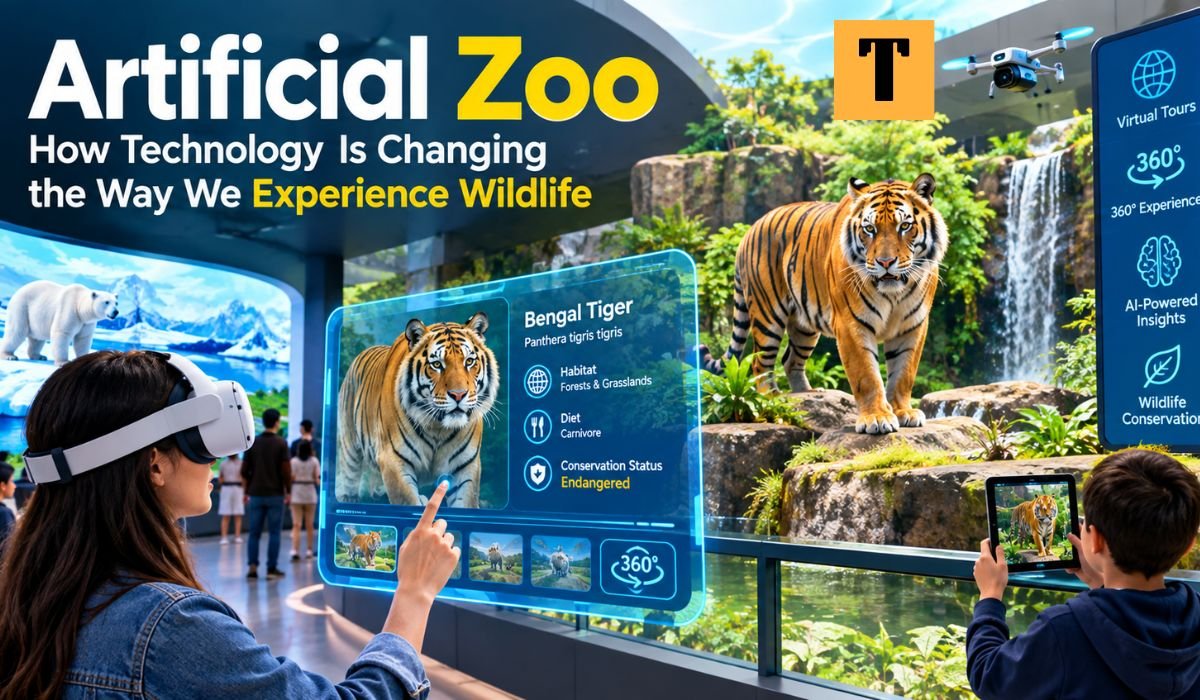
For generations, people have gone to Zoos, Aquariums, Wildlife Parks, and Safaris for a chance to see animals they might otherwise never encounter. Those experiences remain an important way to learn about Wildlife, but technology is opening another door.
Virtual Reality, Augmented Reality, Robotics, Artificial Intelligence, Digital Simulation, and immersive displays are changing how people can interact with animals and ecosystems. Instead of simply looking through an enclosure, visitors can potentially step into a simulated habitat, explore a digital ecosystem, or come face to face with a life-sized robotic animal.
This emerging idea is often described as an Artificial Zoo. The term doesn’t refer to one officially defined type of zoological institution. Rather, it can describe a variety of technology-based Wildlife experiences that use Robotic Animals, Digital Wildlife, virtual environments, interactive displays, or a combination of these tools.
The idea isn’t entirely futuristic, either. The Smithsonian’s National Zoo already provides live virtual programs for children and schools, while Smithsonian researchers are using Artificial Intelligence to help process large collections of Wildlife images for conservation research.
That distinction is important. An Artificial Zoo isn’t necessarily intended to replace Nature or the Traditional Zoo. Its greater potential may be to give people another way to understand animals, explore ecosystems, and learn why Conservation matters.
Quick Bio Information
| Fact | Information |
|---|---|
| Concept | Artificial Zoo |
| Primary Purpose | Wildlife Education And Immersive Experiences |
| Core Technologies | VR, AR, Robotics, AI, Projection, And Digital Simulation |
| Live Animals Required | No, Not For A Fully Artificial Experience |
| Digital Wildlife | Can Represent Animals And Habitats |
| Robotic Animals | Can Reproduce Physical Scale And Programmed Movement |
| Virtual Safari | Can Simulate Wildlife Exploration |
| Extinct Species | Can Be Digitally Or Robotically Reconstructed |
| Educational Role | A Major Potential Application |
| Conservation Role | Mainly Education, Awareness, And Engagement |
| Traditional Zoo Relationship | Can Complement Live-Animal Experiences |
| Family Appeal | Strong Potential For Interactive Learning |
| Accessibility | Digital Formats Can Expand Access For Some Audiences |
| AI Role | Data Analysis, Personalization, And Interaction |
| VR Role | Immersive Simulated Habitats |
| AR Role | Digital Information And Wildlife Over Physical Spaces |
| Robotics Role | Physical Animal Representations |
| Main Limitation | Cannot Fully Reproduce Living Wildlife |
| Key Ethical Issue | Transparency And Authenticity |
| Future Potential | More Immersive And Accessible Wildlife Education |
What Is An Artificial Zoo?
An Artificial Zoo is best understood as a technology-based Wildlife experience rather than a standardized category of zoological institution. There isn’t one fixed blueprint for what such a place must look like.
Depending on the attraction, visitors could encounter life-sized Robotic Animals, Digital Animals, VR environments, AR creatures, projection-based habitats, interactive screens, or several of these technologies working together.
Some Artificial Zoo experiences could be completely artificial, with no living animals at all. Others could exist alongside traditional exhibits inside a zoo, museum, aquarium, or Wildlife Education center.
That flexibility is part of what makes the concept interesting. A technology-based attraction can create environments that would be difficult to build or maintain as physical habitats. It can also introduce visitors to animals that aren’t available in a particular collection.
Still, transparency matters. Visitors should know whether they’re looking at a living animal, a robotic representation, an animation, a projection, or a simulation. A convincing digital Elephant might demonstrate aspects of anatomy or behavior, but it remains fundamentally different from observing a living Elephant.
The same principle applies to extinct animals. Digitally recreating a species is an educational representation; it doesn’t mean that scientists have actually brought the species back to life.
How Does An Artificial Zoo Work?
An Artificial Zoo can bring several technologies together to create an environment that feels more immersive than a conventional display.
Imagine walking into a room where the walls and floor have been transformed into a Tropical Rainforest using Projection Mapping. Rainfall fills the soundscape, while recordings of birds and insects create the impression of a living environment. Sensors could detect visitors’ movements and trigger changes in the display or reveal additional information.
VR can take the experience a step further. With a headset, a visitor could look around a simulated habitat, follow an animal, or explore an environment that would normally require a long and expensive journey.
Robotics adds something different: physical presence. A life-sized robotic animal can reproduce selected movements and give visitors a better sense of an animal’s size and form.
AI could provide another layer of interaction. It might help personalize educational information, answer questions, or analyze Wildlife data behind the scenes.
Even so, these technologies shouldn’t be confused with genuine animal behavior. A robot follows programmed instructions. AI processes information and generates outputs. Neither has the biological instincts, needs, relationships, and unpredictable behavior of a living animal.
That difference between simulation and reality is one of the most important ideas behind a responsible Artificial Zoo.
The Technology Behind An Artificial Zoo
Virtual Reality is particularly useful for creating environments that are geographically distant, difficult to reach, or impractical to recreate physically. Augmented Reality takes a different approach. Rather than replacing the visitor’s surroundings, it adds digital information or Digital Wildlife to the physical world.
The Smithsonian has already demonstrated the educational potential of AR. Its Skin And Bones mobile experience used three-dimensional augmented reality, tracking, animations, videos, and other interactive elements to help visitors explore animal anatomy, ecology, evolution, and related scientific subjects.
That kind of technology illustrates an important point: digital tools don’t have to replace real specimens. They can add context and make scientific collections easier to understand.
Robotics and Animatronics can provide physical scale and programmed movement, while projection systems can transform ordinary rooms into forests, oceans, deserts, or other habitats.
Artificial Intelligence has an important role beyond visitor entertainment, too. In March 2026, Smithsonian researchers described how AI-based computer vision can help ecologists process large collections of Wildlife images gathered through drones, sensors, and other monitoring technologies.
That makes AI particularly interesting in this field. It’s not simply a futuristic feature for an attraction. It is also becoming part of practical scientific work aimed at understanding Wildlife.
What Can Visitors Experience?
The range of experiences possible inside an Artificial Zoo can be much broader than a conventional animal enclosure.
A visitor could move from an African Savanna to a Tropical Rainforest, Arctic environment, Coral Reef, Desert, or Deep Ocean without traveling between continents. Digital Elephants, Lions, Giraffes, Sharks, Whales, Birds, Reptiles, and Insects could all become part of the experience.
Visitors might also follow a simulated migration route, explore animal anatomy, or watch an ecosystem change over time. A Virtual Safari could recreate the feeling of traveling through a Wildlife habitat while providing explanations about the species and environment being shown.
But the most valuable experience wouldn’t necessarily be the most visually impressive one.
Simply displaying a Digital Tiger may attract attention, but explaining where Tigers live, what they eat, how they behave, and which environmental pressures affect them adds far more educational value.
That’s where an Artificial Zoo can move beyond being a technology showcase and become a genuine Wildlife Education experience.
Can An Artificial Zoo Recreate Extinct Animals?
One of the most intriguing possibilities is the ability to represent animals that no longer exist.
Digital models, animation, and Robotics can give visitors a visual interpretation of Extinct Species while teaching them about Evolution, extinction, adaptation, and the changing history of Earth’s ecosystems.
For children in particular, seeing a reconstructed animal may make an abstract lesson much easier to understand. Instead of only reading about an extinct species, they could see its estimated size, habitat, movement, and relationship with its environment.
Scientific caution is essential, however. When evidence about an extinct animal is incomplete, a reconstruction may include informed interpretation. A responsible exhibit should make it clear which details are well established and which are estimates.
It’s also important to distinguish Digital Reconstruction from De-Extinction. A robotic Mammoth or computer-generated Dinosaur is an educational representation. It isn’t a living organism, and displaying one doesn’t mean that scientists have brought the species back.
Clear labeling can help visitors appreciate the technology without confusing a scientific reconstruction with scientific certainty.
Artificial Zoo Vs. Traditional Zoo
A Traditional Zoo and an Artificial Zoo offer very different experiences.
Traditional Zoos care for living animals and can contribute to veterinary care, animal welfare, behavioral observation, research, education, and conservation programs. Visitors also have the opportunity to observe genuine animal behavior, including movements and interactions that can’t be completely predicted.
An Artificial Zoo has a different set of possibilities. It can represent extinct species, simulate difficult-to-access environments, and create controlled educational scenarios without maintaining a living collection of every species featured.
That doesn’t make the two formats interchangeable.
Living Wildlife provides something technology can’t fully reproduce: genuine biological presence. An animal can respond to its surroundings, interact with another animal, behave unexpectedly, or change its behavior from one day to the next.
At the same time, technology can complement traditional zoological institutions. A zoo could use VR to introduce a species that isn’t part of its collection, AR to add educational information to an existing exhibit, or Robotics to demonstrate an extinct animal.
Rather than viewing the two models as competitors, it may be more useful to see them as different tools for connecting people with Wildlife.
Why Could Artificial Zoos Appeal To Families And Travelers?
Wildlife Tourism is increasingly capable of offering experiences that are interactive rather than purely observational. An Artificial Zoo could allow visitors to explore several ecosystems in one location, making the idea particularly appealing to families, students, and people who live far from major natural habitats.
There’s also a practical advantage. Not everyone can travel to a remote rainforest, Arctic environment, or African wildlife reserve. A technology-based experience can bring aspects of those environments into a city or educational setting.
The experience can also be tailored to different interests. One visitor might prefer a calm, guided educational journey, while another could choose a more adventurous Virtual Safari.
Digital Wildlife experiences are already helping extend learning beyond the physical boundaries of zoos. The Smithsonian’s National Zoo has used live virtual field trips to connect educators and young children with animal experts and live animal encounters. According to the Smithsonian, its early-learning program had produced more than a dozen virtual field trips since launching in 2022.
For families, that combination of accessibility, education, and entertainment could make Artificial Zoo experiences particularly attractive.
How Can Artificial Zoos Support Wildlife Education?
Education may ultimately be one of the strongest applications of Artificial Zoo technology.
A simulated ecosystem can make scientific concepts easier to understand because visitors aren’t simply reading about relationships between species; they can see those relationships represented visually.
A Virtual Safari could demonstrate animal migration. An interactive food web could show what happens when one species disappears. A Digital Animal could introduce visitors to anatomy, adaptation, or behavior without disturbing a living creature.
The Smithsonian’s virtual education programs provide a real-world example of how digital Wildlife learning can reach classrooms that may not have convenient access to a zoo or museum. Its K–5 virtual programs include interactive engagement and educational activities, with accessibility features such as captions, interpretation, and screen-reader-compatible activity materials available for relevant programs.
For an Artificial Zoo to establish genuine Expertise and Trustworthiness, its educational content should be developed or reviewed by appropriate specialists. Zoologists, Ecologists, Conservation Scientists, educators, and other subject experts can help ensure that exhibits reflect established scientific knowledge rather than entertainment alone.
That expert input can make the difference between an impressive display and a genuinely useful learning experience.
Are Artificial Zoos More Ethical?
The ethical question is more complicated than simply asking whether artificial animals are better than living animals.
A fully artificial attraction doesn’t require live animals to perform for visitors. That may avoid certain concerns associated with captivity, transportation, breeding, and public display.
However, an Artificial Zoo isn’t automatically ethical simply because it uses robots or Digital Wildlife.
A 2025 perspective published in Biological Conservation examined the potential role of robotic animals in zoos and aquariums. The authors discussed possible benefits, including the ability to represent rare or extinct species and reduce some concerns associated with keeping certain animals in captivity. They also raised questions involving authenticity, conservation messaging, visitor expectations, and transparency.
Those concerns are directly relevant to Artificial Zoos.
A responsible attraction should make it clear what visitors are seeing and how closely the representation reflects scientific evidence. The purpose shouldn’t be to convince someone that a machine is alive. Instead, technology should make scientific information more engaging while remaining honest about its limitations.
In other words, realism can be useful, but transparency is essential.
Can Artificial Zoos Help Wildlife Conservation?
An Artificial Zoo can’t protect a forest, restore a coral reef, or stop illegal Wildlife trafficking on its own. Its most realistic conservation role is in education, awareness, and public engagement.
An immersive exhibit could show how deforestation changes a habitat. Another could demonstrate the effects of plastic pollution on marine ecosystems. A Virtual Migration could follow an animal across a landscape while explaining why connected habitats and Wildlife corridors are important.
Technology can also support conservation research directly.
In 2026, Smithsonian researchers described AI tools that can help ecologists process enormous quantities of Wildlife imagery and identify images containing animals more efficiently.
This distinction is important. An Artificial Zoo can communicate conservation science to the public, while AI and other digital tools can simultaneously assist scientists studying real Wildlife.
A responsible attraction should avoid suggesting that watching a simulation is equivalent to protecting an animal. Instead, it can use the experience to explain why real conservation efforts matter and how people can better understand the challenges facing Wildlife.
Artificial Zoos For Children
Children are likely to be an important audience for interactive Wildlife Education. Technology can turn complicated ideas into experiences they can explore for themselves.
A Digital Ecosystem can demonstrate food chains. An interactive animal can introduce anatomy and behavior. A simulated habitat can show what happens when environmental conditions change.
The Smithsonian’s virtual programs offer a useful real-world example. Its early-childhood field trips combine live animal segments, storytelling, movement, and interaction, allowing educators to bring Wildlife Education into classrooms and homes.
There are still practical considerations for parents and educators.
VR can cause discomfort for some users. Loud sounds, flashing visuals, darkness, and sudden movement may also overwhelm certain children. Not every child learns or responds to immersive technology in the same way.
Good Artificial Zoo design should therefore include clear age guidance, sensory information, and alternative ways to participate. The technology should support learning rather than become an obstacle to it.
Accessibility And The Artificial Zoo
Accessibility could become one of the most valuable features of technology-based Wildlife Education, but digital doesn’t automatically mean accessible.
An indoor attraction may remove some barriers associated with long outdoor journeys, uneven terrain, or extreme weather. Digital programs can also offer captions, interpretation, audio description, screen-reader compatibility, and other accessibility features.
The Smithsonian’s National Zoo currently provides accessibility services that include sign-language interpretation, CART, audio description, sensory resources, tactile elements, and digital accessibility measures. Its virtual K–5 programs also provide captions, interpretation, and accessible activity materials.
These practices offer useful lessons for future Artificial Zoo operators.
Accessibility should be considered from the beginning, not treated as an afterthought. The building, equipment, software, seating, signage, educational content, and staff support can all influence whether an experience is genuinely inclusive.
What Is A Virtual Safari?
A Virtual Safari is a digitally created Wildlife experience that simulates the exploration of an animal habitat.
Instead of traveling through a real reserve, visitors can explore a computer-generated environment through VR, projection, interactive screens, or another digital format. Depending on the design, they might follow animals, observe simulated behavior, or learn about an ecosystem as they move through it.
One major advantage is controlled access. A Virtual Safari can take visitors to environments that may be remote, expensive, dangerous, or difficult to reach. It can also pause the experience, provide scientific explanations, and direct attention toward details a visitor might otherwise miss.
Still, a Virtual Safari shouldn’t be presented as identical to a physical safari.
A real safari involves living animals, changing weather, natural sounds, unpredictable behavior, and a functioning ecosystem. Digital technology can reproduce aspects of that experience, but it can’t recreate every element.
Limitations And Challenges
Artificial Wildlife has clear limitations.
A Robotic Elephant can reproduce its physical size and programmed movements, but it doesn’t breathe, feed, develop social relationships, or respond biologically to its surroundings.
There are practical challenges, too. Robotics, projection systems, VR equipment, sensors, software, and AI systems can require considerable investment and ongoing maintenance. Hardware can break, software can become outdated, and technical problems can interrupt an entire exhibit.
Then there’s the issue of authenticity.
The 2025 Biological Conservation perspective on robotic zoo animals highlighted concerns about how visitors may respond to artificial exhibits and the importance of making their nature clear.
Scientific accuracy presents another challenge. An impressive simulation can still teach the wrong lesson if an animal’s behavior, habitat, diet, or ecological role is portrayed inaccurately.
That means the best Artificial Zoos won’t necessarily be the ones that look the most spectacular. They’ll be the ones that balance immersion with accuracy and make it clear where scientific evidence ends and creative interpretation begins.
The Future Of Artificial Zoos And Wildlife Tourism
The future of Artificial Zoos will likely involve increasingly sophisticated combinations of VR, AR, Robotics, AI, interactive displays, and immersive projection.
AI could personalize educational explanations based on a visitor’s interests or age. Improved sensors and software may allow digital environments to respond more naturally to visitors. Robotics could also become more detailed and responsive as the technology develops.
At the same time, Digital Wildlife technology is likely to remain connected with real conservation research. AI is already being explored for processing large Wildlife datasets, including imagery gathered through drones and other monitoring systems.
That creates an opportunity for Artificial Zoos to become more than entertainment venues. They could help visitors understand how scientists study animals, why ecosystems matter, and what conservation work looks like outside the attraction itself.
Still, technology shouldn’t become the star at the expense of Wildlife.
The most meaningful experiences will use technology as a bridge to scientific understanding. The goal isn’t simply to create an animal that looks real. It’s to help visitors leave with a better understanding of the real animal and the world it depends on.
Final Thoughts
The Artificial Zoo represents an emerging approach to Wildlife Education and Tourism. It can bring distant ecosystems closer, introduce visitors to Extinct Species, create Virtual Safaris, present Digital Wildlife, and turn complicated conservation ideas into experiences that are easier to see and understand.
But technology has limits.
A Digital Elephant isn’t a living Elephant. A simulated Rainforest isn’t a functioning ecosystem. A Robotic Animal can’t reproduce every biological and behavioral quality of Wildlife.
That doesn’t make the technology without value.
Used responsibly, an Artificial Zoo can give people access to species, environments, and scientific ideas that might otherwise remain distant. It can help children learn, give families an interactive experience, and introduce new audiences to the challenges facing Wildlife.
The future of Wildlife Tourism may therefore be less about choosing between Nature and Technology and more about finding responsible ways for the two to work together.
When scientific accuracy, transparency, accessibility, and genuine educational value remain at the center, an Artificial Zoo can become more than an impressive technological attraction. It can become another doorway into understanding the natural world.
FAQs About Artificial Zoo
What Is An Artificial Zoo?
An Artificial Zoo is a technology-based Wildlife experience that can use Robotics, Virtual Reality, Augmented Reality, Digital Simulation, Projection Mapping, and Interactive Displays to represent animals or ecosystems. It may be completely artificial or operate alongside live-animal exhibits.
How Does An Artificial Zoo Work?
An Artificial Zoo can combine several technologies to create an immersive experience. VR can place visitors inside simulated habitats, while AR can add Digital Wildlife to physical surroundings. Robotics can provide physical animal representations, while projection and sound systems can create environmental settings. AI can also support interactive education and Wildlife data analysis.
Can An Artificial Zoo Show Extinct Animals?
Yes. Digital models, animation, and Robotic Animals can represent Extinct Species for educational purposes. These reconstructions can help explain Evolution, extinction, adaptation, and changes in Earth’s ecosystems. They should be clearly identified as reconstructions rather than presented as living versions of extinct animals.
Are Artificial Zoos More Ethical?
Artificial Zoos can avoid some concerns associated with keeping living animals for public display, but artificial technology doesn’t automatically make an attraction ethical. Transparency, scientific accuracy, accessibility, responsible storytelling, and honest communication are all important considerations.
Can Artificial Zoos Help Wildlife Conservation?
They can support Conservation Education by showing how habitat loss, pollution, climate change, and biodiversity decline affect Wildlife. However, they don’t replace habitat protection, field research, rescue programs, veterinary work, or other direct conservation activities.
Are Artificial Zoos Suitable For Children?
They can provide engaging ways for children to learn about animals, habitats, adaptation, and Conservation. Parents should check age guidance and sensory information because VR, loud sounds, flashing visuals, darkness, or sudden movement may be uncomfortable for some children.
What Is A Virtual Safari?
A Virtual Safari is a digitally created Wildlife experience that allows visitors to explore simulated habitats and observe Digital Wildlife without physically traveling to a safari destination. It can provide immersion and education, but it can’t completely reproduce the unpredictability of observing living animals.
Can Artificial Zoos Replace Traditional Zoos?
Artificial Zoos and Traditional Zoos serve different purposes. Technology can represent extinct species and simulate environments, while Traditional Zoos provide direct encounters with living animals and may support animal care, research, education, and conservation. Technology is therefore more realistically viewed as an additional Wildlife Education tool rather than a complete substitute for living collections.
Learn more and explore exciting content on: Magazineluiza com br Email Format: How Magazine Luiza Emails Work










Leave a Reply