
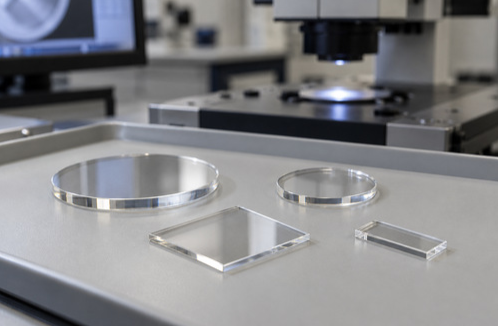
An optical window can meet its outer dimensions and still cause problems inside a medical instrument. It may transmit the illumination band but weaken the return signal, introduce unwanted reflections, or change behavior when secured in its holder. These problems often begin with a specification that describes a transparent disc rather than an optical component.
Choosing the window starts with its function in the equipment. A protective window in a camera, a component near a laser delivery point, and a window in a polarization-sensitive detector can need different combinations of properties. Their purchasing specifications should reflect those differences.
The process becomes more manageable when the requirements are considered in a practical order: the optical signal, the component surfaces, the mechanical interface, and the environment. Each step narrows the range of useful material and finishing options.
Define the wavelength before choosing the material
The operating wavelength or band is the first requirement. If the equipment uses separate illumination and detection bands, both need to be identified. The visible appearance of a material does not establish its transmission in ultraviolet or infrared operation.
Thickness and grade also matter. A transmission curve for one thickness or grade may not represent the proposed part. The buyer should distinguish bulk transmission from losses at the finished surfaces, particularly if a coating will be added later.
Calcium fluoride windows are one option for optical systems needing the material’s transmission characteristics. Sapphire and fused silica offer different combinations of optical and mechanical properties. The appropriate choice follows the actual wavelength requirement and service conditions, rather than the broad label medical equipment.
For a preliminary inquiry, it helps to state the minimum transmission needed over the useful aperture and whether that requirement applies to an uncoated substrate or a completed coated part.
Check whether polarization affects the measurement
Some instruments mainly require light to pass with limited loss. Others analyze polarization and can be sensitive to changes introduced by the window.
A crystalline material may have direction-dependent optical behavior. Sapphire, for example, is birefringent. An optical design using it may need a controlled crystal orientation and an assessment over the actual angles at which light passes through it.
The relevance is visible in published work on polarization-enhanced laparoscopy, where a fused-silica window was selected to avoid effects associated with a conventional sapphire component. [1]
A purchasing team does not need to perform the optical design, but it needs to carry its requirements into the component drawing. If polarization is important, a general statement of optical-grade sapphire leaves a significant part of the request undefined.
Separate surface quality from optical shape
Surface quality, flatness, and transmitted optical performance describe different characteristics. A scratch-and-dig requirement addresses surface defects; flatness describes deviation from a reference surface. The combined behavior of the material and its surfaces determines what happens to a transmitted beam.
A window can look clean while having unsuitable optical shape. Conversely, specifying extremely severe cosmetic limits may add cost without improving the measurement the equipment performs.
Parallelism and wedge also deserve deliberate treatment. A window may need nearly parallel faces, or the optical design may use a controlled wedge to redirect reflected light. An unintended wedge and an intentionally specified wedge are different manufacturing outcomes.
Technical window specifications commonly state these characteristics separately. Manufacturer documentation for wedged windows, for example, identifies surface quality, wedge, transmission band, and coating conditions rather than combining them into one optical-quality claim. [2]
Identify the useful aperture and the mounting surfaces
The clear aperture is the region through which the useful light passes. It may be smaller than the component’s outer diameter because the holder covers part of the perimeter.
That distinction helps place requirements where they are needed. The central optical area may need one surface specification, while an outer land needs a finish suitable for seating or bonding. The drawing should show both if their functions differ.
A component also needs enough mechanical space for the intended assembly. If a seal, adhesive layer, or retaining ring is added later, its geometry should be considered before the window dimensions are finalized. Otherwise, the purchased part can occupy space the assembly process needs.
Where a shoulder or defined seating feature is useful, a stepped window may be an option. The geometry should be reviewed against the mating part; a step is a dimensional feature, not a complete sealing solution.
Specify the coating as a separate requirement
An antireflection coating reduces reflection over particular optical conditions. Wavelength, incidence angle, and polarization affect its performance. A coating designed for one arrangement should not be assumed to meet another.
Laser exposure introduces additional questions. Pulse duration, repetition rate, beam size, and wavelength can matter to damage resistance. A quoted threshold needs its test conditions to be interpreted usefully; a single number detached from those conditions provides little basis for comparison. NIST research publications document how coating damage behavior is assessed under defined exposures. [3]
For a material inquiry, identify whether the supplier is being asked for the substrate only or for a finished coated component. If a coating vendor will receive the part later, agree on the substrate requirements that vendor needs before ordering.
Review temperature and the complete interface
Thermal conductivity and thermal expansion answer different questions. One concerns heat flow; the other concerns dimensional change with temperature. The relevant property depends on the location and function of the window.
A research comparison of quartz and sapphire chambers for infrared laser tissue sealing illustrates how a transparent component can also influence heat transfer in a particular device arrangement. [4]
The mount adds another layer of behavior. Differential expansion, concentrated clamping, and adhesive curing can change the installed component. For equipment undergoing repeated processing, coatings and joints need assessment alongside the substrate.
These questions are most efficiently addressed while the drawing remains adjustable. A small change in a mounting land or edge treatment may be easier to accommodate before prototype components have been purchased.
Build a quotation that can be compared
Stanford Advanced Materials (SAM) supplies optical windows and crystal materials for medical equipment. Buyers can submit the required material, wavelength band, dimensions, clear aperture, finish, and coating requirements for review.
For example, an inquiry for sapphire optical windows should distinguish the outer diameter from the useful aperture and identify any orientation requirement. If the design is still being evaluated, describe the fixed optical conditions and the dimensions that can change.
The acceptance method should then match the specification. Dimensional inspection, surface inspection, and transmission measurement verify different requirements. If a special measurement is needed, discuss its method and reporting before the order is placed.
This makes quotation comparison more useful. A raw blank, polished uncoated window, and coated optical component can have different prices because they include different work. Clear scope allows SAM to review the requested supply and allows the equipment team to judge what further processing remains.
A good window specification describes the light the part must pass and the assembly it must fit. Resolving those details early helps keep a small component from becoming a source of repeated optical and manufacturing adjustments.
References
[1] Biomedical Optics Express. Polarization enhanced laparoscope for improved visualization of tissue structural changes associated with peritoneal cancer metastasis
[2] Thorlabs. High Vacuum CF Flange Viewports for Wedged Windows technical specifications
[3] National Institute of Standards and Technology. Laser induced damage in optical materials NBS Special Publication 568
[4] Lasers in Surgery and Medicine. Comparison of Quartz and Sapphire Optical Chambers for Infrared Laser Sealing of Vascular Tissues












Leave a Reply