
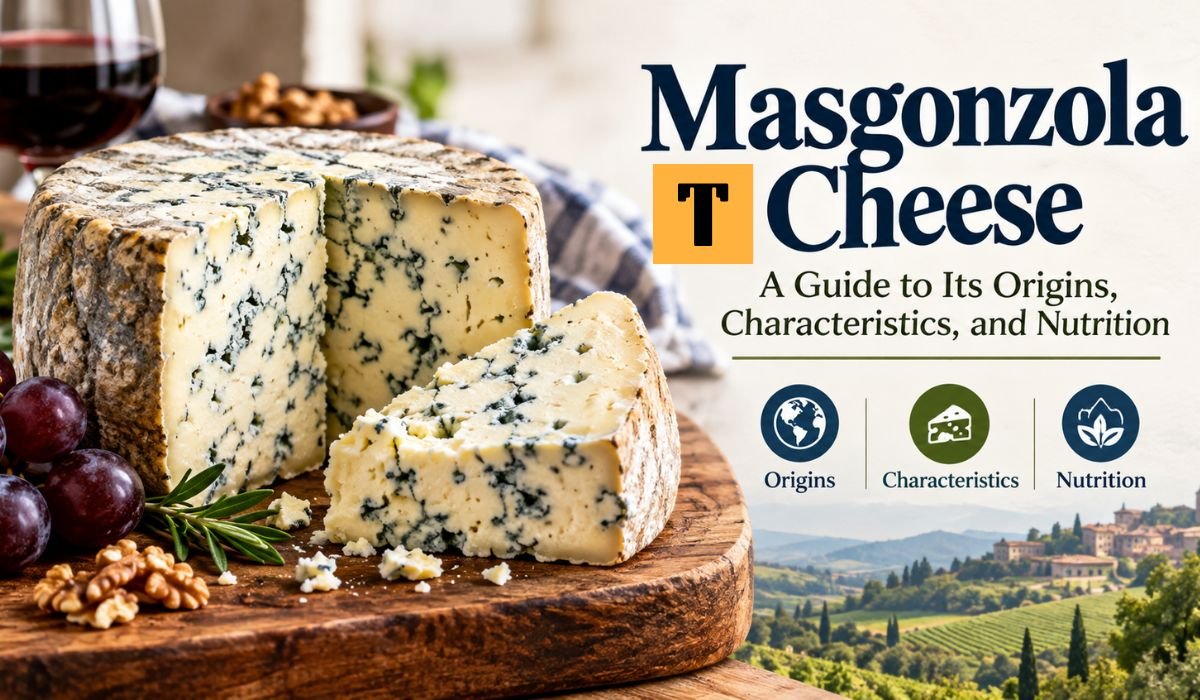
Masgonzola Cheese is a rich, creamy dairy specialty that offers an interesting middle ground for cheese lovers. If you enjoy the bold character of blue cheese but prefer something softer and more buttery, this combination is worth exploring. The name can be confusing, though, because Masgonzola is sometimes described online as if it were a completely separate historic Italian cheese. A more accurate description is that Masgonzola generally refers to a preparation that combines Gorgonzola and Mascarpone.
The appeal comes from the contrast between those two cheeses. Gorgonzola brings blue-green veining, a tangy and salty taste, and the earthy character associated with blue cheese. Mascarpone, meanwhile, contributes a smooth, mild, buttery creaminess. One commercial example from CasArrigoni is made with alternating layers of Mascarpone and mild Gorgonzola, creating a distinctive combination of pale cream and blue-veined cheese.
That distinction matters when researching Masgonzola Cheese Nutrition, its origins, and its characteristics. Unlike a protected cheese with one fixed recipe, Masgonzola-style products can vary by producer. Ingredients, proportions, texture, flavor, and nutritional values may therefore differ.
Quick Bio Information
| Information | Details |
|---|---|
| Name | Masgonzola Cheese |
| Food Type | Gorgonzola And Mascarpone Specialty |
| Main Components | Gorgonzola And Mascarpone |
| Cheese Character | Creamy And Blue-Veined |
| Texture | Soft, Rich, Creamy, And Spreadable |
| Flavor | Buttery, Tangy, Salty, And Mildly Pungent |
| Common Dairy Source | Cow’s Milk In Documented Commercial Examples |
| Related Cheese | Gorgonzola |
| Cream Component | Mascarpone |
| Blue Cheese Component | Gorgonzola |
| Separate Masgonzola PDO | No Established Separate PDO |
| Gorgonzola PDO | Yes |
| Appearance | White Or Pale Yellow Cream With Blue-Veined Sections |
| Common Uses | Pasta, Risotto, Pizza, Sauces, Bread, And Appetizers |
| Main Allergen | Milk |
| Storage | Refrigerated |
| Flavor Intensity | Usually Creamier And Milder Than Strong Blue Cheese |
| Product Variation | Depends On Producer And Recipe |
| Nutrition | Varies By Product |
| Buying Advice | Check The Label And Producer Information |
What Is Masgonzola Cheese?
Masgonzola Cheese is generally understood as a specialty made by combining Gorgonzola and Mascarpone. The name reflects those two components, although it shouldn’t be confused with Gorgonzola PDO, which is a separate protected Italian cheese with clearly defined production requirements.
Gorgonzola provides the blue-veined element and most of the stronger flavor. Mascarpone adds a soft, dense creaminess along with a delicate buttery taste. In a documented commercial example, the Mascarpone appears as a smooth white or pale-yellow cream, while the Gorgonzola layers are creamy and blue-veined.
This combination also explains some of the confusion surrounding the term Masgonzola. Depending on the source or product, readers may encounter names such as Masgonzola, Gorgonzola With Mascarpone, or Gorgonzola and Mascarpone. Rather than assuming that every product follows one traditional recipe, it’s better to check the product label and information provided by the producer.
The Origins Behind Masgonzola
The history of Masgonzola deserves a little clarification. Some online descriptions make it sound like an ancient European cheese with its own long-established tradition. The better-supported story begins with Gorgonzola, the historic Italian blue cheese that has protected PDO status.
Gorgonzola PDO is produced from whole pasteurized cow’s milk under defined production rules. Its production involves lactic ferments, rennet, and Penicillium spores, followed by molding, salting, and maturation. The cheese is eventually pierced so air can enter its interior, encouraging the development of its characteristic blue-green veins.
Masgonzola shouldn’t therefore be given an invented independent history. The more defensible explanation is that it is a culinary preparation built around two established Italian dairy traditions: Gorgonzola and Mascarpone. A current commercial example demonstrates how the two can be combined in alternating layers.
That distinction is important for anyone researching the Masgonzola Cheese History. It keeps the article grounded in what can actually be supported instead of turning assumptions into historical facts.
How Masgonzola Is Made
There isn’t one official Masgonzola production method that applies to every product. That’s a significant difference between Masgonzola and Gorgonzola PDO.
The Gorgonzola component follows a carefully controlled cheesemaking process. Gorgonzola PDO is made with pasteurized whole cow’s milk, lactic cultures, rennet, and Penicillium spores. Once the milk coagulates, the curd is molded and drained before the cheese is salted and matured. During maturation, the cheese is pierced to allow oxygen into the interior and support the development of its characteristic blue veining.
The Masgonzola-style preparation then combines this Gorgonzola with Mascarpone. In the documented CasArrigoni product, the two are arranged in alternating layers rather than being treated as one traditional blue-cheese recipe.
For that reason, describing Masgonzola as a Gorgonzola-And-Mascarpone Cheese Specialty is more accurate than claiming it has a single standardized production method. Different producers can use different proportions, techniques, and formulations.
What Does Masgonzola Look Like?
Masgonzola has an appearance that immediately reflects its two main ingredients. The Mascarpone portion is generally smooth, dense, and white or pale yellow, while the Gorgonzola portion is creamy and marked by blue-green veining.
That contrast gives the cheese a distinctive visual appeal. Rather than looking like a conventional block of blue cheese covered throughout with blue veins, a Masgonzola-style product can show pale creamy sections alongside darker blue-veined portions.
The exact appearance isn’t identical across every product. Some versions may have clearly defined layers, while others can appear more blended. Refrigeration, formulation, and the ratio of Gorgonzola to Mascarpone can also affect the final texture and appearance.
This makes Masgonzola particularly attractive for cheese boards and appetizers, where the contrast between its creamy and blue-veined sections can be part of the presentation.
Masgonzola Flavor And Texture
The flavor of Masgonzola is largely a story of balance. Gorgonzola supplies the stronger personality, bringing salty, tangy, earthy, and distinctly blue-cheese notes. Mascarpone takes the edge off that intensity with its mild, buttery, creamy character.
For people who enjoy blue cheese but find particularly strong varieties overwhelming, that balance can make Masgonzola easier to approach. It still has recognizable blue-cheese character, but the experience isn’t based entirely on sharpness or pungency.
The texture follows the same pattern. Mascarpone contributes a smooth, dense creaminess, while Gorgonzola adds a more structured and veined quality. Together, they can create a cheese that’s easy to spread while retaining the depth associated with Gorgonzola.
Masgonzola Varieties And Product Differences
It’s important not to present terms such as “Young Masgonzola” or “Aged Masgonzola” as officially recognized varieties unless a particular producer specifically uses those classifications. Unlike Gorgonzola PDO, Masgonzola doesn’t have one universally standardized classification system.
Instead, differences generally come from the individual product. The proportion of Gorgonzola and Mascarpone, the type of Gorgonzola used, the manufacturing technique, and the producer’s recipe can all influence the finished cheese.
For example, a documented CasArrigoni product uses Mascarpone and mild Gorgonzola in alternating layers. Its nutritional information is specific to that particular product rather than being a universal nutritional profile for everything described as Masgonzola.
This is useful to remember when shopping. If two products look similar but come from different producers, they may not have exactly the same flavor, texture, ingredients, or nutritional values. The package label remains the best source for product-specific information.
Masgonzola Compared With Gorgonzola
Masgonzola And Gorgonzola are closely connected, but they aren’t the same product.
Gorgonzola is an established Italian PDO cheese with specific geographical and production requirements. Gorgonzola PDO is made exclusively from pasteurized whole cow’s milk and is subject to controlled production and traceability requirements.
Masgonzola generally takes Gorgonzola and combines it with Mascarpone. That additional ingredient changes both texture and flavor. Gorgonzola provides the blue-veined character, saltiness, tang, and depth, while Mascarpone adds softness and a gentler buttery quality.
This distinction is particularly important for readers searching Masgonzola Vs Gorgonzola. Masgonzola isn’t simply another spelling or name for the protected cheese. It’s better understood as a preparation centered on Gorgonzola and enriched with Mascarpone.
How To Eat Masgonzola Cheese
Masgonzola is especially enjoyable when paired with foods that can complement or balance its rich flavor. It can be spread over crusty bread or crackers, served as part of a cheese board, or paired with fruit, nuts, and honey.
Pears and apples work particularly well because their natural sweetness and freshness can offset the cheese’s salty and tangy notes. Figs offer a softer sweetness, while walnuts introduce an earthy crunch. Honey can create an appealing sweet-and-savory contrast.
Its soft consistency also makes Masgonzola convenient for warm dishes. Rather than adding Gorgonzola and Mascarpone separately, a suitable Masgonzola-style product can provide both creaminess and blue-cheese flavor in a single ingredient.
Masgonzola In Cooking
Masgonzola has plenty of potential beyond the cheese board. Its creamy consistency makes it especially useful in pasta sauces and risotto, where it can melt into the dish and create richness while adding the characteristic flavor of Gorgonzola.
It can also be used with pizza, flatbreads, potatoes, vegetables, and savory pastries. Because the flavor can be fairly concentrated, a relatively small amount may be enough to give a dish a noticeable lift.
For home cooks, one of its biggest advantages is convenience. Recipes that traditionally call for both Gorgonzola and Mascarpone can sometimes use a suitable Gorgonzola-and-Mascarpone preparation instead. That can simplify the recipe while preserving the creamy, savory character the dish needs.
Masgonzola Nutrition
There isn’t one universal Masgonzola Cheese Nutrition profile because different products can have different formulations. A documented CasArrigoni Gorgonzola-and-Mascarpone product lists 394 calories, 38 grams of fat, 26 grams of saturated fat, 1.2 grams of carbohydrates, 12 grams of protein, and 0.6 grams of salt per 100 grams.
Its organic version has a different nutritional profile, listing 342 calories, 32 grams of fat, 21 grams of saturated fat, 1.6 grams of carbohydrates, 12 grams of protein, and 0.7 grams of salt per 100 grams.
Those differences are a useful reminder that nutrition figures shouldn’t automatically be applied to every product called Masgonzola. Ingredients, proportions, and production methods can affect the final numbers.
Overall, Masgonzola can contribute protein and other nutrients found in dairy foods, but it’s also a rich food. Depending on the product, it can be relatively high in calories, fat, saturated fat, and salt. For that reason, portion size is an important part of enjoying it.
Is Masgonzola Cheese Healthy?
Whether Masgonzola Cheese fits into a healthy diet depends on the individual product and a person’s overall eating pattern. Calling it simply a “health food” would overlook some important nutritional considerations.
The cheese can contribute protein to the diet, and its dairy components can provide useful nutrients. At the same time, the combination of Gorgonzola and Mascarpone can make it relatively energy-dense and high in fat, including saturated fat.
Salt is another factor worth considering. Gorgonzola itself can contain a meaningful amount of salt, while the exact level in a Masgonzola preparation depends on the specific recipe and product.
The practical approach is straightforward. There’s no need to avoid Masgonzola simply because it’s rich, but it makes sense to enjoy it in moderate portions and consider the rest of the meal when planning how much to serve.
Storage And Food Safety
Masgonzola should be refrigerated and handled according to the instructions on its packaging. Like other perishable dairy foods, it shouldn’t be left at room temperature for extended periods.
Food safety becomes particularly important with soft and blue-veined cheeses. The FDA advises pregnant people to avoid soft and blue-veined cheeses made with unpasteurized milk and recommends checking the label to confirm whether the product was made with pasteurized milk.
This matters because Listeria monocytogenes can grow at refrigerator temperatures, so refrigeration reduces risk but doesn’t eliminate every potential food-safety concern.
For that reason, anyone at higher risk from foodborne illness should pay close attention to the product label and current food-safety guidance. Keeping the cheese properly refrigerated, using clean utensils, following package instructions, and respecting use-by guidance are sensible precautions for everyone.
Final Thoughts
Masgonzola Cheese becomes much easier to understand once the ingredients behind the name are clear. Rather than treating it as a mysterious historic cheese with a standardized tradition of its own, it’s more accurate to describe Masgonzola as a creamy specialty built around Gorgonzola And Mascarpone.
That combination explains much of its appeal. Gorgonzola brings blue-veined character, tanginess, saltiness, and depth, while Mascarpone contributes softness and buttery richness. The result is a versatile cheese that can be enjoyed on bread, paired with fruit and nuts, or incorporated into pasta, risotto, sauces, pizza, and other dishes.
Its nutritional profile also deserves a balanced assessment. Documented products can provide protein, but they may also be rich in calories, fat, saturated fat, and salt. Since formulations vary, readers should rely on the nutrition label for the particular product they’re buying rather than assuming that one set of numbers applies to every Masgonzola preparation.
Ultimately, the appeal of Masgonzola lies in contrast. The bold personality of Gorgonzola meets the gentle creaminess of Mascarpone, creating a cheese that’s both distinctive and approachable. Once that relationship is understood, Masgonzola is far less mysterious and much more interesting—not as a cheese with an invented ancient history, but as a flavorful and versatile combination built from two established Italian dairy traditions.
Frequently Asked Questions About Masgonzola Cheese
What Is Masgonzola Cheese?
Masgonzola Cheese generally refers to a specialty that combines Gorgonzola and Mascarpone. A documented commercial example uses alternating layers of the two cheeses, creating a creamy preparation with blue-veined sections.
Is Masgonzola The Same As Gorgonzola?
No. Gorgonzola is an established Italian PDO cheese with defined production requirements. Masgonzola generally combines Gorgonzola with Mascarpone, which gives it a softer and creamier character.
What Does Masgonzola Taste Like?
Masgonzola combines the tangy, salty, earthy character of Gorgonzola with the mild, buttery creaminess of Mascarpone. Depending on the product, the blue-cheese notes can range from relatively gentle to more pronounced.
Is Masgonzola A Blue Cheese?
Masgonzola contains Gorgonzola, which is a blue-veined cheese. However, it’s more accurate to describe Masgonzola as a Gorgonzola-and-Mascarpone specialty rather than as a separate protected blue-cheese variety.
How Is Masgonzola Used?
Masgonzola can be spread on bread and crackers, served with fruit and nuts, or incorporated into pasta, risotto, sauces, pizza, and other savory dishes. Its creamy consistency makes it particularly useful when both richness and blue-cheese flavor are wanted.
Is Masgonzola High In Calories?
Some commercial examples are calorie-dense. One documented product contains 394 calories per 100 grams, while its organic version contains 342 calories per 100 grams. Because recipes vary, the nutrition label for the specific product should always take priority.
Should Masgonzola Be Refrigerated?
Yes. Masgonzola is a perishable dairy product and should be kept refrigerated according to the manufacturer’s instructions. Proper handling is especially important because soft and blue-veined cheeses can present food-safety considerations.
Can Pregnant People Eat Masgonzola?
Pregnant people should check whether the specific product is made with pasteurized milk. FDA guidance advises pregnant people to avoid soft or blue-veined cheeses made from unpasteurized milk. Checking the product label is therefore essential.
Learn more and explore exciting content on: Cricfooty: Meaning, History, Website, and Everything You Need to Know







Leave a Reply